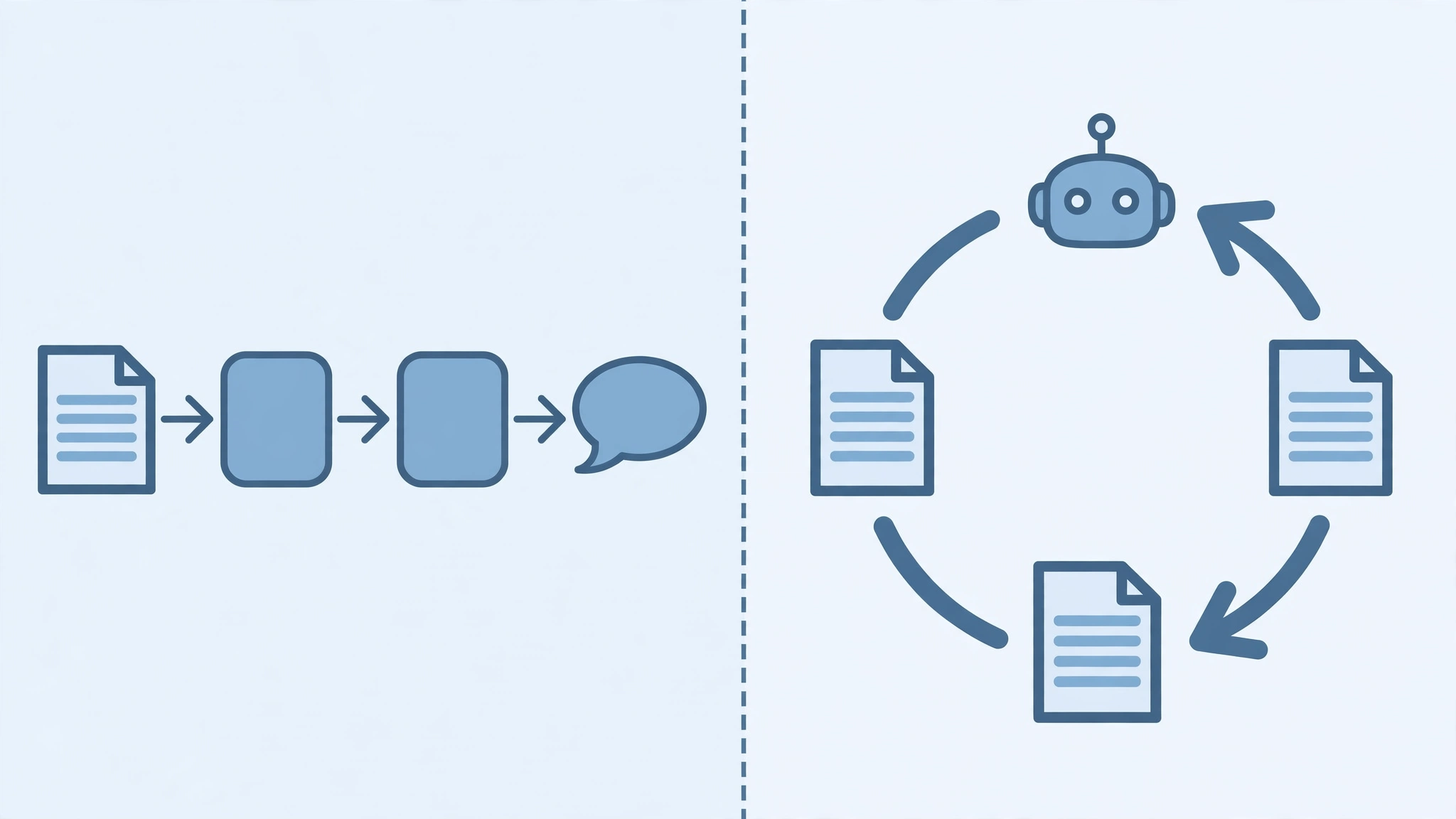
Ask a standard RAG system a question and it does one thing: it searches your documents once, hands the closest matches to a language model, and prints whatever the model makes of them. If the search grabbed the wrong passages, the answer is wrong, and the system has no way to notice. Agentic RAG removes that single point of failure. It puts an AI agent in charge of the retrieval itself — an agent that plans what to look for, searches more than once when the first attempt falls short, checks whether what it found actually answers the question, and only then writes the response.
That control is the whole difference, and it cuts both ways. Agentic RAG handles questions that break a plain pipeline: multi-part questions, questions spread across several systems, questions where the first search is guaranteed to miss. In exchange, every question costs more model calls, takes longer to answer, and fails in more interesting ways. This guide explains what agentic RAG is, how the loop works, the architecture patterns teams actually build with, and — the part most explainers skip — when the extra machinery earns its keep and when it doesn’t.
What Is Agentic RAG?
Agentic RAG (agentic retrieval-augmented generation) is a RAG architecture in which an AI agent, rather than a fixed pipeline, controls the retrieval process. The agent decides what to retrieve, where to look, how many times to search, and whether the evidence it has gathered is good enough to answer from. Retrieval stops being a single step the system performs and becomes a tool the agent uses repeatedly, under a goal.
Plain RAG in 60 seconds
Retrieval-augmented generation, introduced by Lewis and colleagues at Meta AI in 2020, grounds a language model in your own data instead of its training data alone. Your documents are split into chunks, each chunk is converted into an embedding (a list of numbers capturing its meaning), and the embeddings are stored in a vector database. When a question arrives, the system embeds the question, retrieves the chunks whose embeddings sit closest to it, pastes those chunks into the prompt, and the model answers from them.
It works well right up until it doesn’t. The pipeline runs once, in a straight line, with no judgment in it. It can’t rephrase a badly worded question, can’t notice that the retrieved chunks are about the wrong product, and can’t go back for the document it actually needed. Every weakness of plain RAG traces back to that rigidity.
What makes it “agentic”
Four capabilities turn the pipeline into an agent. A widely cited survey of agentic RAG (Singh et al., 2025) groups them as planning, tool use, reflection, and multi-agent collaboration:
- Planning — the agent breaks a complex question into sub-questions and works through them in order, instead of embedding the whole tangled question and hoping for the best.
- Tool use — retrieval is one tool among several. The agent can also query a SQL database, call an API, run a web search, or check a knowledge graph, and it picks the tool that fits each sub-question.
- Reflection — the agent grades what it retrieved and what it drafted. Weak evidence triggers another search with a rewritten query; a draft that isn’t supported by the evidence gets revised or withheld.
- Multi-agent collaboration — in larger systems, specialised agents split the work: one retrieves, one evaluates, one synthesises.
Strip any one of these away and you slide back toward a pipeline. Keep them, and the system behaves less like a search box and more like a junior researcher who checks their own work.
What a RAG agent actually is
The terms get used interchangeably, so it is worth pinning them down. A RAG agent is the component: a language model wrapped in a control loop, given instructions, a set of retrieval tools, and state (memory of what it has tried so far). Agentic RAG is the architecture you get when that agent runs your retrieval. One RAG agent working alone is the simplest form of agentic RAG; a team of RAG agents dividing retrieval, grading, and writing between them is the same architecture at a larger scale. When vendors say “RAG agents,” they almost always mean the components inside an agentic RAG system.
How Agentic RAG Works
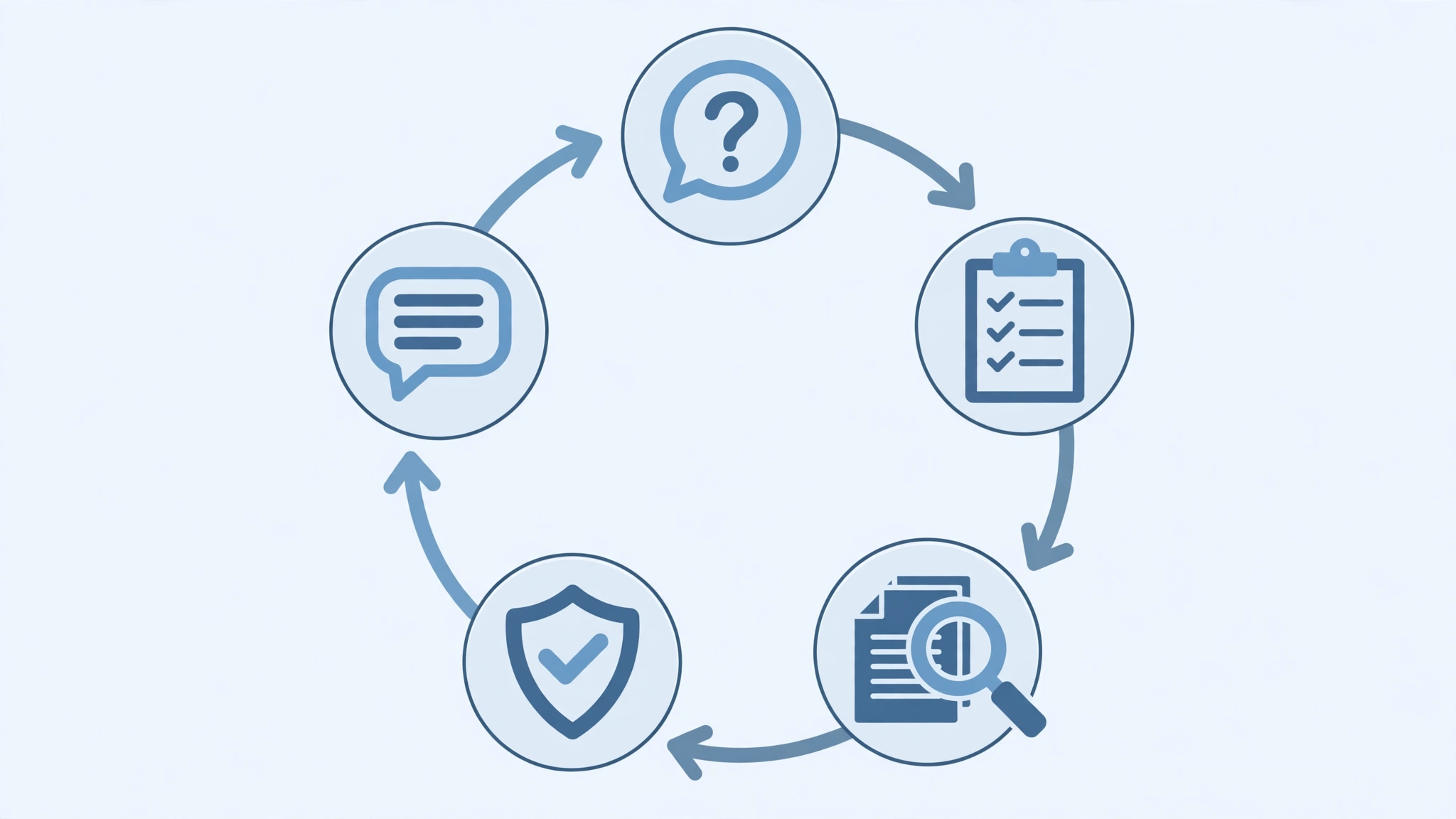
The straight line becomes a loop with six moves:
- Interpret — the agent reads the question and judges what kind of question it is: a simple lookup, a comparison, a multi-hop question whose answer depends on facts from several places.
- Plan — for anything non-trivial, it decomposes the question into sub-questions and decides which source or tool each one needs.
- Retrieve — it runs the first searches: vector search over documents, a database query, an API call, whichever the plan calls for. This is agentic retrieval — retrieval chosen by the agent, per sub-question, rather than one search for everything.
- Grade and filter — the agent scores the retrieved material for relevance and sufficiency. Irrelevant chunks are dropped. Gaps are named explicitly: “I have the policy, but not the customer’s contract terms.”
- Loop or answer — if the evidence is thin, the agent rewrites the query, tries a different source, or searches again. If the evidence is sufficient, it moves to generation. Loops are bounded: a sane system sets a maximum number of iterations and a token budget, and stops when either runs out.
- Validate and respond — the draft answer is checked against the evidence. Claims that nothing retrieved supports get cut or flagged, and then the answer ships — or the system abstains and says it couldn’t find enough, which is a legitimate outcome, not an error.
A concrete pass: a support lead asks, “Which enterprise customers are affected by last week’s API change, and what notice period did we promise each of them?” A plain pipeline embeds that whole sentence and retrieves whatever chunks mention “API change” — probably the changelog, with no customer or contract information in it. An agentic system plans instead. It pulls the changelog to identify the change, queries the CRM or usage database to find enterprise accounts actually calling the deprecated endpoint, then retrieves each affected account’s contract terms to extract the promised notice period, and assembles the answer from all three. Three sources, three different tools, one question — that is the shape of problem the architecture exists for.
Agentic RAG vs RAG
| Feature | Traditional RAG | Agentic RAG |
|---|---|---|
| Control flow | Fixed pipeline, runs once | Agent loop, runs until the evidence is enough or the budget runs out |
| Queries per question | One | As many as the question needs |
| Data sources | Usually one knowledge base | Documents, databases, APIs, web, knowledge graphs |
| Query handling | The question is searched as written | Questions are decomposed and rewritten between rounds |
| Self-correction | None | Grades retrieval and drafts; retries, reroutes, or abstains |
| Latency | Low and predictable | Higher and variable — depends on loop count |
| Cost per question | One retrieval + one generation | Multiple model calls per question |
| Complexity | Simple to build and debug | Orchestration, budgets, and evaluation to maintain |
| Best for | Direct lookups with answers in one place | Multi-step questions spread across sources |
The honest summary: traditional RAG is a lookup, agentic RAG is a process. A lookup is the right tool when the answer sits in one document and the question arrives well-formed. A process earns its overhead when neither of those is true.
Agentic RAG vs agentic AI
These two get conflated constantly, including in keyword tools. Agentic AI is the broad category: any system where a model plans and acts through tools toward a goal. Agentic RAG is one specific application of it, where the goal is answering questions from retrieved knowledge and the tools are primarily retrieval tools. Every agentic RAG system is an instance of agentic AI; most agentic AI systems (a coding agent, a booking agent) are not RAG at all. If a vendor’s “agentic” product never retrieves and grounds its answers in your documents, it may be a fine agent, but it isn’t agentic RAG.
Where agentic search fits
Agentic search is the same loop pointed at the live web instead of your own data: the system issues several searches, reads pages, follows up on what it finds, and synthesises an answer with citations. Research modes in the major AI assistants work this way. The mechanics overlap heavily with agentic RAG — planning, iterative retrieval, self-checking — and production systems increasingly blend the two, searching internal documents and the web in the same pass. The distinction that matters is the corpus: your governed data, the public web, or both.
Agentic RAG Architecture and Patterns
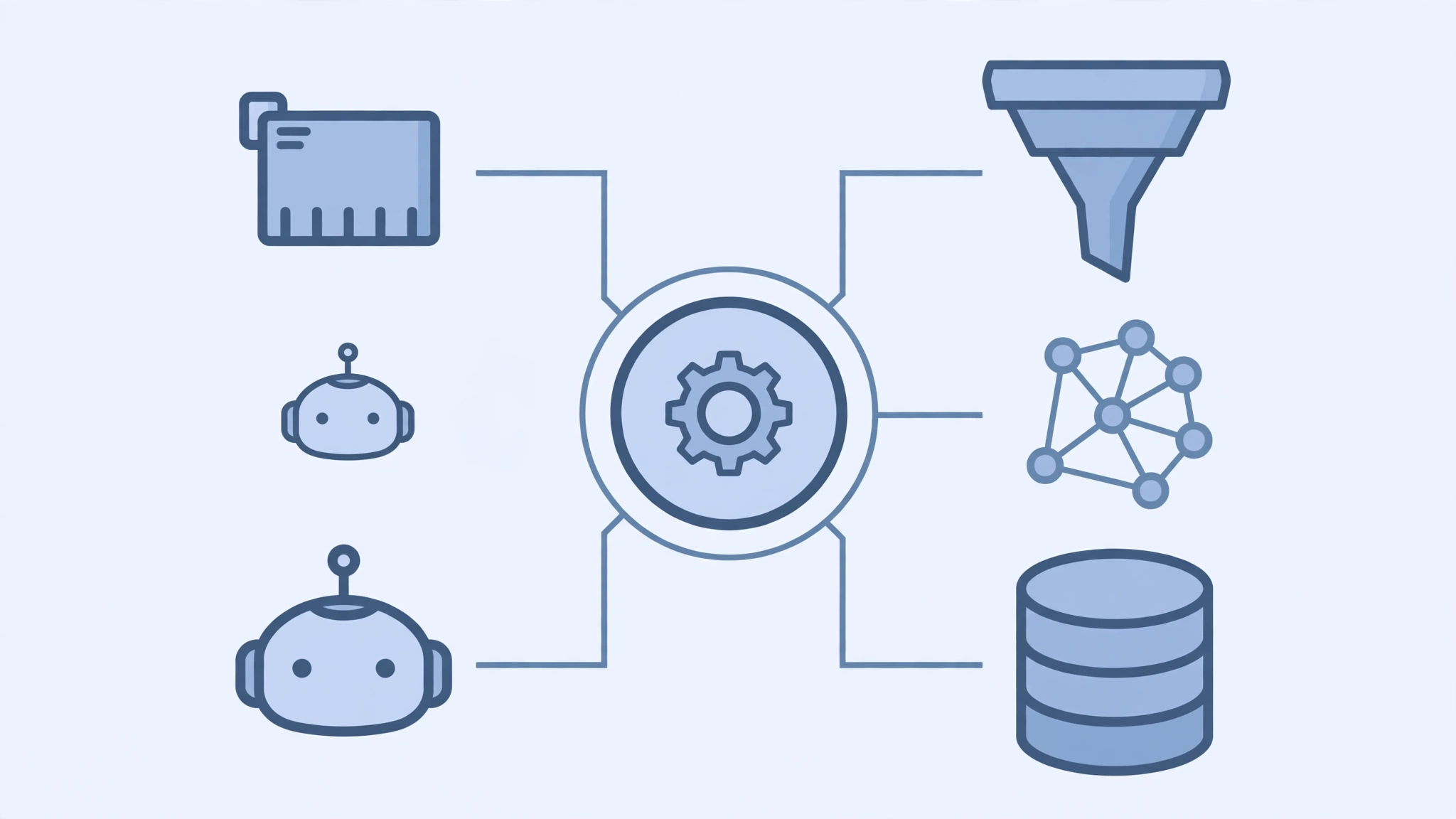
Underneath the marketing, almost every agentic RAG system is assembled from the same components, combined through a handful of well-studied patterns.
The core components
Five pieces recur in every serious build. An orchestrator runs the loop and holds the state — what has been asked, tried, and found so far; frameworks like LangGraph model this as an explicit graph of nodes and edges. Retrieval tools expose each source behind a clean interface the agent can call: a vector store, a keyword index, a SQL database, a web search API. A grader (sometimes called an evaluator) scores retrieved material for relevance before it reaches the generator. Memory carries context across steps, and in multi-turn products across conversations. And the generator is the language model that writes the final answer from the surviving evidence. Budgets and stop conditions wrap the whole thing: maximum iterations, maximum spend, and a defined behaviour when the evidence never becomes sufficient.
Routing: the single-agent pattern
The simplest agentic pattern, and the right first step for most teams. One agent reads the question and routes it: product questions to the product index, billing questions to the billing system, small talk to the model with no retrieval at all. Routing alone fixes a common plain-RAG failure — searching the wrong corpus confidently — without any loop at all.
Corrective RAG (CRAG)
Corrective RAG, from Yan et al. (2024), inserts a quality gate between retrieval and generation. A lightweight retrieval evaluator scores the retrieved documents and sorts the result into one of three states. Confident and relevant: the documents are refined — split into smaller “knowledge strips,” scored, and stripped of filler — before generation. Clearly wrong: retrieval is discarded and the system falls back to a broader search, in the original design a web search. Ambiguous: both paths combine. CRAG’s practical appeal is that it bolts onto an existing system — your model and your vector database stay exactly as they are; you add a scoring step between them.
Self-reflective RAG (Self-RAG)
Self-RAG, from Asai et al. (2023), puts the judgment inside the model instead. The model is fine-tuned to emit special reflection tokens as it works: tokens that decide whether retrieval is needed at all, whether a retrieved passage is relevant, whether a sentence it just wrote is actually supported by that passage, and whether the answer is useful. The result is a generator that retrieves on demand and critiques itself segment by segment. The catch is the fine-tuning: true Self-RAG requires a model trained to speak that token language, which is why most production systems borrow the idea — a separate grading step — rather than implementing the paper literally.
Adaptive RAG
Adaptive RAG, from Jeong et al. (2024), starts from an obvious observation: not every question deserves the full loop. A small classifier assesses the question’s complexity first and routes accordingly — no retrieval for questions the model can answer directly, a single retrieval pass for straightforward lookups, and the full iterative loop only for genuinely multi-step questions. It is less a rival pattern than a discipline the others need: spend the expensive machinery only where the question justifies it.
Multi-agent RAG
When one agent’s context window and attention become the bottleneck, the work splits. A retriever agent gathers, an evaluator agent grades and sends back gaps, a synthesis agent writes, and a coordinator agent owns the plan. Specialisation helps on broad, multi-domain questions, and each agent can use a cheaper model where the task allows. It also multiplies everything that can go wrong — cost, latency, and the number of places a bad decision can hide — which is why multi-agent setups should be the last pattern a team reaches for, not the first.
Graph RAG, the agentic way
Some questions are about relationships, not passages: which suppliers are exposed if this port closes, which components depend on the service that just failed. Text chunks answer those badly, because the answer lives in connections between entities. Graph RAG retrieves from a knowledge graph instead — entities and their relationships — and in an agentic system the graph becomes one more tool: the agent traverses it when the question is relational, and falls back to text retrieval when it isn’t.
Where MCP fits
The Model Context Protocol (MCP) is a standard for connecting models to tools and data sources through one interface, instead of a custom integration per source. It is not a rival to agentic RAG and not a replacement for retrieval — it is plumbing. As MCP servers for databases, document stores, and search tools mature, the retrieval tools in an agentic RAG stack increasingly sit behind MCP, which makes sources easier to swap and to govern. Expect the term to keep appearing next to agentic RAG in platform marketing; underneath, it changes how tools connect, not how the loop thinks.
Agentic RAG Frameworks and Platforms
You can build the loop yourself with an agent framework, or buy it inside an enterprise platform. The honest difference: frameworks give you control and homework; platforms give you governance and a bill.
| Option | Type | Best for |
|---|---|---|
| LangGraph | Build framework | Explicit, stateful agent loops with grading and retry nodes — the most common choice for custom agentic RAG |
| LlamaIndex | Build framework | Data-heavy RAG; strong indexing and retrieval tooling with agent workflows on top |
| CrewAI | Build framework | Multi-agent setups where specialised agents divide retrieval and synthesis |
| Haystack | Build framework | Pipeline-style RAG that is growing agent components; teams that prefer modular, inspectable stages |
| IBM watsonx | Enterprise platform | Regulated enterprises that want agentic RAG inside an existing IBM governance stack |
| Salesforce Agentforce | Enterprise platform | Support and sales questions grounded in Salesforce data |
| Kore.ai | Enterprise platform | Packaged enterprise search and support assistants |
| Progress Agentic RAG | Enterprise platform | A bought, managed agentic RAG product for enterprise knowledge retrieval |
Frameworks first, if your team writes code and your questions are unusual — the loop’s behaviour is yours to tune, and the grading and stopping logic is where quality actually lives. We compared two agent frameworks head-to-head in LangGraph vs Atomic Agents if you want a feel for how they differ. Platforms make sense when the questions are standard (support, enterprise search) and the buying criteria are access control, audit trails, and procurement rather than loop design.
Use Cases That Justify the Extra Machinery
Agentic RAG is one pattern inside the wider world of AI automation workflows, and it earns its place in the same way any automation does: where the manual version is slow, multi-step, and repeated often. Three use cases clear that bar consistently.
Customer service automation
Support questions look simple and rarely are. “Can I return this, and will the refund cover the repair I already paid for?” requires the current returns policy, the customer’s order, and the warranty terms — three sources, and the policy source has to be the current version, not last quarter’s. This is the deployment pattern behind the search interest in how to deploy agentic rag for customer service automation: an agent that checks the order system, retrieves the governing policy, drafts the answer with the evidence attached, and escalates to a human with its working shown when the evidence is thin. The escalation path is not a failure of the design; it is the design.
Enterprise search across silos
The average enterprise question crosses systems: the spec is in Confluence, the numbers are in a warehouse, the decision was argued out in email. Single-index search answers whichever third of the question its corpus happens to hold. An agentic system that routes sub-questions to each silo and synthesises across them is the first version of enterprise search that matches how the questions are actually shaped.
Research and analysis
Analyst work — competitive teardowns, literature reviews, due-diligence summaries — is multi-document synthesis by definition. The question decomposes naturally, sources disagree and have to be weighed, and the output must show its evidence. Iterative retrieval with grading maps directly onto how a human researcher works, which is why deep-research products are built this way.
When Agentic RAG Is NOT Worth It
The sections above are the case for the architecture. This is the case against reaching for it by default, and it is the section most explainers don’t write, because most explainers sell the thing.
- Your questions are simple lookups. If the answer sits in one document and users ask in predictable words, plain RAG answers it in one pass. The loop adds cost and latency to reach the same text.
- Your corpus is small or static. A few hundred stable documents do not need an agent to navigate them. A decent index and a reranker will outperform an agent stack you have to babysit.
- The path is latency-sensitive. Voice interfaces, checkout flows, anything where a person waits in real time: a loop that takes three retrieval rounds takes three rounds’ worth of time. Variable latency is worse than slightly weaker answers in most of these contexts.
- You can’t evaluate it. An agentic system without an evaluation set is a cost centre with good demos. If nobody will build and maintain a set of test questions with known answers, stay with the pipeline you can actually measure.
- The cost math doesn’t close. Every loop iteration is another set of model calls — retrieval grading, query rewriting, generation, validation. A question that takes four rounds can reasonably cost several times what a single pass costs, at thousands of questions a day that multiplier is the budget conversation, not a footnote.
A short decision check before building: are a meaningful share of your questions multi-part or multi-source? Does your plain RAG baseline measurably fail on them? Can you name who owns evaluation? Three yeses, build it. Otherwise, improve the baseline — better chunking, hybrid search, a reranker — and revisit when the failures say so.
Why Agentic RAG Systems Fail in Production
The demo almost always works. Production failures cluster in predictable places:
- Runaway loops. No maximum iteration count, no token budget, no stop condition the agent can’t argue with. The agent keeps searching because searching is what it does, and the bill and the latency arrive together.
- A grader that can’t grade. The whole loop trusts the evaluator’s judgment about relevance. A weak grader waves bad evidence through and sends good evidence back for another round, and every downstream step inherits the error. Prompt-based grading on a small model is where this usually hides.
- Retrieval debt underneath. Agents cannot retrieve documents that were never indexed, were chunked into nonsense, or sit in a source nobody connected. Most “the agent gave a wrong answer” post-mortems end at the index, not the agent.
- Prompt injection through retrieved content. The agent reads documents as instructions-adjacent context. A poisoned or merely careless document — a web page, a ticket, a shared file — can steer the agent’s next actions. Source allowlists and treating retrieved text as data, never as commands, are baseline hygiene, not paranoia.
- Stale indexes answering with superseded policy. The agent faithfully retrieves the refund policy that was replaced last month, because the old one was never removed. Versioning and expiry on indexed content matter more in agentic systems, because the agent will confidently build a three-step answer on the stale page.
- Failures nobody can see. Multi-step, non-deterministic behaviour is hard to reproduce from a user complaint. Without per-step tracing — which route, which sources, which grades — the team is debugging a rumour.
None of these are reasons to avoid the architecture. All of them are reasons the architecture is a system to operate, not a feature to switch on.
How to Evaluate a RAG Agent
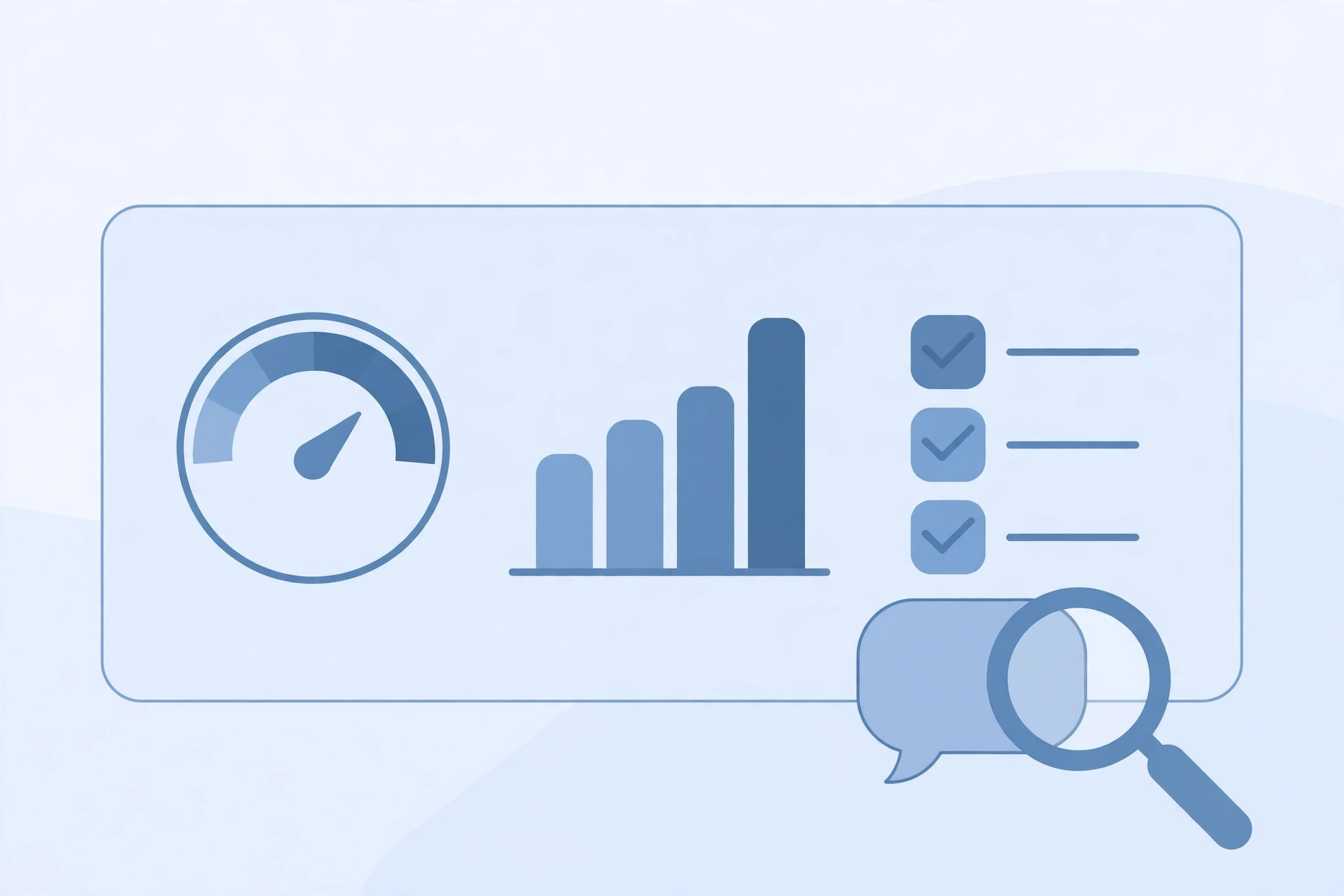
Evaluate the layers separately, because an end-to-end score can’t tell you which layer failed. Five measurements cover most of it:
- Routing accuracy — on a fixed set of test questions, how often does the agent choose the right source and the right strategy (including the decision not to retrieve)?
- Retrieval quality — of the chunks the agent ends up using, how many were relevant (context precision), and of the chunks that should have been found, how many were (context recall)? Open-source tooling such as RAGAS computes these faithfulness and relevance metrics against your test set.
- Groundedness — is every claim in the final answer supported by retrieved evidence? This is the metric that predicts whether users get burned.
- Abstention behaviour — when the evidence isn’t there, does the system say so? Track how it handles questions your corpus deliberately cannot answer. A system that never abstains is a system that invents.
- Cost and latency per accepted answer — not per answer: per answer that passed the groundedness bar. This is the number that tells you whether the loop is earning its iterations.
Run the same set against your plain RAG baseline before you celebrate. The point of the exercise is the comparison, not the score.
How Teams Build One (Without Regretting It)
The builds that survive production tend to follow the same order:
- Build the plain RAG baseline properly, and an evaluation set with it. Most teams discover their “we need agents” problem is actually a chunking or indexing problem, and the baseline plus test set is how you find out cheaply.
- Add routing. One agent decision — which source, or no retrieval at all. Measure again.
- Add grading and a bounded loop. Grade retrieved chunks, retry with a rewritten query when they fail, and hard-cap the iterations and spend from day one.
- Add sources as tools, one at a time. Each new source gets its own retrieval tests before it joins the loop.
- Add guardrails last, because now you know what breaks. Source allowlists, injection screening on retrieved content, abstention paths, per-step tracing.
Skip a step and you will meet it later as an incident. The teams that regret agentic RAG are almost never the ones that built it in this order.
FAQs
Is RAG itself agentic?
No. RAG is a retrieval technique: fetch relevant text, generate from it. It becomes agentic only when an agent controls the process — deciding whether to retrieve, choosing sources, grading results, and iterating. Plenty of systems marketed as agentic RAG are a pipeline with one extra rewrite step; the test is whether anything in the system can make a decision the designer didn’t hard-code.
RAG agent vs agentic RAG — are they the same thing?
Nearly. The RAG agent is the component — the model plus its loop, instructions, and retrieval tools. Agentic RAG is the architecture built around one or more of those agents. Vendors mix the terms freely, but when you’re comparing products, “how many agents and what does each one own?” is a more useful question than which label is on the box.
Does agentic RAG replace fine-tuning?
No — they solve different problems. Fine-tuning changes how the model behaves and what it knows how to do; retrieval changes what current, specific information it can see. An agentic RAG system still cannot see a document that isn’t in a connected source, and a fine-tuned model still cannot know your policy changed last Tuesday. Many production systems use both: a model tuned for the task, retrieving for the facts.
Can agentic RAG plug into the systems we already have?
Yes, and that is the normal deployment shape. Each existing system — the document store, the CRM, the ticketing tool, the warehouse — is exposed to the agent as a retrieval tool with its own permissions, increasingly through MCP servers. The practical advice is to connect one source, evaluate it, and add the next. Connecting six systems on day one means debugging six integrations through an agent that won’t sit still.
How much more does agentic RAG cost than plain RAG?
Count model calls. A plain RAG question costs one retrieval and one generation. An agentic question adds the planning step, a grading call, a generation, a validation pass — and multiplies most of that by the number of loop iterations. A three-round question can reasonably run several times the cost of a single pass, before you count the larger orchestration models teams tend to put in charge. Adaptive routing is how mature systems keep the average down: the loop runs at full depth only on the questions that need it.
Agentic RAG vs agentic search — what’s the difference?
The loop is the same; the corpus differs. Agentic search iterates over the live web and cites public sources. Agentic RAG iterates over your data — your documents, databases, and tools — under your access controls. Products are converging on systems that do both in one pass, but for an enterprise buyer the questions stay separate: what may it read, and whose permissions apply?
Bottom Line
Agentic RAG is what happens when retrieval grows a supervisor: a system that plans its own searches, checks its own evidence, and keeps digging when the first attempt isn’t good enough. For multi-part questions scattered across documents, databases, and tools — support questions with a policy and an order history behind them, research questions no single document answers — it is a genuine step past anything a fixed pipeline can do, and the pattern the research products and enterprise platforms are converging on. For a clean corpus and straightforward questions, it is an expensive way to arrive at the same paragraph. Build the plain version first, measure where it fails, and let the failures — not the hype cycle — tell you when the loop has earned its place.