Last updated: October 2026. Changelog: added DOE Quantum Genesis competition (Sep 2026), IonQ qLDPC error-correction result (Oct 2026), Oratomic $475M raise (Oct 2026).
For most of its history, quantum computing news followed a script: a lab announced a bigger qubit count, a press release claimed the classical world was finished, and eighteen months later nobody could reproduce any of it. The period from late 2024 through 2026 broke that script. Error correction — the thing that was always “ten years away” — started working. Machines you can actually buy time on got announced with delivery dates. And in a plot twist nobody’s press team planned, a laptop overturned a quantum supremacy claim.
This guide covers what actually changed between December 2024 and October 2026, what survived contact with reality, and what it means if you build software. Every claim below is tagged with where it stands: peer-reviewed, independently verified, vendor-reported, or still theoretical. That tagging is the whole point — in quantum computing, the source of a claim matters as much as the claim.
How to read a quantum headline
Before the breakthroughs, a filter. Run every quantum announcement through these four checks:
- Peer-reviewed or press release? A Nature or Science paper went through referees. A company blog post went through marketing. Both can be true; only one has been checked.
- Logical or physical qubits? A physical qubit is fragile hardware. A logical qubit is many physical qubits working together with error correction to act as one reliable unit. “1,000 qubits” with no error correction is a completely different machine from “50 logical qubits.”
- What classical baseline? “10 septillion years on a supercomputer” means nothing without knowing which algorithm the classical side was allowed to use. Classical simulation methods keep improving — sometimes on a laptop.
- Can anyone else run it? Results on a company’s own hardware, measured by the company’s own team, using the company’s own benchmark, deserve a discount until independently reproduced.
Keep this filter in your pocket. You’ll need it below.
TL;DR — every breakthrough that mattered, December 2024 to October 2026
| Date | Breakthrough | Who | Why it mattered | Status |
|---|---|---|---|---|
| Dec 2024 | Below-threshold error correction on Willow | Adding qubits started reducing errors instead of adding them | Peer-reviewed (Nature) | |
| Dec 2024 | 48 logical qubits from neutral atoms | Harvard / MIT / QuEra | Logical qubits at meaningful scale, not just one or two | Peer-reviewed (Nature) |
| Feb 2025 | Majorana 1 topological chip | Microsoft | A whole new qubit type — if the physics holds | Vendor-reported, contested |
| Feb 2025 | Ocelot chip with cat qubits | AWS | Error suppression built into the hardware itself | Vendor-reported |
| Mar 2025 | Beyond-classical materials simulation | D-Wave | Annealing hardware beat classical on a real physics problem | Peer-reviewed (Science) |
| Jun 2025 | 10,000× quantum-classical integration record | IBM + RIKEN (Fugaku) | Quantum and supercomputer working as one system | Vendor-reported |
| Sep 2025 | 6,100-atom neutral-atom array | Caltech | Largest precisely controlled atom array, 13-second coherence | Peer-reviewed |
| Oct 2025 | Verifiable quantum advantage test | A supremacy-style result independent researchers could reproduce | Peer-reviewed | |
| Oct 2025 | Nobel Prize for superconducting qubits | Clarke, Devoret, Martinis | The field’s foundations recognized at the highest level | — |
| Nov 2025 | Helios announcement (36 algorithmic qubits) | IonQ | Trapped-ion roadmap accelerating | Vendor-reported |
| May 2026 | Supremacy claim overturned on a laptop | Flatiron Institute | Tensor networks beat a “classically intractable” result | Peer-reviewed |
| Sep 2026 | 1,000× faster error-corrected operations (theory) | Chalmers | Speed as error reduction — if the experiment works | Theoretical (PRL) |
| Sep 2026 | $215M Quantum Genesis competition | U.S. DOE | Federal money now defines “fault tolerant”: 100 logical qubits | Official announcement |
| Oct 2026 | 74× faster logical operations via qLDPC | IonQ | Error correction getting cheaper and faster | Vendor-reported, preprint |
The 30-second version
- Error correction crossed the threshold. In December 2024, Google showed that adding more qubits could reduce errors instead of multiplying them — the result the field had chased since 1995.
- Neutral atoms became the commercial route. The first error-corrected machines with delivery dates and customer names are atom-based, not superconducting.
- 2026 became the year of verification. A laptop overturned a supremacy claim, the DOE wrote down what “fault tolerant” officially means, and vendors started getting graded by someone other than themselves.
Breakthrough 1: Error correction finally worked
What “below threshold” actually means — and why it’s the biggest result of the decade
Here’s the problem that haunted quantum computing for thirty years. Qubits are absurdly fragile: heat, vibration, stray electromagnetic fields — all of it corrupts them. The fix, proposed by Peter Shor in 1995, is quantum error correction: spread one logical qubit across many physical ones in a pattern called the surface code, so errors can be detected and fixed without ever directly measuring (and destroying) the quantum information.
The catch was brutal. The surface code only pays off below a threshold: each physical qubit has to be good enough that adding more of them reduces the logical error rate instead of increasing it. For nearly three decades, nobody could demonstrate it. Bigger codes meant more errors. The field was stuck above the threshold, and every roadmap quietly assumed someone would eventually get below it.
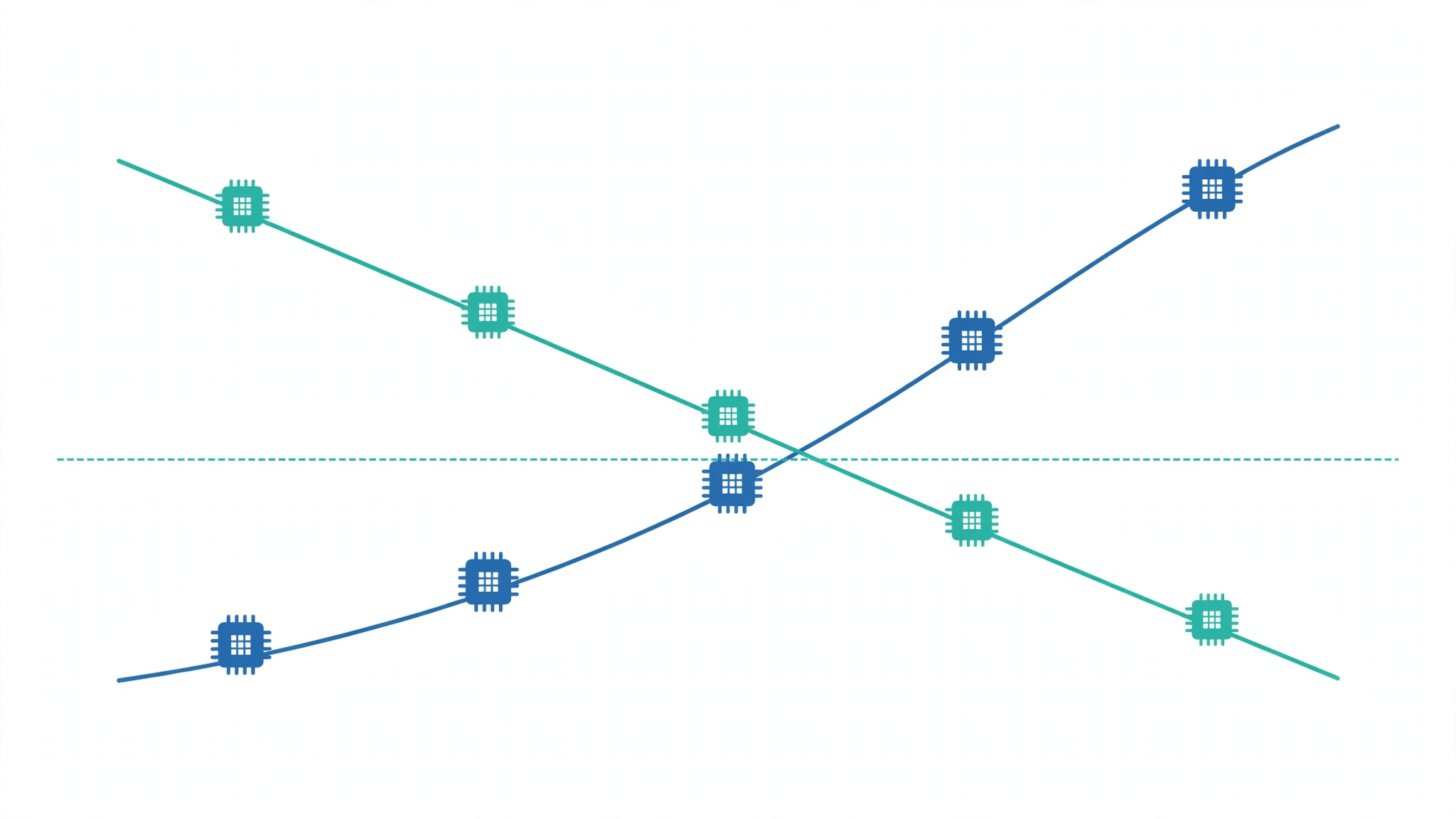
In December 2024, Google’s 105-qubit Willow chip did it. The team ran surface codes at increasing distances — 3×3, 5×5, 7×7 grids of physical qubits — and each step up cut the logical error rate roughly in half. More qubits, fewer errors. Published in Nature, with the data in the open. This is the result everything else in this article stands on. Without it, every roadmap below is fiction; with it, they’re engineering plans.
The 48-logical-qubit result nobody should forget
Willow got the headlines, but a quieter December 2024 result may matter more for the long run. A Harvard, MIT, and QuEra team demonstrated 48 logical qubits built from neutral atoms, running error-corrected algorithms. Where Willow proved the principle on superconducting hardware, this proved scale on a platform that could plausibly manufacture its way to thousands of logical qubits. The two results jointly won Physics World’s Breakthrough of the Year for 2024 — the field’s establishment signaling that error correction, not qubit count, was now the story.
October 2026: error correction is getting cheaper, not just better
The newest entries in this race are about efficiency. In September 2026, IonQ demonstrated a real-time error decoder running on a single ordinary CPU that, in simulated benchmarks, kept up with 408 logical qubits across 31.5 million operations with just 0.02% time overhead. In early October, IonQ’s team reported a qLDPC-based error-correction method delivering up to 74× faster logical operations. The honest caveats: both are company-reported, the decoder paper is an arXiv preprint awaiting peer review, and simulations aren’t hardware. But the direction is unmistakable — the field has moved from “can we correct errors at all” to “can we correct them cheaply enough to matter.”
Why it matters for builders: every serious hardware roadmap from 2025 onward assumes below-threshold operation holds. That’s why IBM can credibly target 200 logical qubits by 2029 and why the DOE can define fault tolerance in terms of logical qubits at all. The physics risk has been replaced by engineering risk — which is exactly the kind of risk software people know how to plan around.
Breakthrough 2: New qubit bets — Majorana 1 and Ocelot
Microsoft’s topological gamble
In February 2025, Microsoft unveiled Majorana 1, a chip built around a qubit type nobody else is pursuing: the topological qubit. The idea is elegant — encode information in the topology of the system rather than in fragile quantum states, so the hardware itself resists entire categories of errors. Microsoft’s claim: a new material called a topoconductor, 8 topological qubits demonstrated, and a path to a million qubits on a single chip.
Here’s the filter from the top of this article, applied honestly. Topological qubits are the highest-risk, highest-reward bet in the field. Microsoft’s Majorana claims have been contested by physicists for years — a 2018 Nature paper on Majorana signatures was retracted, and the community’s default stance is now “skeptical until independently reproduced.” Majorana 1’s readout results were published, but the underlying topological qubit claim has not been independently verified. If it works, the timeline to fault tolerance compresses dramatically, because topological qubits need far less error-correction overhead. If it doesn’t, it’s an expensive detour. Both outcomes are live possibilities, and anyone telling you otherwise is selling something.
AWS’s cat qubits
Also in February 2025, AWS revealed Ocelot, its first quantum chip, built around “cat qubits” — named for Schrödinger’s cat. The trick: engineer the qubit so that one entire type of error is suppressed in hardware, which slashes the overhead of correcting the remaining errors. It’s a middle path between conventional superconducting qubits (correct everything in software) and topological qubits (correct everything in physics). Less dramatic than Majorana 1, arguably more likely to ship.
Why it matters for builders: you don’t need to pick a winner. You need to know that the winning hardware in 2030 might not be superconducting, which means any serious quantum software investment should target the abstraction layer — frameworks like Qiskit or CUDA-Q — not a specific chip.
Breakthrough 3: Neutral atoms went commercial
Why atoms won the commercial race
Of all the plot twists in this story, this is the one industry insiders saw coming first. Neutral-atom quantum computers trap individual atoms with laser tweezers and use them as qubits. The advantages compound: atoms are naturally identical (no manufacturing variation), they can be physically moved around to connect any qubit to any other, and operations can run massively in parallel. As QuEra’s advisors like to point out, when your qubits can move, connectivity stops being the bottleneck that strangles superconducting layouts.
Magne, AIST, and the 6,100-atom array
The commercial milestones stacked up fast:
- Magne — Microsoft and Atom Computing’s machine for Denmark: 50 logical qubits from roughly 1,200 physical ones, with delivery expected in early 2027. The first customer-bound error-corrected system with a date attached.
- QuEra and AIST Japan — a system with around 37 logical qubits from 260 physical ones, opening to global customers. Japan’s national lab betting on neutral atoms is a signal about where serious institutional money thinks the technology is heading.
- Caltech’s 6,100-atom array (September 2025) — the largest precisely controlled neutral-atom array ever built, with 13-second coherence times. Still a research system, but it shows the platform’s scaling headroom: nobody is running out of atoms.
The honest tradeoff: slow gates
Neutral atoms have a real weakness, and the field’s honest voices say it out loud. Atomic gate operations run 100 to 1,000 times slower than superconducting ones. IBM’s researchers have made this point directly: raw gate speed still favors superconductors by orders of magnitude. The neutral-atom counter is “time to solution” — what matters isn’t how fast each gate is, but how fast you get a correct answer, and massive parallelism plus better connectivity can win that race. It’s a genuine engineering debate, not a settled one.
Why it matters for builders: the first error-corrected machines you can actually buy time on will be neutral-atom systems. That’s where the early ecosystem — the tooling, the example workloads, the people who know how to program them — is forming right now.
Breakthrough 4: Speed as error reduction — the Chalmers result
September 2026 brought the year’s most interesting theoretical result. A Chalmers University of Technology team showed that operations on error-corrected bosonic qubits could run 1,000 times faster using a technique called single-cycle Floquet control, published in Physical Review Letters.
The insight is worth understanding even if the experiment hasn’t happened yet: qubits accumulate errors over time, so faster operations mean less time for errors to creep in. Speed is error correction, in a real mathematical sense. A 1,000× speedup doesn’t just make computations faster — it relaxes the accuracy demands on everything else in the system.
The caveat stays attached: this is a theoretical study. The experimental demonstration is pending, and quantum computing has a long graveyard of beautiful theories that didn’t survive contact with a dilution refrigerator. Watch for the follow-up experiment — if it reproduces, superconducting timelines shorten meaningfully.
Why it matters for builders: file this under “watch, don’t act.” But understand the principle, because it reframes how you’ll evaluate every hardware claim from here on: ask about gate speed and error rates together, never separately.
The classical counter-punch: a supremacy claim overturned on a laptop
May 2026 delivered the result this article’s credibility rests on. A quantum advantage claim published in Science in March 2025 — the kind of “beyond classical” result that generates headlines — was overturned by researchers at the Flatiron Institute using tensor network methods. Much of the classical simulation ran on an ordinary laptop.
This deserves a pause, because it’s the most important thing in this article for calibrating your trust. Tensor networks are a classical technique that compresses quantum states the way a zip file compresses data — exploiting structure that brute-force simulation misses. Every time someone claims a computation is “classically intractable,” the correct response is: intractable for which classical method? The Flatiron team, led by researchers who describe themselves as “skeptical by default,” keeps finding that the answer is “not tensor networks.”
None of this means quantum advantage is impossible — Willow’s below-threshold result and D-Wave’s materials simulation stand on different, sturdier ground. It means the bar for claims keeps rising, which is exactly what a maturing field looks like. Classical computing isn’t standing still while quantum catches up; it’s sprinting too, and any honest account of quantum progress has to say so.
Why it matters for builders: before you buy any “classically intractable” claim — in a vendor pitch, a paper, or a headline — ask whether tensor networks were tried. It’s the single highest-value question in quantum computing right now.
The 2026 scorecard: state of the race in one table
| Company | Qubit type | Logical qubits (claimed) | Key claim | Availability |
|---|---|---|---|---|
| Superconducting | Below-threshold demo | Error rate halved per code distance; verifiable advantage test | Research; early access program | |
| IBM | Superconducting | 200 logical target (Starling, 2029) | qLDPC cuts correction overhead ~90%; 100M gates | Cloud (Heron systems today) |
| QuEra | Neutral atom | ~37 logical (AIST system) | 48-logical-qubit Nature paper; commercial systems | Customer access via AIST |
| Atom Computing | Neutral atom | 50 logical (Magne, 2027) | ~1,200 physical → 50 logical for Denmark | Delivery early 2027 |
| IonQ | Trapped ion | 36 algorithmic (Helios) | 74× faster logical ops (qLDPC, Oct 2026, preprint) | Cloud + enterprise deals |
| Quantinuum | Trapped ion | High-fidelity leader | Best two-qubit fidelities in the industry | Cloud (Azure, etc.) |
| Microsoft | Topological | 8 (Majorana 1) | Topoconductors; million-qubit path | Research; contested |
| AWS | Superconducting (cat qubits) | Ocelot chip | Hardware-level error suppression | Research (Braket for access) |
| PsiQuantum | Photonic | Fault-tolerance target | Silicon-photonics manufacturing path | Research |
| Xanadu | Photonic | Research stage | Room-temperature photonic approach | Cloud (early) |
| D-Wave | Annealing | — (different model) | Beyond-classical materials simulation (Science) | Cloud (Leap) |
| Rigetti | Superconducting | Research stage | Modular multi-chip approach | Cloud |
| Nvidia | None (classical half) | — | CUDA-Q + NVQLink: GPU-accelerated quantum simulation | Available now |
Two notes on this table. First, “algorithmic qubits” (IonQ’s metric) and “logical qubits” measure different things — IonQ’s number reflects usable circuit depth on its trapped-ion hardware, not error-corrected logical qubits. Comparing them directly is exactly the kind of category error the skepticism filter exists to catch. Second, Nvidia’s row is the most strategically interesting: the company with no qubits at all may capture the most near-term value by owning the classical half of every hybrid quantum workload.
What enterprises actually did: pilots with receipts
| Organisation | What they did | Result | Status |
|---|---|---|---|
| Ford Otosan | Production logistics optimization | Quantum-assisted scheduling in live operations | Production |
| HSBC + IBM | Portfolio optimization | 34% improvement on the target metric | Pilot |
| Ansys + IonQ | Engineering simulation (CAE) | 12% accuracy improvement | Pilot |
| Boeing | QUICK program participation | Quantum sensing/computing exploration | Research |
| Amgen, BMW | Early access (IonQ Helios) | Evaluation workloads | Pilot |
| Telstra + SQC | Predictive network modeling (Watermelon) | Training time cut from weeks to days | Commercial trial |
| Schneider Electric + SQC | Home energy forecasting (Watermelon) | Up to 41% accuracy gain vs classical | Commercial trial |
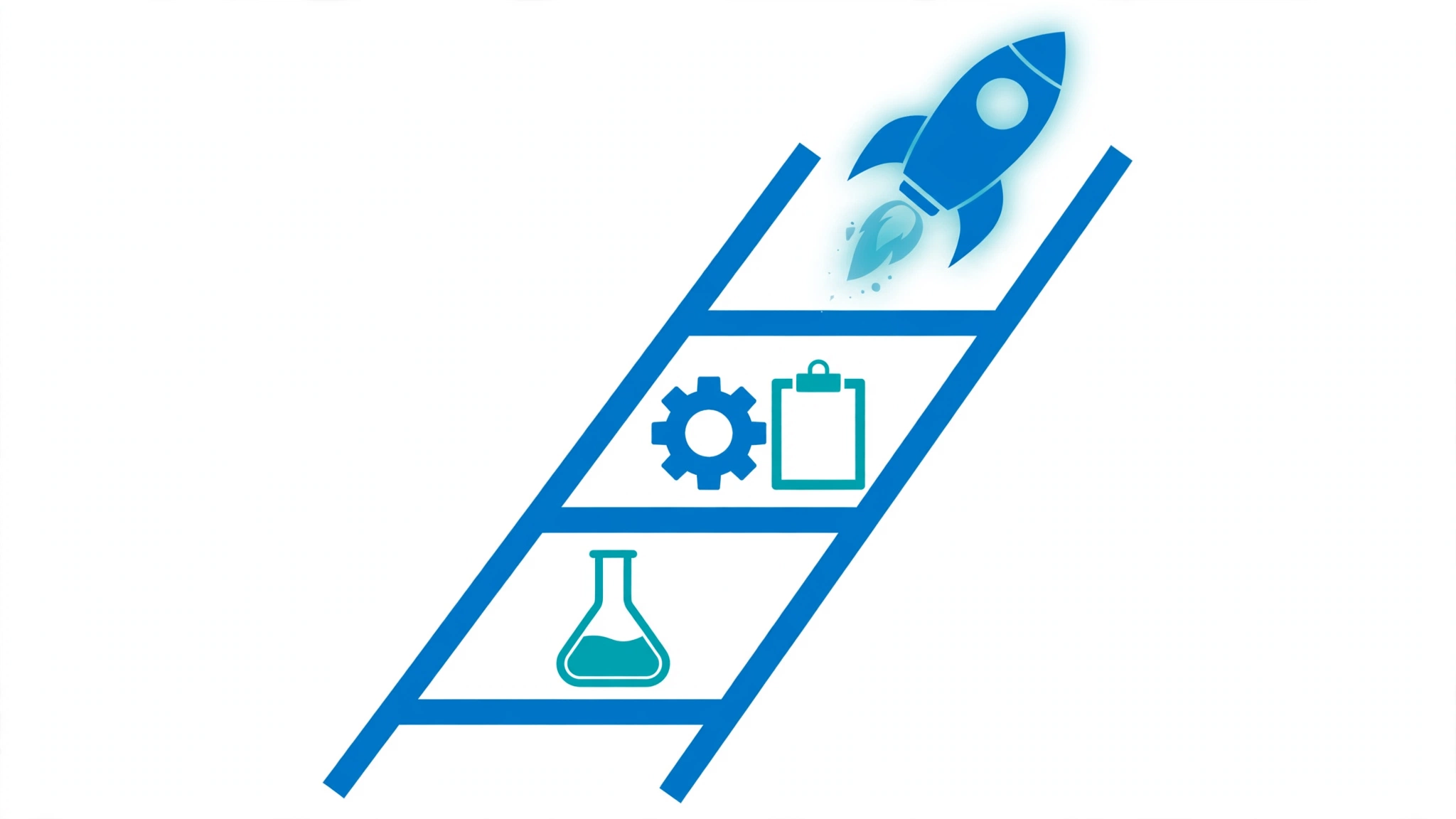
Read that table the way the ladder image shows it: almost everything is still at pilot stage, Ford Otosan stands alone in production, and several of the most impressive numbers come from vendor-sponsored trials. That’s not a dismissal — pilots with measured results are genuine progress — but “34% improvement in a pilot” and “34% improvement in production” are different claims, and only one company has crossed that line.
Post-quantum cryptography: the migration is the story
Buried in most quantum coverage is the development that affects your infrastructure right now. Quantum computing’s most concrete near-term impact isn’t a faster computer — it’s the slow-motion expiration of the encryption protecting everything you ship.
Harvest now, decrypt later
The threat model has a name: harvest now, decrypt later. Adversaries can record encrypted traffic today and decrypt it years from now once a cryptographically relevant quantum computer exists. Any data that needs to stay secret for a decade — medical records, state secrets, long-lived credentials, backup tapes nobody remembered to purge — is already exposed if it’s protected only by RSA or elliptic-curve cryptography. You don’t need a quantum computer to exist today for this to be your problem today.
The window just shortened
Two things changed the timeline. First, in August 2024, NIST finalized its first post-quantum standards: FIPS 203 (ML-KEM) for key exchange, FIPS 204 (ML-DSA) for digital signatures, and FIPS 205 (SLH-DSA) as a hash-based backup — with HQC added in March 2025 as a non-lattice hedge. Migration went from “someday” to “there are now official algorithms; start.” Second, in May 2025, Google researchers showed that breaking RSA-2048 would take roughly 20 times fewer quantum resources than previously estimated. The theoretical quantum computer needed to break your encryption just got five times smaller in every dimension that matters. NIST’s own transition guidance then put dates on it: classical public-key algorithms deprecated after 2030, disallowed after 2035, with U.S. national security systems facing a January 2027 compliance horizon for new acquisitions. That’s not a distant policy debate — that’s a procurement calendar.
The engineering checklist
- Inventory your cryptography. You can’t migrate what you haven’t mapped. Find every RSA, ECDSA, and Diffie-Hellman dependency — including the ones in vendor libraries and firmware.
- Prioritize long-lived data. Anything encrypted today that must stay secret past ~2035 goes first.
- Pilot PQC in TLS now. ML-KEM is standardized; hybrid classical-plus-PQC handshakes are deployable. Major browsers and CDNs have already run experiments.
- Build crypto agility. The ability to swap algorithms without rearchitecting is the real deliverable — FIPS 203/204 are the defaults today, but the 2016–2024 standardization saga taught everyone that algorithms get replaced.
- Track your vendors. Your migration is only as fast as your slowest dependency’s roadmap.
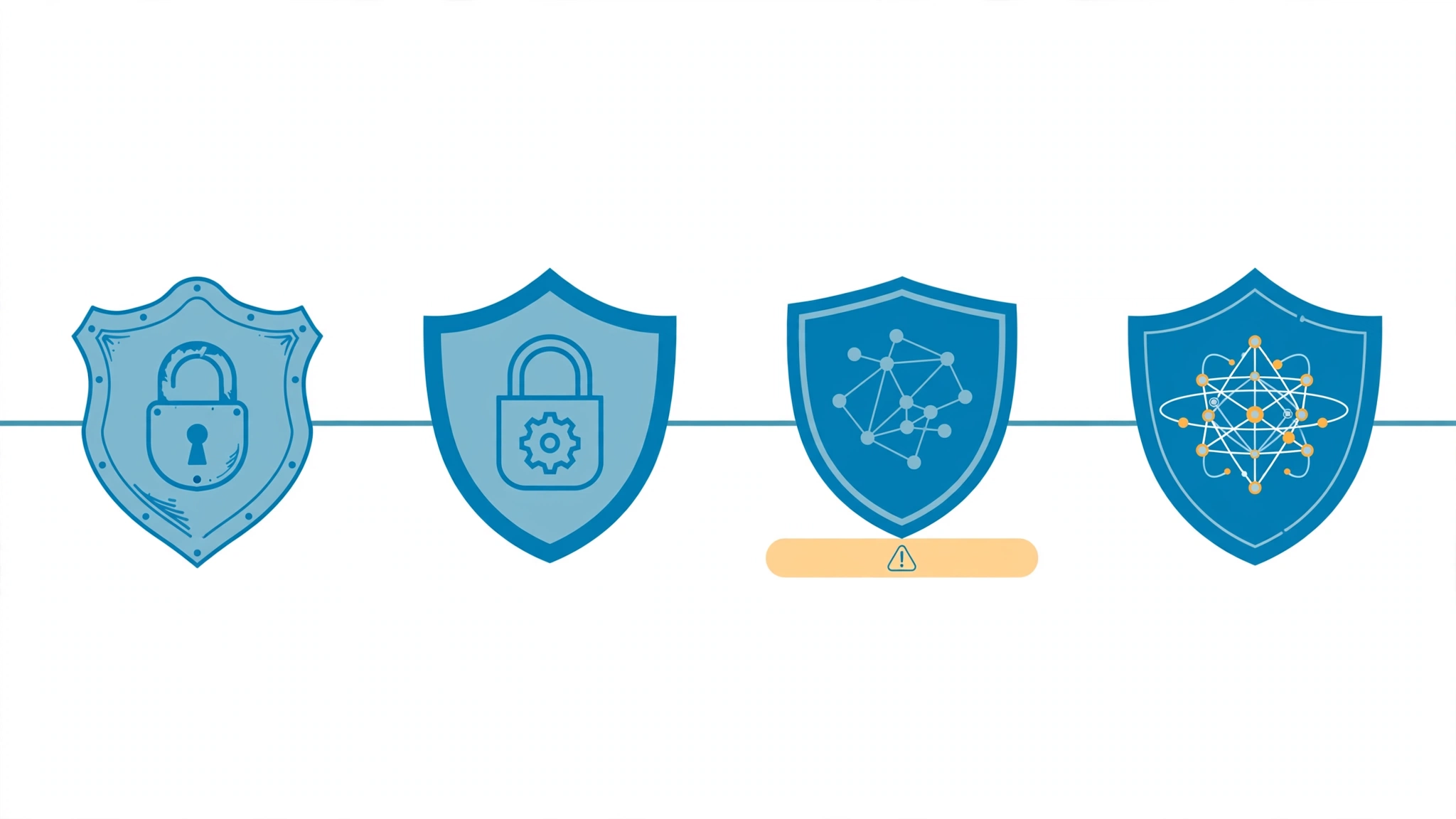
The country race: US, China, Europe
United States
The U.S. is playing the private-capital game and winning it. IBM, Google, Quantinuum, and IonQ give the country unmatched depth across superconducting, trapped-ion, and (via investment) neutral-atom approaches. In September 2026, the DOE’s Quantum Genesis competition added federal structure to the chaos: up to $215 million for the first fault-tolerant machines hitting 100 logical qubits and hundreds of millions of fault-tolerant operations — plus $45 million for national labs to independently verify the claims. Note the honesty clause buried in the announcement: only $2.5 million is actual 2026 money; the rest needs Congress. Still, for the first time, “fault tolerant” has something close to an official American definition, and vendors grading their own homework is now a recognized problem with a funded solution. Applications were due October 19, 2026 — watch who applied.
China
China is spending state billions and leading in deployment-adjacent areas like quantum communication networks, while its computing hardware — 100+ qubit superconducting chips — trails the U.S. commercial frontier but closes steadily. The honest assessment: second place, but the gap is narrowest where it matters for national capability, not where press releases are written.
Europe and the UK
Europe is spending tens of billions across national programs, with Denmark’s Magne deal as the flagship: a European country buying a customer-ready error-corrected machine for delivery in 2027. Germany’s Quantum Computing Competition selected its consortia in October 2026, including planqc’s neutral-atom LOGIQC project. Europe’s bet is that research excellence plus industrial policy converts to leadership — the same bet it keeps placing, with mixed historical returns.
How to touch a quantum computer today
You don’t need a dilution refrigerator. Here’s the actual on-ramp:
- Cloud access: AWS Braket, IBM Quantum, and Azure Quantum all rent time on real quantum hardware by the shot or circuit. IBM’s Heron systems are the most accessible superconducting option; IonQ and Quantinuum hardware is reachable through the same cloud consoles; D-Wave’s annealers have their own cloud (Leap).
- Frameworks: Qiskit (IBM) remains the default starting point with the deepest tutorial ecosystem. Nvidia’s CUDA-Q is the rising alternative, especially with NVQLink coupling quantum simulation to GPU clusters — and honestly, most of what you’ll do in the next two years is simulate quantum circuits on GPUs, where Nvidia already owns the stack.
- What it costs: free tiers exist (IBM’s free plan, simulators everywhere), paid access runs from cents per shot to thousands per month for priority queues. Expect queue times on real hardware and generous simulator limits for learning.
- The real barrier: formulating your problem quantum-natively. The hardware is rentable; the expertise to map a logistics problem or a chemistry simulation onto qubits is scarce and expensive. That’s the actual bottleneck, and no cloud console fixes it.
What to watch next: dated predictions
- October 19, 2026 — DOE Quantum Genesis applications closed. The applicant list, when it surfaces, tells you who thinks they can hit 100 logical qubits.
- 2026 (rest of year) — IBM’s Kookaburra: the first qLDPC-based modular processor. If it works, the “90% less overhead” claim gets hardware validation.
- Early 2027 — Magne delivery to Denmark. The first customer test of a 50-logical-qubit machine. Everything about neutral-atom commercial claims gets checked against this box.
- 2027 — IBM’s Cockatoo: entangling two modules. The modular-scaling thesis lives or dies here.
- 2028 — IonQ’s 1,600-logical-qubit target and the DOE’s September 2028 evaluation. Watch whether either date moves.
- 2029 — IBM Starling: 200 logical qubits, 100 million gates. The industry’s most concrete fault-tolerance deadline.
- Ongoing — the Chalmers experimental follow-up; Oratomic’s attempt to reach fault tolerance with 10,000 qubits instead of a million (backed by a fresh $475M at a $5.4B valuation); and the PQC migration deadlines firming up across federal procurement.
Dated predictions are linkable assets. If you’re reading this after any of these dates, check what actually happened — that’s the verification habit this whole field needs.
Frequently asked questions
Is quantum computing real in practice, or still theoretical?
Both, at different layers. The physics is real and peer-reviewed — below-threshold error correction happened, in Nature, in December 2024. Commercial utility is mostly still at pilot stage, with exactly one production deployment (Ford Otosan) widely cited. Anyone selling you “quantum is here” or “quantum is hype” as a total story is wrong.
What is a logical qubit, and how is it different from a physical qubit?
A physical qubit is the actual hardware — fragile, error-prone, losing information in microseconds. A logical qubit is many physical qubits (hundreds to thousands, depending on the code) running error correction together to behave as one reliable qubit. When a headline says “1,000 qubits,” ask which kind. The answer changes the meaning completely.
Are quantum computers close to breaking encryption?
Not close in the “there’s a machine doing it” sense — breaking RSA-2048 still needs millions of physical qubits nobody has. But the migration is close: NIST finalized post-quantum standards in August 2024, and “harvest now, decrypt later” means data encrypted today is already at risk. The encryption story is a now-problem, not a someday-problem.
When will quantum computers be useful?
The honest answer depends on your definition. Useful for science (chemistry, materials simulation): pilot-stage now, with the DOE targeting scientifically relevant machines by 2028. Useful for your business: probably late 2020s at the earliest, and only for specific problem classes — optimization, simulation, certain machine learning workloads. If your problem runs fine on a GPU farm, a quantum computer is not your next upgrade.
Which qubit technology is winning?
Neutral atoms are winning the commercial error-correction race (first customer machines, 2027 deliveries). Superconducting qubits are winning the scale and ecosystem race (IBM, Google, deepest tooling). Trapped ions are winning the fidelity race (best individual operation quality). Topological qubits are winning the potential race and losing the verification race. There is no overall winner, and that’s the correct answer.
Can classical computers still beat quantum computers?
Regularly. The Flatiron Institute’s May 2026 tensor-network result overturned a published quantum advantage claim using a laptop. Classical simulation is improving fast — especially GPU-accelerated simulation via tools like CUDA-Q. Quantum advantage is a moving target, and “beyond classical” claims expire.
Do quantum computers have to be kept extremely cold?
Superconducting ones do — near absolute zero, in dilution refrigerators that cost more than houses. But neutral-atom, trapped-ion, and photonic systems run at or near room temperature. The “quantum = freezer” image is a superconducting artifact, not a universal law.
How can I learn quantum computing as a developer?
Start with Qiskit (IBM’s framework) and its free textbook, run circuits on simulators before touching real hardware, and learn just enough linear algebra to understand what a qubit state actually is. The Qiskit and CUDA-Q documentation both assume you’re a programmer, not a physicist. Skip the pop-science books; build something small instead.
Which country leads in quantum computing?
The U.S. leads in private capital and hardware depth (IBM, Google, IonQ, Quantinuum). China leads in state funding scale and quantum networks. Europe leads in coordination ambition, with real machines like Magne landing in Denmark in 2027. For a builder, what matters is where the hardware access and jobs cluster — right now, that’s the U.S., with meaningful nodes in the UK, Germany, France, Japan, and Australia.
What is quantum-inspired computing?
Classical algorithms that borrow ideas from quantum computing — like tensor networks or quantum-inspired optimization — running on ordinary hardware. Silicon Quantum Computing’s Watermelon system, named to Fast Company’s 2026 Next Big Things list, is the commercial flagship: quantum-enhanced features accelerating classical AI training, with Telstra cutting model training from weeks to days. Sometimes the best use of quantum research is making classical computers better.
Conclusion
The reframe worth keeping: 2024 proved the physics, 2025 shipped the first machines with delivery dates, and 2026 started grading everyone’s homework — with laptops, federal competitions, and independent testbeds. The field grew up.
The honest bottom line hasn’t changed as much as the headlines suggest. There is still no magic shortcut, no encrypted vault being cracked, no classical data center being replaced. What changed is the kind of uncertainty: it moved from “can this ever work” to “who ships a verifiable result first.” That’s the difference between a science project and an engineering industry, and it’s why the winners won’t be whoever announces the most qubits — it’ll be whoever survives independent verification.
If you build software, the move is the same one it’s always been with immature platforms: learn the abstraction layer, run the simulators, start the PQC migration, and keep the skepticism filter from the top of this article within arm’s reach. The breakthroughs are real. So is the hype. Your job is telling them apart.
Further resources
- Google’s Willow announcement — the below-threshold result in the company’s own words
- DOE Quantum Genesis competition — the $215M federal definition of “fault tolerant”
- IBM’s Starling roadmap — 200 logical qubits by 2029, via postquantum.com’s analysis
- NIST post-quantum cryptography standardization — the standards behind the migration