Search this exact phrase, and something becomes obvious fast: a lot of the “best AI image editor” roundups ranking #1 are written by the company selling that #1 pick. A tool vendor’s own blog ranking its own product first isn’t a scandal, exactly — it’s just not independent, and treating it as a neutral recommendation is how people end up picking based on marketing copy instead of actual performance. The good news is that genuinely independent, blind-tested data exists for this category now, and it tells a more useful — and more specific — story than any single “best” pick can.
The Short Answer
There is no single best AI image editor in 2026 — the right tool depends on what you’re actually doing. For raw editing quality on instruction-following image edits, independent blind-vote testing currently ranks Gemini 3.1 Flash Image ahead of GPT Image 2 and Gemini 3 Pro Image. For professional photography workflows needing layers, masking, and RAW processing, Adobe Photoshop with Firefly AI and Adobe Lightroom remain the strongest choice. For single-purpose enhancement — denoising, upscaling, deblurring — Topaz Photo AI leads independent hands-on testing. For quick, no-skill social and e-commerce edits, free tools like Canva, Pixlr, and PhotoRoom cover the vast majority of casual use cases without a paid plan.
Why “Best” Depends Entirely on the Task
This is the part most roundups collapse into a single ranked list, and it’s genuinely the wrong way to evaluate this category. An AI image editor built for prompt-based creative generation and one built for correcting a client’s RAW wedding photos are solving different problems with different quality bars — a tool that excels at one will frequently disappoint at the other. The useful question isn’t “what’s the best AI image editor” in the abstract; it’s “what’s the best AI image editor for [background removal / RAW batch editing / social graphics / product photos]” — and the answer changes meaningfully across those.
For Raw Editing Quality: What Blind Testing Actually Shows
The most trustworthy data point in this entire category comes from blind human-vote testing rather than any vendor’s self-reported benchmark: the same source image and the same edit instruction, shown to voters without model names attached, compared head-to-head. As of September 2026, that testing places Gemini 3.1 Flash Image at the top with an arena score of 2827, ahead of GPT Image 2 (2785) and Gemini 3 Pro Image (2763), based on over 11,500 blind votes across image-to-image edits.
What separates a genuinely strong AI image editor in this category isn’t flashy output — it’s precision: following an instruction exactly while leaving everything else in the image untouched, without warping faces, breaking geometry, or hallucinating extra detail that wasn’t asked for. That precision is exactly what blind testing is built to catch and self-reported vendor claims aren’t.
For Professional Photography Workflows
Prompt-based editors solve a different problem than what working photographers actually need day to day: batch processing hundreds of RAW files, precise masking, and non-destructive layered edits. Adobe Lightroom remains the strongest choice for photographers specifically because of its AI-assisted masking and adaptive presets across large batches — this is workflow efficiency at scale, not single-image polish. Adobe Photoshop with Firefly AI extends this further for final-file production work, combining generative fill and object removal with the precise manual layer and selection controls professionals already rely on for client-ready output.
Topaz Photo AI occupies a narrower but genuinely excellent lane: single-purpose enhancement. Independent hands-on testing has found its denoising, deblurring, and upscaling quality ahead of general-purpose editors specifically because it’s built to do only that, rather than spreading capability across generation, editing, and enhancement simultaneously.
For Quick, No-Skill Edits
Not everyone needs professional-grade control, and pretending otherwise oversells complexity most people don’t need. Canva, Pixlr, Fotor, and Picsart all offer genuinely capable free AI editing tools — background removal, basic enhancement, resizing — that cover the large majority of casual social media and presentation needs without a learning curve or a paid plan. For e-commerce specifically, PhotoRoom and Claid are purpose-built for product photo cleanup and consistently outperform general-purpose editors on that narrower task.
A Genuinely Important Distinction Most Guides Skip: Where Your Photos Actually Go
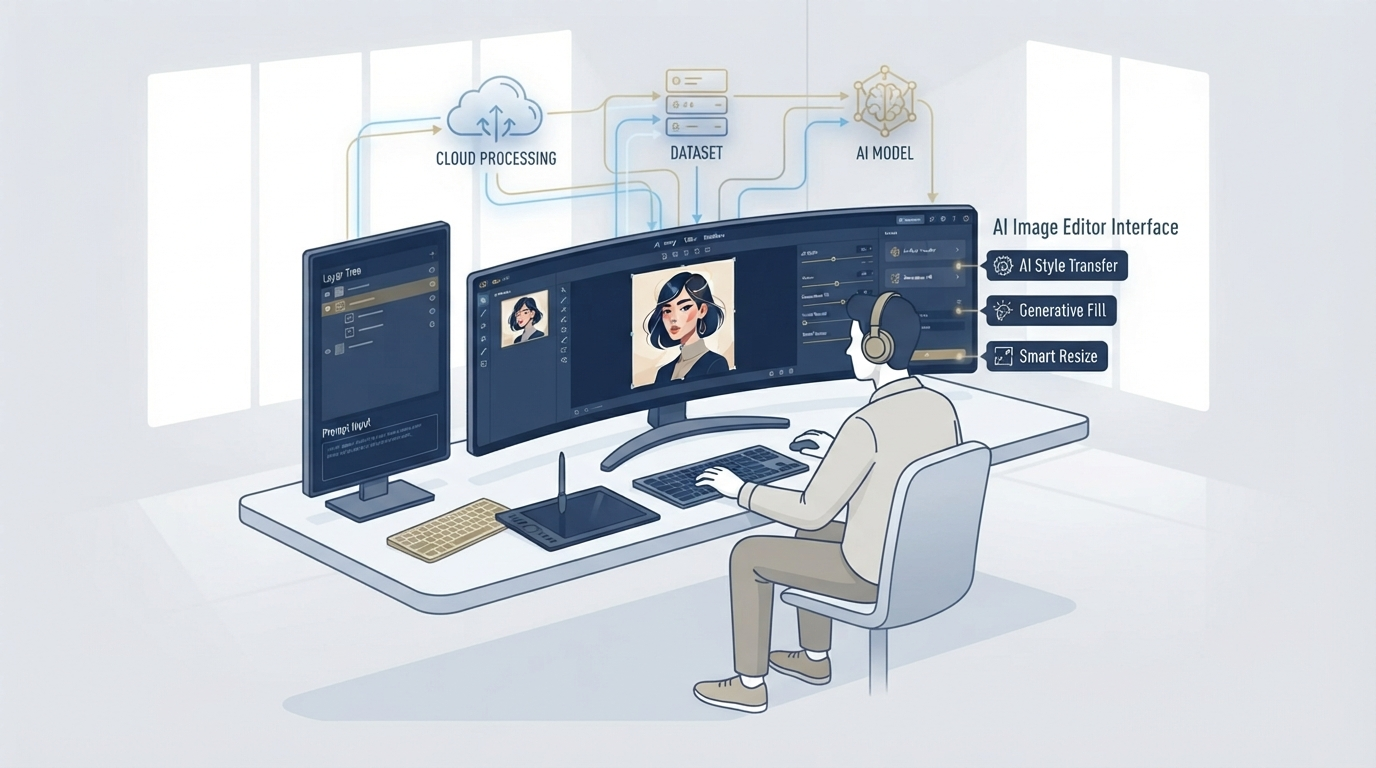
Privacy varies significantly across this category, and it’s worth checking before uploading anything sensitive: desktop tools like Photoshop, Lightroom, DxO, and ON1 process images locally on your device, while cloud-based tools like Canva, Pixlr, PhotoRoom, and most prompt-based generators upload your images to remote servers for processing. For personal photos, client work under an NDA, or anything you wouldn’t want stored on a third-party server, that distinction matters more than any feature comparison.
How to Actually Choose
| If you need… | Best fit |
|---|---|
| Precise instruction-following edits (background swaps, object changes) | Gemini 3.1 Flash Image or GPT Image 2 |
| Professional RAW batch processing | Adobe Lightroom |
| Full production control (layers, masking, client files) | Adobe Photoshop with Firefly AI |
| Best-in-class denoise/upscale/deblur only | Topaz Photo AI |
| Free, no-skill social/casual edits | Canva, Pixlr, or Picsart |
| E-commerce product photo cleanup | PhotoRoom or Claid |
| Local processing (privacy priority) | Photoshop, Lightroom, DxO, or ON1 |
What “Good” AI Editing Actually Looks Like
The tells that separate a genuinely good result from an obviously AI-processed one are consistent across tools: skin texture that stays visible after retouching rather than going waxy and smooth, backgrounds that match the original lighting after a swap instead of looking pasted in, and upscaled detail that looks plausible rather than smeared or invented. Worth checking any tool against these specifically, in a real test with your own images, before committing to a paid plan based on a demo reel.
Frequently Asked Questions
What’s the actual best AI image editor overall?
There isn’t one — the honest answer depends on the task. Independent blind testing currently favors Gemini 3.1 Flash Image for precise editing instructions, while professional workflows are still better served by Photoshop/Lightroom, and casual use is well covered by free tools like Canva.
Are free AI image editors actually good enough, or do I need to pay?
For most casual, social, and presentation use cases, free tools like Canva, Pixlr, and Picsart are genuinely capable. Paid tools earn their cost specifically for professional batch workflows, advanced masking, or best-in-class single-purpose enhancement.
Do AI image editors upload my photos to a server?
It depends on the tool. Desktop software like Photoshop, Lightroom, DxO, and ON1 process locally. Cloud-based tools, including most prompt-based generators, upload images to remote servers — worth checking directly if privacy matters for your use case.
Why do so many “best AI image editor” articles disagree with each other?
Partly because “best” genuinely depends on the task, and partly because several widely-published rankings are written by the vendor of the tool being ranked first — worth checking whether a “best of” list has any independent testing behind it or is self-published marketing.
Is Photoshop still worth it now that simpler AI editors exist?
For final client files, layered composites, and detailed manual correction, yes — independent comparisons consistently note that Photoshop’s ability to correct an AI suggestion rather than just accept its first attempt is what keeps it ahead of simpler apps for professional work.
The honest shortcut through this entire saturated category isn’t finding the one tool that wins every category — it’s matching the tool to the specific edit you’re actually making, and treating any “best overall” claim from a company reviewing its own product with the same skepticism you’d apply to any other confident, self-interested pitch.