

For years, the inside of a flagship phone looked pretty much the same no matter the brand: a chip, a battery, and a thin sheet of graphite doing its best to spread heat around before the whole thing throttled itself to survive. That changed quietly on the Android side over the past several years, and it changed loudly in September 2025, when iFixit’s teardown confirmed that Apple had finally put a real vapor chamber inside the iPhone 17 Pro. The internet noticed immediately, and search volume for the term has been climbing since.
Here’s what’s actually sitting inside that phone, why it matters more than a spec-sheet checkbox, and — because the confusion is genuinely widespread — which devices actually have one.
The Short Version
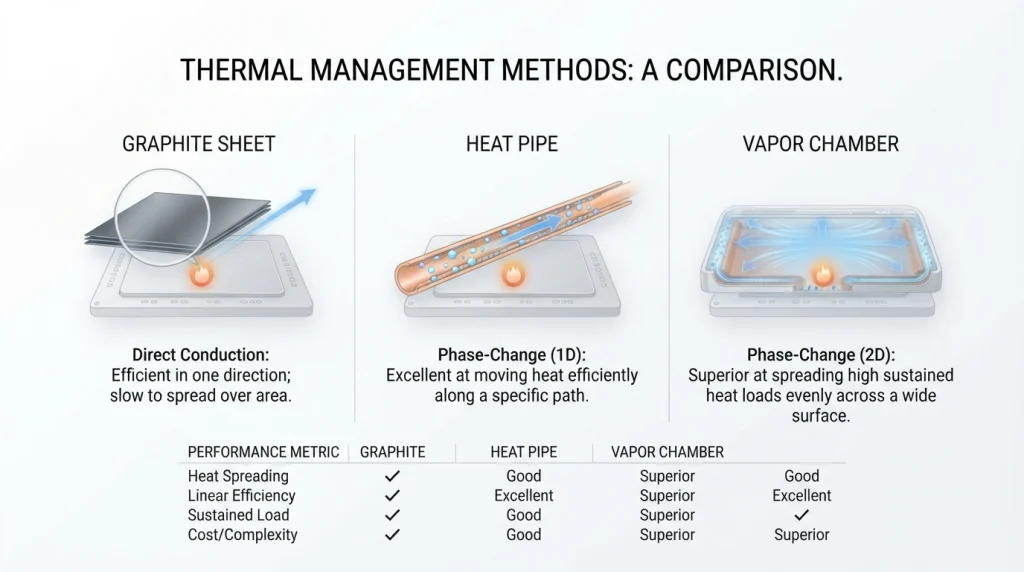
A vapor chamber is a sealed metal chamber containing a small amount of liquid (deionized water, in most implementations) that evaporates when it contacts a hot component, spreads as vapor across the chamber’s full surface area, condenses back to liquid on the cooler edges, and cycles back to repeat the process — continuously, for as long as the device is running. It’s the same phase-change principle behind a heat pipe, but spread across a two-dimensional plane instead of a single tube, which is why it cools more evenly across a wider area. As of 2026, it’s confirmed on the iPhone 17 Pro and Pro Max specifically — not the standard iPhone 17, and not the iPhone Air, both of which retain graphite-based cooling.
What’s Actually Happening Inside the Chamber

Picture a tiny, sealed steam engine shrunk down to fit against a chip. The liquid inside sits at the bottom of the chamber under a partial vacuum, which lowers its boiling point dramatically — low enough that the heat from a working processor is enough to flash it into vapor almost instantly. That vapor doesn’t need to be pushed anywhere; it naturally expands to fill the chamber, carrying the heat with it toward every cooler surface it touches. Once it hits those cooler edges, it condenses back into liquid and gets pulled back toward the hot spot by capillary action — usually through a wick structure lining the interior, often a sintered copper mesh — ready to repeat the cycle.
The entire loop happens in milliseconds, repeating continuously and without any moving parts, fans, or pumps. That’s the real advantage over graphite: graphite conducts heat well in a straight line but is comparatively slow to spread it across an entire surface. A vapor chamber does both — absorb and spread — at once, over a much larger area.
What Changed With the iPhone 17 Pro Specifically
Apple’s implementation, confirmed through teardown analysis, sits directly on top of the A19 Pro chip and uses a stainless-steel enclosure rather than the aluminum casing more common in earlier Android implementations — a material choice that trades a small amount of weight for meaningfully better corrosion resistance and structural durability over the device’s lifespan. Independent thermal testing following the teardown found the iPhone 17 Pro running measurably cooler than the iPhone 16 Pro Max under sustained load, with the difference most noticeable during genuinely demanding tasks — extended 4K video recording, sustained gaming sessions, and heavy on-device AI processing, all scenarios where a phone’s thermal ceiling directly limits how long it can maintain peak performance before throttling kicks in.
It’s worth being precise about scope here, since a lot of secondhand coverage blurs this: this is Pro-and-Pro-Max-only. The regular iPhone 17 and the iPhone Air use the less powerful A19 (not A19 Pro), run cooler by design, and Apple kept them on graphite-based cooling rather than adding the extra manufacturing cost of a vapor chamber where it wasn’t strictly necessary.
The MacBook Air Question, Answered Directly
A meaningful number of people search this topic expecting to find vapor chamber cooling in the MacBook Air, and the honest answer is: it isn’t there, and it isn’t likely to be. The MacBook Air is a fanless, entirely passively-cooled laptop by design — its entire cooling strategy relies on the aluminum unibody itself acting as a heat sink, not on an internal active or phase-change cooling component. Vapor chambers earn their place in devices with a genuine sustained-heat problem to solve; the Air’s lower-power chip and thin, all-metal chassis were engineered around avoiding that problem in the first place rather than solving it with additional internal hardware.
Vapor Chamber vs. Heat Pipe vs. Graphite: The Real Difference
| Cooling method | How it spreads heat | Best suited for |
|---|---|---|
| Graphite sheet | Direct conduction along a thin, flat sheet | Lower-power devices, thin builds where internal space is tightest |
| Heat pipe | Phase-change liquid cycling through a narrow sealed tube | Directing heat along one specific path (chip to a specific exhaust point) |
| Vapor chamber | Phase-change liquid cycling across a full 2D sealed chamber | High sustained heat loads needing even spread across a wide area |
The practical takeaway: heat pipes are excellent at moving heat efficiently in one direction; vapor chambers are better when heat needs to spread out across a broad surface rather than travel along a single path. That’s exactly why phones with tightly packed, high-heat components (flagship gaming phones, and now Apple’s Pro-tier chips) have gravitated toward the chamber design specifically.
Not Just Phones
Vapor chambers didn’t start in smartphones — they’ve been standard in high-end desktop CPU and GPU coolers for years, where the same core physics apply at a larger scale. The device category changes, but the underlying engineering problem doesn’t: dense, powerful components generating more heat than a simple metal sheet can spread fast enough. If you’ve ever looked at a premium graphics card cooler and wondered why it looked more complex than a basic heatsink, there’s a reasonable chance a vapor chamber was part of the answer.
Which Phones Actually Have One
Beyond Apple’s new implementation, vapor chamber cooling has been common in Android flagships for several generations — it’s part of why the “why is Apple just now catching up” reaction was so widespread among Android users when the iPhone 17 Pro leaks first surfaced. Whether a specific device — including the Google Pixel 9 — includes one depends on that model’s individual engineering choices and thermal design goals, and tends to vary generation to generation rather than being a fixed feature of any single brand across its whole lineup. If it matters for a specific purchase decision, checking that model’s official teardown or manufacturer spec sheet is more reliable than assuming based on brand alone.
Frequently Asked Questions
Does the iPhone 17 have vapor chamber cooling?
No — only the iPhone 17 Pro and iPhone 17 Pro Max have it, confirmed via teardown. The standard iPhone 17 and iPhone Air use graphite-based cooling.
Is vapor chamber cooling better than a heat pipe?
Not universally better — they solve different problems. Heat pipes excel at directing heat efficiently along one path; vapor chambers excel at spreading heat evenly across a wider surface area, which matters more in devices with dense, high-output components.
Does the MacBook Air have a vapor chamber?
No. The MacBook Air is fanless and passively cooled through its aluminum chassis, without any internal vapor chamber or heat pipe.
How much cooler does a vapor chamber actually make a phone?
Independent testing on the iPhone 17 Pro found several degrees of measurable temperature reduction under sustained heavy load compared to the previous generation’s graphite cooling, with the difference most apparent during extended gaming or video recording sessions.
Do vapor chambers make a phone heavier?
Marginally, yes — a sealed metal chamber weighs more than a thin graphite sheet, though manufacturers typically offset this with material and design choices elsewhere in the device.
Every generation of phone hardware eventually runs into the same wall: more processing power packed into a case that isn’t getting any thicker. Vapor chamber cooling isn’t a permanent solution to that tension — it’s this generation’s best answer to it, and Apple’s own hardware history hasn’t always gotten these internal engineering bets right on the first try (its display cable design famously wasn’t, back when Flexgate became a household term among MacBook owners). Whether this one holds up the same way over years of real-world use is the part no teardown can answer yet — only time, and a few million phones running hot in real pockets, will tell.