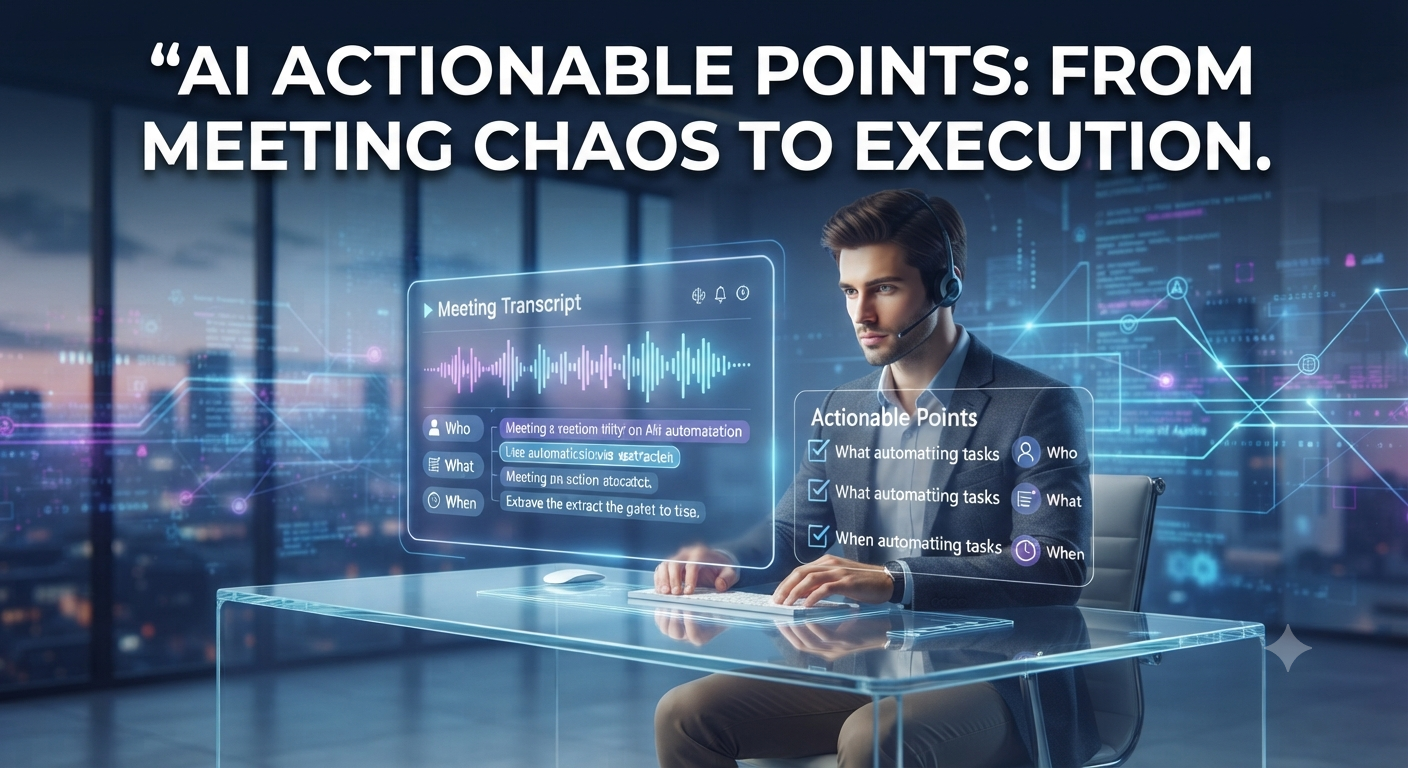
In today’s fast-paced digital work environment, modern organizations and solo creators alike constantly battle the overwhelming flow of communication. Between video conferences, client voice notes, brainstorming sessions, and sprawling project threads, vital project details are frequently lost in translation. Without a streamlined way to capture and process these discussions, teams experience major productivity bottlenecks and missed deadlines.
Artificial intelligence has completely changed how we handle workflow organization, moving manual note-taking into the background. Instead of relying on memory or messy hand-written logs, intelligent platforms now process communications in real time. This technological shift ensures that no critical discussion point slips through the cracks, allowing teams to focus entirely on execution rather than administrative overhead.
What Are Actionable Points and Why Do Traditional Workflows Fail?
An actionable point is a clearly defined, measurable task assigned to a specific individual with a firm deadline and concrete deliverable. Unlike generic notes or broad brainstorming thoughts, a true actionable point eliminates ambiguity so that everyone knows exactly what needs to be done, who is responsible, and when it is due. In fast-moving projects, these distinct tasks form the backbone of successful execution and accountability.
Unfortunately, traditional workflows and manual documentation methods frequently fail to capture these details accurately. Human note-taking is inherently subjective; people miss crucial minutes, write down vague summaries, or forget to assign ownership while actively participating in a conversation. As a result, teams are left with disorganized records that require hours of post-meeting cleanup. Modern productivity standards bypass these human errors by utilizing automated systems designed to isolate and structure clear actionable points instantly from live conversations.
AI-Powered Meeting Action Items: The 5W Framework (Who, What, When)
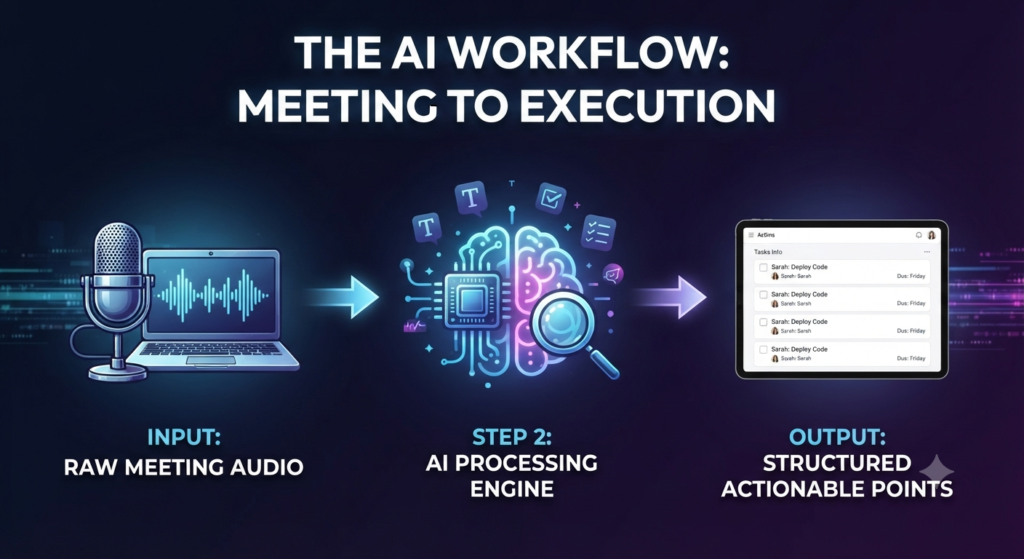
When dealing with fast-paced business operations and complex project sprints, ensuring absolute clarity requires a structured approach. This is where the classic 5W framework—focusing heavily on Who, What, and When—becomes essential for turning raw conversation into execution. Traditionally, project managers had to manually review lengthy transcripts to extract these details. Today, deploying an AI meeting notes action item generator automates the entire process, parsing audio files or live video streams to detect commitments instantly.
Modern platforms leverage advanced natural language processing to act as a reliable AI transcript-to-action items tool. As team members speak, the underlying machine learning models identify contextual cues—such as name associations, assigned duties, and promised deadlines—and map them directly into a standardized format. For instance, if a team member says, “Sarah will finish the software bug fixes by Tuesday,” the AI extracts Sarah as the assignee (Who), the bug fixes as the deliverable (What), and Tuesday as the deadline (When).
Integrating these automated workflows directly into your daily routine eliminates the administrative drag of manual follow-ups. Instead of spending hours cleaning up notes after a call, teams can rely on AI to structure and push these data points straight into project management dashboards, ensuring complete accountability and seamless execution across every project milestone.
Personal Action Items & GTD (Getting Things Done) with AI Assistants
For solo creators, freelancers, and knowledge workers, managing day-to-day tasks requires more than just team meeting notes; it demands a reliable personal organization system. The Getting Things Done (GTD) methodology, pioneered by David Allen, relies on capturing, clarifying, organizing, reflecting, and engaging with tasks so that your mind remains clear for creative work. However, keeping up with a rigorous GTD system manually can quickly become a full-time administrative job in itself.
By integrating artificial intelligence into your personal workflow, you can streamline the entire capture-to-execution cycle. Machine learning models and smart assistants act as an extension of your cognitive workflow, helping to sort, prioritize, and structure daily personal actionable points derived from unstructured brainstorming sessions, voice memos, or random notes. When you dump a stream of consciousness or a messy voice recording into an AI assistant, it can instantly parse the input through a GTD filter—separating actionable projects from reference material, assigning context tags, and suggesting logical next steps.
This level of artificial intelligence productivity workflow integration transforms how you handle daily execution. Instead of spending valuable mental energy organizing your to-do lists, you can leverage automated task management software from meetings and personal brainstorming to maintain an up-to-date inventory of commitments. The AI evaluates your backlog, highlights high-impact priorities, and ensures that every personal goal is broken down into concrete, trackable steps ready for immediate action.
Good vs. Bad Actionable Points: Examples in Modern Software Workflows
The line between a productive team and a stalled project often comes down to the quality of the tasks written down during a meeting. In modern software workflows, distinguishing between a vague statement and a high-impact, concrete task is essential for maintaining momentum. When notes are ambiguous, team members experience friction, deadlines are missed, and accountability dissolves.
To understand how fine-tuning language changes project execution, consider the stark contrast between poor task documentation and precise execution planning:
- Bad Example: “Look into marketing stuff sometime soon.”
- Why it fails: This statement completely lacks structure. It provides no ownership (Who is doing it?), no specific deliverable (What needs to be done?), and no timeline (When is it due?), rendering it virtually useless in an automated environment.
- Good Example: “Sarah to finalize the Q3 AI software feature breakdown by Thursday at 5 PM.”
- Why it succeeds: This represents a true actionable point. It designates a clear owner, outlines a precise deliverable, and establishes a hard deadline that can be tracked easily within a software dashboard.
Leveraging artificial intelligence tools helps bridge this gap automatically. When raw transcripts or messy voice notes contain vague phrasing, smart prompt engineering and automated assistants can reframe unstructured thoughts into clear, professional, and trackable tasks. By enforcing these standards across your workflow, your team ensures that every meeting outcome translates directly into measurable progress.
Built-in Action Item Templates and Prompt Frameworks for AI Tools
Achieving maximum efficiency when extracting actionable points from unstructured discussions often comes down to the prompts and templates you use. Relying solely on default AI outputs can sometimes yield generic summaries, which is why integrating specialized prompt frameworks into your workflow is a game-changer for project management. Whether you are utilizing advanced platforms or testing the best AI tools for extracting action items, providing the right structural context ensures the AI returns clean, formatted, and ready-to-use tasks every single time.
To standardize your workflow, you can copy, paste, and adapt these proven prompt frameworks directly into your AI assistant or transcription software:
The Executive Meeting Prompt Template:
“Analyze the following meeting transcript. Extract all explicit commitments and group them strictly into clear actionable points. For each task, format the output with:
1) Assignee Name,
2) Specific Deliverable, and
3) Hard Deadline. Discard all general chit-chat and filler conversation.”
The Brainstorming to Task List Template:
“Review this messy brainstorming session. Identify practical ideas and translate them into concrete project steps following a Getting Things Done (GTD) methodology. Ensure every resulting item has a single owner and a measurable milestone.”
The Voice Memo Refinement Template:
“Take this raw voice transcription and clean up any vague phrasing. Rewrite every informal thought into a professional, trackable task following a ‘Good Example’ standard (Who, What, When).”
By embedding these structured templates into your daily operations, you eliminate ambiguity and allow automated tools to process your communications with pinpoint accuracy, keeping your entire workflow seamless and accountable.
Frequently Asked Questions (FAQs)
What is the best AI tool to automatically extract actionable points from meeting transcripts?
Several advanced transcription and productivity platforms excel at isolating tasks from live conversations. Tools equipped with robust natural language processing—such as specialized AI meeting assistants—can instantly parse audio streams, filter out filler conversation, and output clean task lists. Choosing the best AI tools for extracting action items depends largely on your existing ecosystem, whether you need native integrations with Zoom and Microsoft Teams or direct syncing into project management software like Trello and Asana.
How can software integration turn voice notes into structured task lists?
Modern artificial intelligence platforms utilize machine learning models that act as an AI transcript-to-action items tool. When you upload a raw voice memo or a disorganized brainstorming recording, the software scans the text for contextual cues, key names, promised deliverables, and time markers. It then structures this unstructured data using predefined prompt frameworks, automatically breaking down a messy voice note into trackable, actionable points ready for immediate assignment.
What is the difference between a vague note and a truly actionable point?
A vague note usually lacks accountability and concrete scope—such as writing down “follow up on marketing later.” In contrast, a true actionable point is built on strict parameters that eliminate ambiguity: a designated owner (Who), a precise deliverable (What), and a firm deadline (When). By leveraging automated task management software from meetings, teams can automatically catch vague phrasing and reframe notes into high-impact, measurable tasks.