Walk into any office supply aisle and you’ll see “ink” used loosely to describe whatever goes in any printer — but laser printers and inkjet printers aren’t running on the same substance at all, and the difference explains almost everything about why laser printers behave the way they do: why the pages come out dry instantly, why the cartridges cost more upfront but often last far longer, and why a laser printer left unused for months still works fine on the first try.
The Short Answer
No — laser printers don’t use liquid ink. They use toner, a fine, dry powder made from a mixture of plastic polymer, carbon, and coloring agents, which gets electrostatically transferred onto paper and then melted into place with heat. Inkjet printers are the ones spraying microscopic liquid ink droplets through nozzles. The two technologies solve the same basic problem — putting an image on paper — through genuinely different physical processes, not just different branding for the same substance.
How a Laser Printer Actually Puts Toner on the Page
Step 1: Charging the Drum
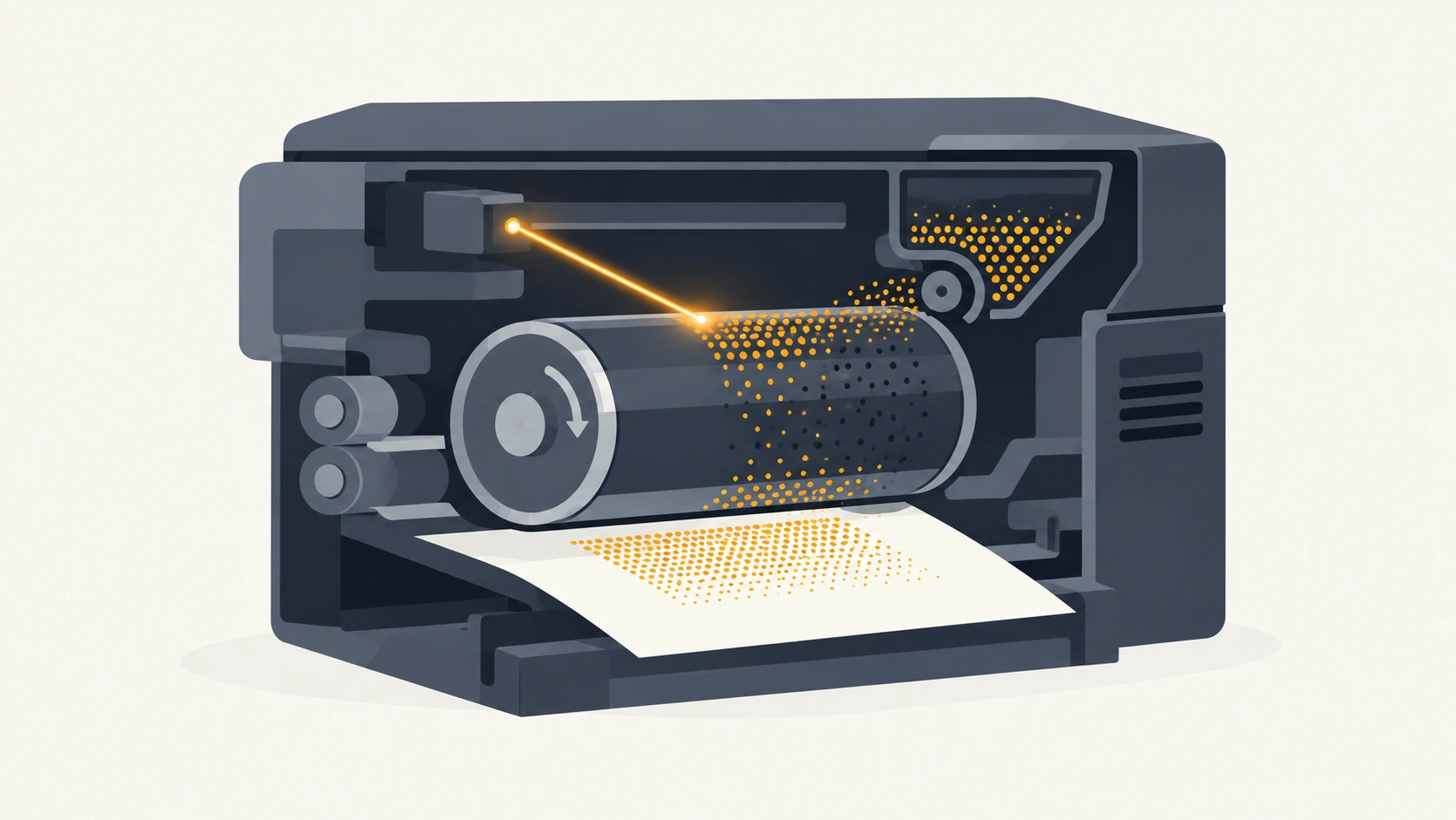
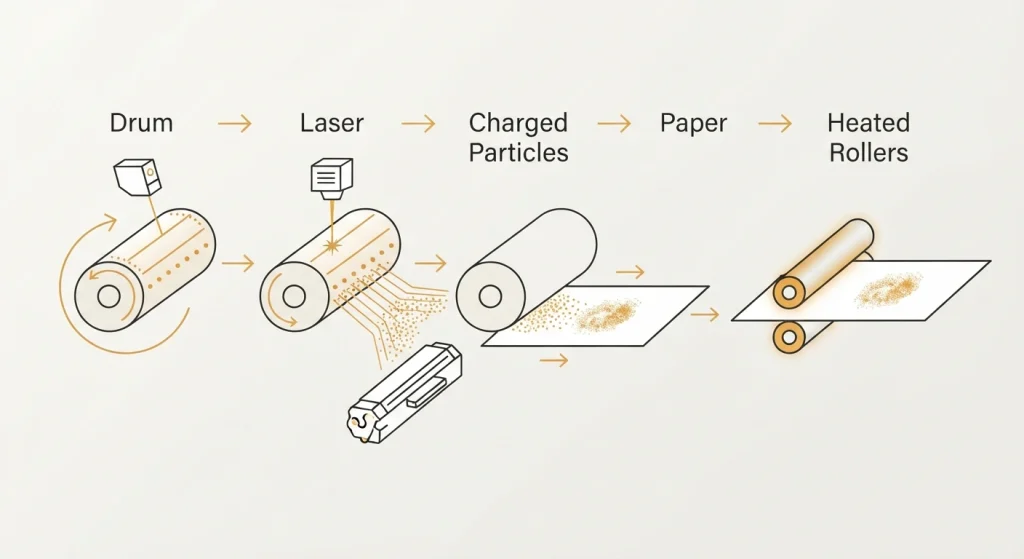
Inside the printer, a wire heats up and passes an electrical charge to a rotating metal drum, giving the drum’s surface a uniform positive charge before anything else happens.
Step 2: The Laser Draws the Image
A laser beam, directed across the drum’s surface via a series of precisely angled mirrors, selectively discharges the positive charge in the exact pattern of the text or image being printed. Wherever the laser hits, that spot’s charge flips from positive to negative — effectively drawing an invisible electrostatic version of your document directly onto the drum.
Step 3: Toner Sticks to the Charged Pattern
As the drum continues rotating, it passes through a reservoir of toner powder. The toner particles, carrying an opposite electrical charge to the discharged areas, are attracted specifically to the negatively charged regions the laser just traced — meaning toner only sticks exactly where your document needs ink to appear, and nowhere else.
Step 4: Transfer to Paper
The paper itself is given a stronger opposite charge than the drum, which pulls the toner off the drum’s surface and onto the page in the same precise pattern.
Step 5: Fusing It Permanently
The page then passes through a fuser unit — heated rollers that melt the toner particles and press them permanently into the paper fibers. This fusing step is exactly why laser-printed pages come out of the printer completely dry and immediately smudge-resistant, unlike inkjet pages, which need a moment for wet ink to actually absorb and dry.
Why Laser Printers Use Toner Instead of Liquid Ink at All
This isn’t an arbitrary design choice — toner is specifically what makes the electrostatic process above work in the first place. A dry powder can hold and respond to an electrical charge in a way liquid ink simply can’t, which is the entire mechanical basis for how a laser printer selectively deposits material in an exact pattern without spraying anything. Liquid ink is built around a completely different delivery method — tiny nozzles physically spraying droplets — which is why the two printer types aren’t interchangeable in how their cartridges work, even though people frequently use “ink” as a generic catch-all term for both.
Real Practical Differences This Creates
Toner Doesn’t Dry Out
Because it’s a solid powder rather than a liquid, toner has no risk of drying out or clogging print nozzles during periods of inactivity — a laser printer that’s sat unused for months will typically print perfectly on the first try, while an inkjet left idle that long often needs a nozzle-cleaning cycle first, or has genuinely dried-out cartridges needing replacement.
Cost Structure Runs the Opposite Direction of Inkjets
Toner cartridges cost considerably more upfront than ink cartridges — sometimes exceeding $200 for high-capacity business cartridges — but they typically last for thousands, sometimes tens of thousands, of pages. This flips the usual math: laser printers cost more per cartridge but meaningfully less per printed page over volume, which is exactly why offices and anyone printing in real volume default to laser, while low-volume home users often find inkjet’s lower upfront cost genuinely more practical for their actual usage.
Print Longevity and Water Resistance
Toner-fused text and images resist fading, moisture, and smudging considerably better than liquid ink, since the toner is physically melted into the paper fibers rather than absorbed as a wet substance that later dries. Documents that need to last years without degrading — contracts, archival records, anything that might get slightly damp — hold up better coming out of a laser printer.
The Exception Worth Knowing: Solid Ink Printers
This is the detail most explainers skip entirely, and it’s worth knowing specifically because it complicates the clean “laser = toner, inkjet = liquid ink” rule people usually repeat. A small category of printers — Xerox’s solid ink line being the best-known example — uses solid wax-based ink sticks that get melted into a liquid state only inside the printer immediately before application, then solidify again on the page. These aren’t laser printers and aren’t inkjets in the conventional sense either — they’re a genuinely separate third category, uncommon enough that most people never encounter one, but real enough that a blanket statement about “all non-laser printers use liquid ink” isn’t quite accurate.
Color Laser Printers: Still Toner, Just Four Colors of It
Color laser printers work through the same core electrostatic-and-fuser process described above, just repeated across four separate toner cartridges — cyan, magenta, yellow, and black (CMYK) — layered together in successive passes to build a full-color image. This is still fundamentally a dry-powder process, not a shift to liquid ink for color specifically, which is a common point of confusion for people assuming color printing requires the inkjet approach.
Frequently Asked Questions
Can I put ink in a laser printer by mistake?
No — laser printers are physically built around toner cartridges specifically designed for the electrostatic charging and fusing process. Liquid ink cartridges are a different shape and mechanism entirely and aren’t compatible with laser printer hardware.
Why is toner more expensive than ink per cartridge?
Toner cartridges cost more upfront primarily because they contain considerably more material and are engineered to print a much higher page volume per cartridge — the higher price reflects far more printed pages per cartridge, not a proportionally worse value.
Does toner expire or dry out like ink does?
No — since toner is a dry powder rather than a liquid, it doesn’t dry out or clog the way inkjet cartridges can during extended periods of non-use, which is one of laser printing’s genuine practical advantages for infrequent printing.
Are color laser printers still toner-based, or do they use ink for color?
Still toner-based — color laser printers use four separate toner cartridges (cyan, magenta, yellow, black) that layer together through the same electrostatic and fusing process as black-and-white laser printing, not a switch to liquid ink.
Is there any printer that uses something other than ink or toner?
Yes — solid ink printers, most notably Xerox’s line, use wax-based solid ink sticks that melt to liquid only briefly inside the printer before application, making them a genuinely distinct third category from both standard toner-based laser printers and liquid-ink inkjets.
The confusion around this question mostly comes down to language, not technology — “ink” has become the generic word people reach for regardless of what a printer actually uses, the same way “Kleenex” gets used for any tissue. Xerox’s own technical documentation, from the company that invented the process, is worth a look if you want the full electro-photographic explanation in more technical detail than the everyday version covered here.