Type “ark augmented reality” into a search engine and you’ll get a genuinely confusing mix of results — a Microsoft Research paper, an unrelated AR hardware prototype, occasional confusion with Apple’s ARKit, and blog posts using the phrase loosely without pointing to anything specific. That confusion isn’t accidental; it’s a genuine case of one acronym pointing to several unrelated things. This piece focuses on the one with real technical substance: ArK, a 2023 Microsoft Research framework built to solve one of AR’s oldest problems — getting a system to understand a space it’s never seen before.
Quick Answer
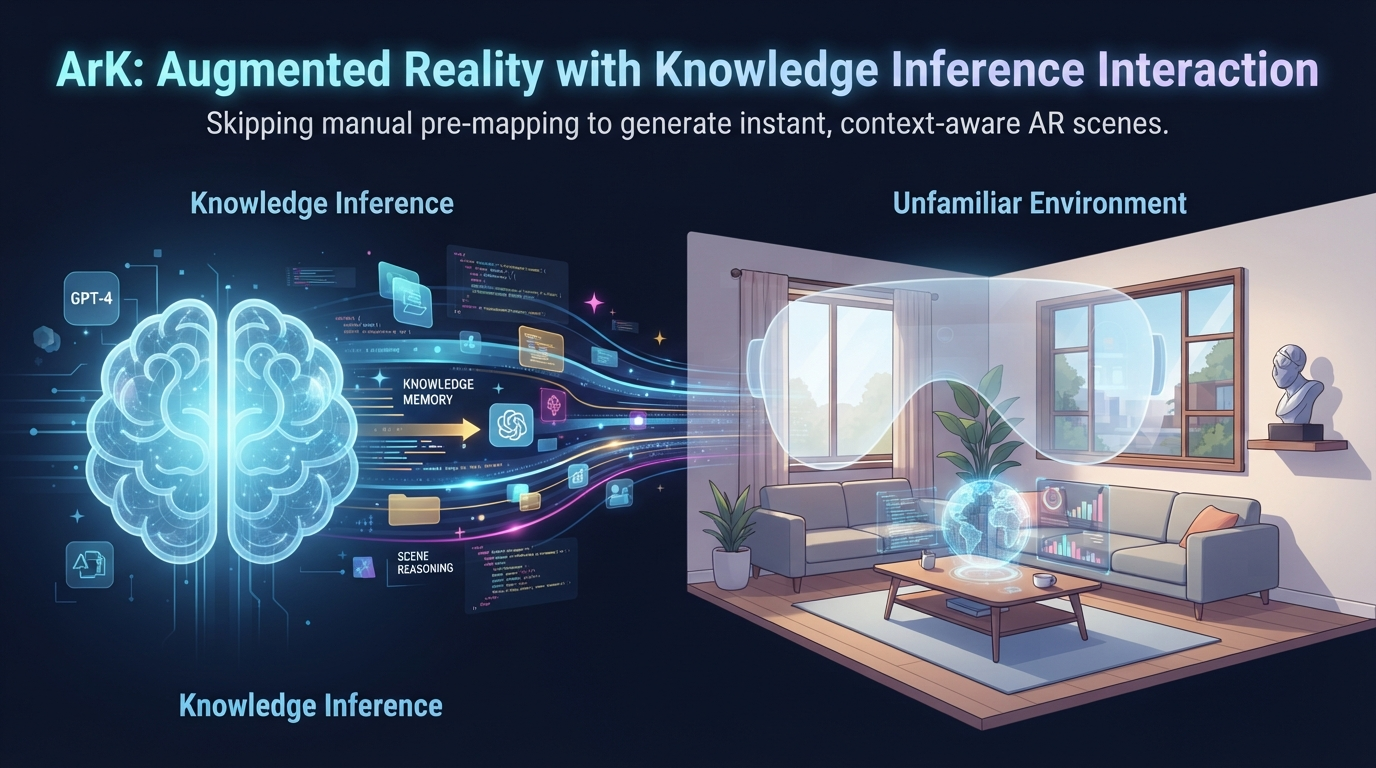
ArK stands for “Augmented Reality with Knowledge Inference Interaction,” a research framework introduced in a 2023 paper from Microsoft Research and academic collaborators at the University of Washington, MILA, and UCLA. It combines knowledge pulled from foundation models like GPT-4 and DALL·E with cross-modal reasoning (vision, text, depth) to generate plausible AR scenes in unfamiliar environments — without requiring a person to manually pre-map the space first. As of 2026, it remains a research framework, not a shipped product, app, or headset feature.
The Problem ArK Was Built to Solve
Traditional AR overlays depend on manual scene mapping. A developer scans a room ahead of time, places virtual markers, and the app reliably shows content in roughly the right spot — as long as nothing about the room changes. That setup works fine in a controlled showroom demo, but it breaks the moment someone opens the app somewhere new, with different lighting, layout, and furniture. Enterprise and field-service AR has run into this exact wall for years: the expensive part was never the headset, it was the weeks of manual pre-mapping needed before an app worked reliably in a new warehouse or facility.
ArK’s core idea is to skip that manual step by borrowing knowledge already baked into large foundation models, rather than collecting fresh training data for every new environment a user might walk into.
How the System Works
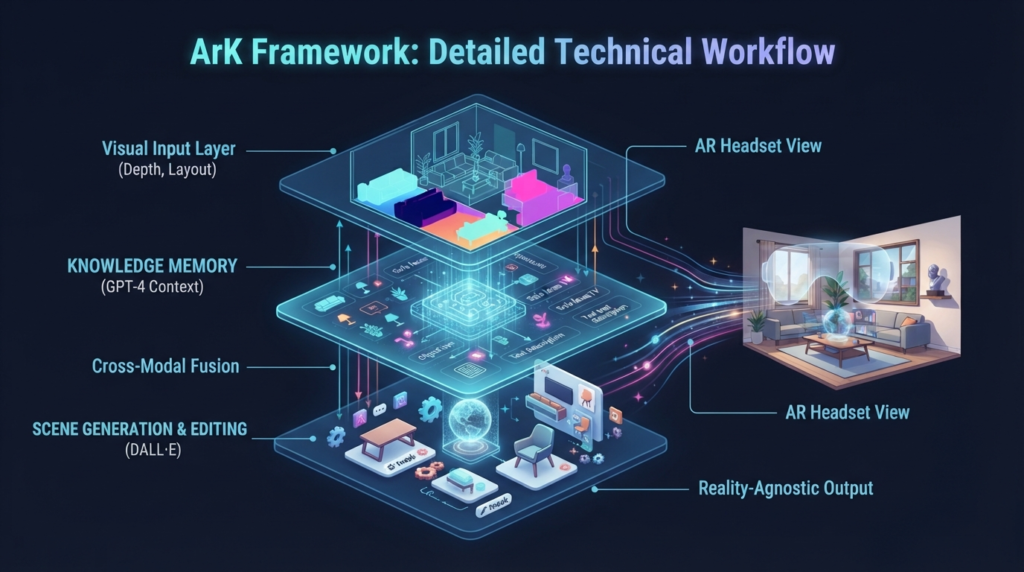
The framework rests on three components working together. Knowledge memory pulls relevant context from foundation models and external knowledge bases. Cross-modality reasoning combines visual input, text, depth data, and sometimes gesture input into a fuller read of the physical space. Scene generation and editing then uses that combined understanding to build or adjust both 2D and 3D content on the fly — even in a room the system has never encountered before.
The training approach behind this is worth understanding at a high level: a memory agent is pre-trained to retrieve relevant knowledge for a given image-and-text pair, generates question-and-answer prompts, and passes those to a language model that writes prompts for DALL·E. Reinforcement learning then compares the generated output against the original image, using that similarity as a reward signal to improve the agent’s questions over time. The researchers describe the resulting behavior as “reality-agnostic” — the same underlying approach can, in principle, work across purely virtual, purely physical, or blended scenes.
What the Research Actually Shows — and What It Doesn’t
Independent evaluation of the original paper found the approach measurably improved generated scene quality compared to baseline AR and generative methods, with human reviewers rating ArK-produced scenes above those from unmodified foundation models across several task types. That’s a real, if narrow, technical result — worth keeping in proportion. It doesn’t mean any AR headset ships with this today, and it’s worth being specific that the paper itself circulates as an arXiv preprint rather than a peer-reviewed conference publication, which is common in fast-moving AI research but still worth knowing when weighing how settled the claims are.
It’s also fair context that broader augmented reality as a technology category has continued attracting serious investment and platform development since 2023 — the specific problem ArK targets (operating reliably in unmapped environments) remains one of the more persistent open problems in the space, which is part of why research like this keeps getting cited even without a commercial product attached to it yet.
Where It Could Actually Matter
The paper’s authors point to two natural fits: gaming simulation and general mixed-reality environments, both of which share a common trait — content needs to work in spaces nobody mapped out ahead of time. A few concrete scenarios follow directly from that: game worlds generating plausible props and layouts for a room scanned live rather than relying on a fixed asset library; mixed-reality collaboration tools where remote participants see consistent, contextually appropriate overlays despite sitting in entirely different physical rooms; and training simulations that need to understand an unfamiliar space fast enough to overlay accurate instructions without a technician pre-mapping every location first.
Real Limits Worth Knowing
Performance is directly tied to the foundation models underneath it — if the underlying model misjudges a scene, the AR output inherits that mistake. The original evaluation focused on specific benchmark tasks, and generalizing that performance to every AR use case (outdoor geo-anchored AR, fast-moving sports overlays) hasn’t been demonstrated. Contextual memory quality depends on the input data feeding it, a limitation shared by essentially every AI-driven system, not unique to this one. And as of this writing, there’s no public code release tied to the project, which means outside researchers can’t easily reproduce the exact setup described in the paper.
Is There an App Called Ark Augmented Reality?
Not from this research. If a mobile app store search turns up something using a similar name, it isn’t connected to the Microsoft Research framework — the project’s own repository listed its code as “coming soon” at publication and no public release has surfaced since. Worth checking a developer’s actual identity before downloading anything using this name.
Frequently Asked Questions
Is ark augmented reality a real product I can buy?
No. As of 2026, it remains a research framework rather than a commercial app, headset, or purchasable product.
How is ArK different from Apple’s ARKit?
ARKit is Apple’s development toolkit for building AR apps on iOS — a commercial, shipped product. ArK is an unrelated research framework focused on using AI knowledge memory to help systems understand unfamiliar physical spaces.
Has the ArK paper been peer-reviewed?
Not as of this writing — it circulates as an arXiv preprint rather than a paper accepted at a peer-reviewed venue, which is common but worth factoring into how settled its claims should be treated.
Why do search results for “ark augmented reality” contradict each other so often?
Because the term overlaps with at least three unrelated things: the Microsoft Research paper, an unrelated AR hardware prototype, and loose blog usage that isn’t tied to any specific system. Most coverage picks one meaning without flagging the others.
Conclusion
“Ark augmented reality” isn’t one single thing, and most of the confusion around the term starts from treating it like it is. The version with real substance behind it — Microsoft Research’s ArK framework — is a genuinely interesting approach to one of AR’s hardest unsolved problems, but it remains research-stage in 2026, not a product you can buy or download.
A closely related concept worth understanding alongside this is how AI systems handle structured knowledge and reasoning more broadly — the same foundation-model reasoning that powers ArK’s scene understanding is part of why critical thinking about AI output matters more now, not less, as covered in our piece on critical thinking exercises for the AI era.