
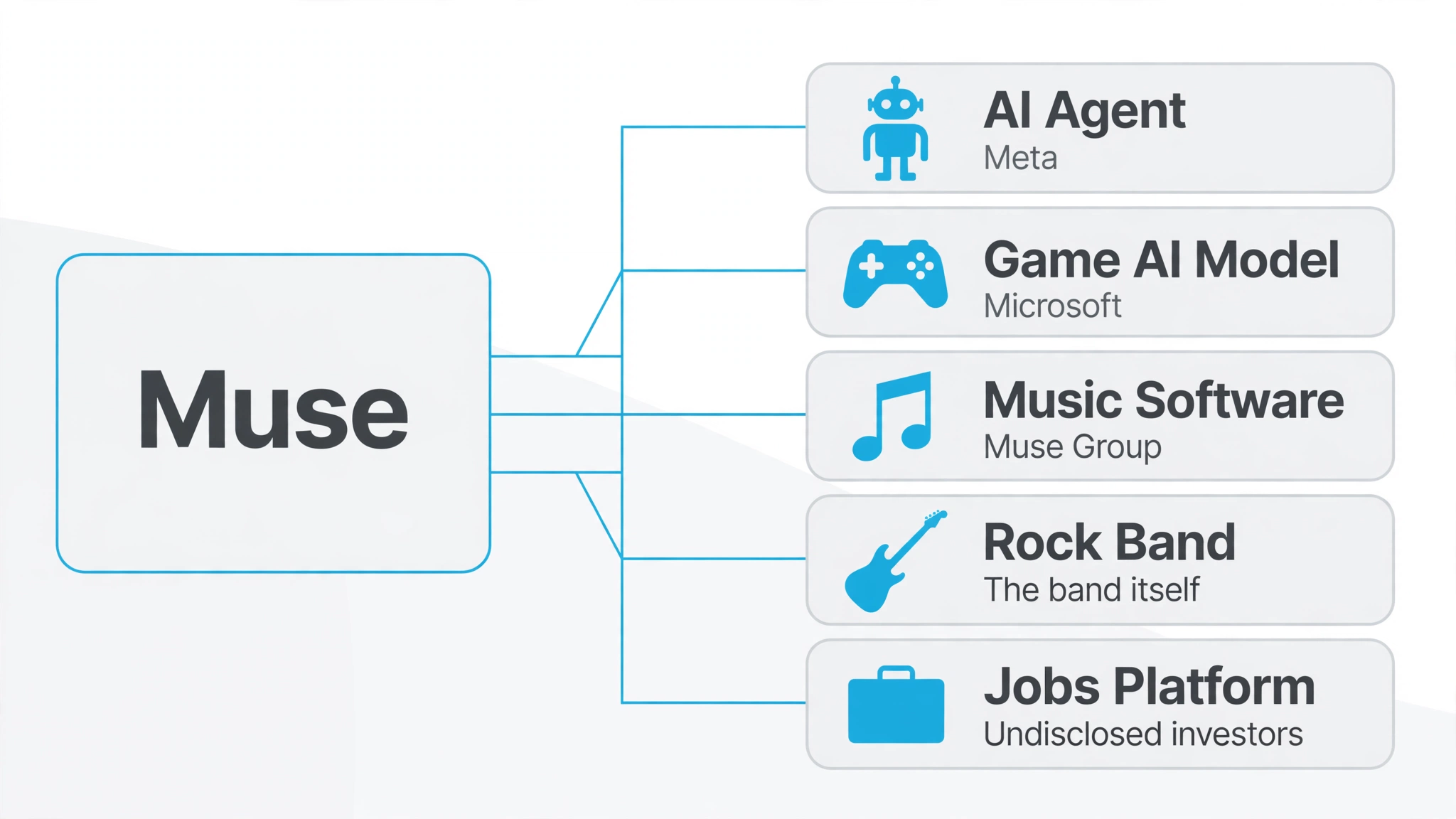
Type “Muse” into Google and you get a rock band, two rival AI systems from two rival tech giants, a music-software empire in Cyprus, and a jobs website that was sold last year to buyers nobody will name. Search “who owns Audacity” and the second result is a marketing company in Atlanta that has nothing to do with the audio editor. Search “The Muse acquired 2025” and the jobs site does not appear at all — two completely different companies called Muse were acquired that year, and neither of them is it.
So the honest answer to “who owns Muse?” is another question: which one? There are five that matter, and their ownership stories could not be more different. One sits inside the most founder-controlled company in tech. One is a research project its owner never turned into a product. One belongs to a guitarist-turned-founder in Cyprus who bought back his private-equity partner in June. One is a band whose singer trademarked the name personally in 1999 — and negotiated with Mark Zuckerberg over it in 2026. And one changed hands in September 2025 without a press release, a named buyer, or a new CEO anyone can identify.
This is the third audit in our name-collision series, after Seekde and Adstotally. Same rules as those: every owner below is traced to a source, and where the record runs out, we say so.
Quick answer: Muse AI belongs to Meta. Microsoft’s Muse belongs to Microsoft. Muse Group is majority-owned by its founder, Eugeny Naidenov. The band Muse has no owner — it releases through its own label inside Warner Music Group. And The Muse, the jobs site, was acquired in September 2025 by an investor group that has never been named.
| Muse | What it is | Founded | Owner | Based in |
|---|---|---|---|---|
| Muse AI | Personal AI agent | 2026 | Meta Platforms | United States |
| Muse (Microsoft) | Gameplay-generating AI model (WHAM) | 2025 | Microsoft | United States |
| Muse Group | Music software and publishing group | 2021 (roots in 1998) | Eugeny Naidenov, majority owner | Limassol, Cyprus |
| Muse | Rock band | 1994 | No single owner — the band, via its own Helium-3 imprint inside Warner | Teignmouth, England |
| The Muse | Jobs and careers platform | 2011 | Undisclosed investor group (since 2025) | New York City |
Who Owns Muse AI?
Muse AI is owned by Meta Platforms. Meta announced it on September 8, 2026, as “the world’s first personal AI agent built for everyone,” launching in the United States on iOS, Android, the web at muse.ai, and WhatsApp, for users 18 and over. Canada followed on September 18.
The control chain: Zuckerberg, then the lab, then Wang
Meta is a public company, but its control is not meaningfully public. Mark Zuckerberg holds roughly 60% of Meta’s voting power through super-voting Class B shares, against an economic stake of only about 13% — a structure Meta’s own 2026 proxy statement documents, and one he has refused to dilute even while planning new share classes to fund the AI build-out. So the chain above Muse runs like this: Zuckerberg controls Meta; Meta’s AI work sits in Meta Superintelligence Labs; and the labs are led by Chief AI Officer Alexandr Wang, the Scale AI founder Meta brought in to run its AI push. When a ranking explainer answers “who owns Muse AI?” with a single word — “Meta” — it is correct and incomplete in equal measure. The product answers, ultimately, to one man’s voting shares.
What Muse AI actually is
Muse is not the chatbot Meta already had. It is an agent: you hand it a task — triage an inbox, research a purchase, fill a form, book a trip, buy the thing — and it goes and does it, working after you close the app and returning when it needs a decision. Each user’s Muse runs in its own secure cloud machine with its own browser (Meta calls it the Muse Secure VM), which is what lets it log into sites and click through checkouts on your behalf. It runs on Meta’s Muse Spark model family; the launch version was Muse Spark 1.3, also exposed to developers through the Meta Model API. The family has kept moving since launch — Muse for Mac arrived on September 17, 2026, and Meta released Muse Spark Open, an open-weights version of the model, on October 15.

Who built Muse Spark?
Muse Spark is Meta Superintelligence Labs’ own model line, built in-house rather than licensed — the agent and the model share both a name and an org chart. That matters for the ownership question more than it might seem: unlike agents assembled on top of someone else’s model, Muse’s owner controls the whole stack, from the model weights to the virtual machine your agent lives in to the checkout it pays through, which runs on Stripe Link with one-time-use card numbers.
Is Muse AI free?
Mostly, with meters attached. The free tier runs up to 100 million tokens a week, a figure Zuckerberg stated himself. Above it sit two paid plans reported by TechCrunch at launch: Power at $20 a month (500 million tokens a week, per Meta’s help center) and Maximum at $100 a month (3 billion tokens a week). One caveat worth knowing before you rely on any comparison table, including ours: Meta has never published a full pricing page breaking down what each tier actually buys you in task terms. The token ceilings exist; the fine print does not.
The name Meta had to take
Here is the detail almost every Muse AI explainer misses: Meta did not coin this name in a vacuum, and it did not get all of it for free. The Instagram handle @muse belonged to the band Muse — more on their side of that negotiation below — and the domain muse.ai previously belonged to an independent AI video platform that rebranded to Skiv in March 2026. Meta’s product is the third occupant of its own name, which is precisely why this article exists.
Ten million agents in six weeks, and the trust question
Adoption is not the question mark. The Muse app topped 6.6 million installs within a month of launch, per Sensor Tower estimates reported by TechCrunch, and on Meta’s October 21 earnings call Zuckerberg said more than 10 million people in the US and Canada had set up a Muse agent. The open question is accountability. An agent that logs into your accounts, reads your email, and spends your money will eventually do something you did not want — and Muse has already had its first taste of that: Meta paused chat sharing after researchers surfaced roughly 6,800 exposed conversation links, and a separate incident saw a user’s home address surface in a Marketplace interaction. Meta’s mitigations are real — a review system it calls Sentinel screens agent actions, and payments run through protected one-time cards — but they underline the point of this section. With Muse, “who owns it” is not trivia. The owner is who answers when the agent gets it wrong.
Muse AI vs Meta AI: not the same product
Meta AI is the assistant built into Facebook, Instagram, and WhatsApp — it answers questions inside Meta’s apps. Muse is a separate, standalone product with its own app, its own virtual machine, and its own subscriptions, built to do things rather than discuss them. Meta AI has not been shut down or renamed; the two coexist, one as the answerer, one as the doer. Nearly every “who owns Muse AI” page on the internet eventually has to untangle this pair, which tells you how much confusion the naming created.
The Other AI Muse: Microsoft’s Muse (WHAM)

Microsoft’s Muse is owned by Microsoft — and it is not a product you can sign up for. It is a research model, announced on February 19, 2025, a full year and a half before Meta’s agent launched. The two share nothing but the name, and the confusion between them is live: at the time of writing, a Microsoft Muse explainer ranks on the first page for “what is Muse AI,” and listicles keep grouping Microsoft’s model with 2026 consumer agents it has nothing to do with.
What WHAM is
Muse is the public name for WHAM, the World and Human Action Model, built by Microsoft Research’s Game Intelligence and Teachable AI Experiences teams together with Xbox Game Studios’ Ninja Theory, and published in the journal Nature (vol. 638, pp. 656–663). Where Meta’s Muse performs tasks, Microsoft’s generates gameplay: trained on more than a billion image-and-controller-action pairs from Ninja Theory’s Bleeding Edge — roughly seven years of gameplay — WHAM learned how a game world looks and how it reacts to a player’s inputs, well enough to generate consistent, varied, persistent gameplay sequences frame by frame. Microsoft’s pitch was creative tooling and preservation: research lead Katja Hofmann framed it as a model for gameplay ideation, and gaming AI chief Fatima Kardar argued that beloved games lost to old hardware could one day be playable again on any screen because a model, not the original code, renders them.
Where it stands in 2026
The original WHAM-1.6B generated its 300×180 gameplay at roughly a frame per second — a research result, not a game. Its successor, WHAMM, changed the demo if not the status: released April 4, 2025, it powers a browser-playable, fully AI-generated version of Quake II inside Copilot Labs, running above 10 frames per second at 640×360 off about a week of curated training data. Microsoft was candid about the limits — enemies blur, the damage readouts are wrong, and the model’s memory of anything off-screen lasts about 0.9 seconds. The demo is still live and free to try as of October 2026. But the model’s official listing in Microsoft’s own Azure AI Foundry catalog describes Muse as a model “intended for academic research purposes only,” trained on a single game. The weights, sample data, and a WHAM Demonstrator are open for researchers; no Xbox product, consumer or commercial, has shipped from it. Reports of an “Xbox Labs” initiative building on Muse remain unconfirmed speculation. Verdict for this section: Microsoft owns a Muse it has chosen, so far, not to sell.
Meta’s Muse vs Microsoft’s Muse
| Meta’s Muse | Microsoft’s Muse | |
|---|---|---|
| Owner | Meta Platforms | Microsoft |
| What it is | Personal AI agent | Generative gameplay model (WHAM) |
| Launched | September 2026 | February 2025, as research |
| Status | Live product with paid tiers | Research only; no shipped product |
| Can you use it? | Yes — app and web, US and Canada | Only the Quake II demo in Copilot Labs |
In one line: Meta’s Muse does your tasks; Microsoft’s Muse dreams up games. If a page about “Muse AI” mentions controllers, frames per second, or Ninja Theory, you are reading about the wrong one — and until now, no page ranking for either has properly separated them.
Who Owns Muse Group?
Muse Group is majority-owned and controlled by its founder and CEO, Eugeny Naidenov. The company is headquartered in Limassol, Cyprus, operates from mu.se, and owns the software a large share of the world’s amateur musicians use daily. It is also the Muse whose ownership story is hardest to find assembled anywhere — Wikipedia’s product pages never name Naidenov, the company’s own About page omits its private-equity chapter entirely, and the big company databases are, as we will get to, still describing a company that no longer exists.
The chain, dated
| When | What happened |
|---|---|
| 1998 | Eugeny Naidenov founds Ultimate Guitar in Kaliningrad, Russia |
| 2017 | Ultimate Guitar acquires MuseScore |
| April 2021 | Muse Group is formed as the parent company; the Audacity trademark is acquired |
| December 2023 | The Hal Leonard acquisition closes; Francisco Partners takes a minority stake |
| June 2026 | Francisco Partners exits; the buyout is financed by J.P. Morgan credit facilities and cash on hand, with no new equity investor |

Who owns MuseScore?
MuseScore — the free notation software, now branded MuseScore Studio since January 2024, alongside the MuseScore.com score-sharing platform — was acquired by Ultimate Guitar in 2017 and sits inside Muse Group today. Its operating company finished relocating to the group’s Cyprus headquarters in 2022. One piece of honest context: the year of the ownership change upstairs was also a year of churn downstairs, with MuseScore Studio’s design lead, product owner, and engraving lead all departing within the same stretch. Asked whether the private-equity exit drove the personnel moves, Muse Group’s head of communications told Scoring Notes: “As far as we’re aware, the FP decision was not at all a factor.”
Who owns Audacity?
Muse Group acquired the Audacity trademark in a deal announced on April 30, 2021, taking over the two-decade-old open-source audio editor — and walked straight into the defining controversy of its ownership. On July 2, 2021, a new privacy policy disclosed collection of IP addresses, operating-system versions, and crash data, sharing with “our main office in Russia,” and a ban on under-13s that clashed with Audacity’s open-source license. The open-source news site FOSSPost branded the policy “spyware,” the label stuck across tech press, and Muse Group responded that the backlash stemmed from unclear phrasing and promised revisions. Five years on, that row is still why “who owns Audacity” gets asked with suspicion — and the search results for it are a mess in their own right, mixing in an unrelated Atlanta company also named Audacity and 2021 articles still describing Muse Group as owned by a Russian parent called WSM Group, a structure no current source supports.
Who runs Muse Group now
Naidenov today, in the company’s own current telling, is founder and CEO — a detail older coverage gets backwards: 2021 reporting listed him as chairman with Michael Trutnev as CEO. Alongside him sits Mo Chahdi as Executive Chairman and COO. The Francisco Partners exit itself was clean private-equity arithmetic: in with the Hal Leonard deal in December 2023, out about two and a half years later, announced June 3, 2026, financed through senior credit facilities arranged by J.P. Morgan plus cash on hand rather than a replacement backer. Terms were never disclosed. Muse Group says it more than tripled in size during the partnership; Naidenov’s statement on the exit — “Muse Group is now ready for its next phase” — is what a founder says when the phase is his again.
What the company databases get wrong
Search Muse Group’s head term and you will not find a Wikipedia article — there isn’t one. You will find startup databases, and they contradict each other and the record. Tracxn still gives the headquarters as San Francisco (that is Ultimate Guitar’s base, not the group’s) and lists “$4.32M raised from Francisco Partners” — an amount no party ever disclosed. CB Insights still shows Francisco Partners as an investor months after the exit. Even the user numbers split by source: the company and its profiles claim 400 million users, while J.P. Morgan’s own case study on the exit financing says the portfolio serves “over 500 million annual users.” The full portfolio, for the record: MuseScore and MuseScore Studio, MuseScore.com, Audacity, Ultimate Guitar, Hal Leonard — the largest sheet-music publisher in the world, based in Milwaukee — plus StaffPad, MuseHub, Audio.com, and MuseSounds.
Who Owns Muse the Band?

Nobody owns Muse the band — a band is not a subsidiary. But of all five Muses in this article, the band’s grip on its own name and catalogue is the most deliberately constructed, and almost none of that story appears anywhere except a fan-maintained wiki. The members’ names you can get from Wikipedia. The ownership structure, until now, you mostly could not.
The members
Muse formed in Teignmouth, Devon, in 1994 — cycling through names like Gothic Plague and Rocket Baby Dolls on the way — and the lineup has never changed: Matt Bellamy, Chris Wolstenholme, and Dominic Howard. Since 2022 they have toured with an additional musician, Dan Lancaster, who succeeded long-time touring member Morgan Nicholls; the official band remains the trio it has been for three decades.
Who fronts it: Matt Bellamy
Bellamy is the lead singer, guitarist, pianist, and lyricist — the band’s creative center and, as the next two sections show, its legal one as well. When this article talks about the band owning things, in practice it is usually Bellamy’s name on the paperwork.
Their own label inside Warner
Since before Black Holes and Revelations in 2006, Muse’s records have carried a dual credit: Warner Records and Helium-3, the band’s own imprint, which operates as a subdivision of Warner Music Group — Muse catalogue numbers have carried the “HEL-” prefix ever since. The arrangement is still in force on the newest evidence available: their tenth album, The Wow! Signal, released June 26, 2026, is credited to Warner Records / Helium-3. In plain terms, the band did not just sign to a major label; it built its own label inside one, and kept it for twenty years. Their management, for completeness, is Three Six Zero.
Who owns the name “Muse”?
Bellamy personally, at least on paper: the “Muse” trademark was filed by Matthew Bellamy and his solicitors on July 21, 1999, covering recordings, clothing, and live performance — years before the band was a stadium act. That filing stopped being trivia in 2026, when Meta’s agent needed the @muse handle the band held on Instagram. The band moved to @museband (and @Musetheband on X) after Bellamy met Zuckerberg and negotiated terms himself. His summary of the deal is the most quotable line in this entire audit: “It’s a trademark thing… I said, ‘Don’t touch music, don’t touch merchandise.’ So I can sell Muse AI T-shirts, but I can’t make a Muse AI.” A rock band’s singer, in other words, sat across from the owner of Muse AI and kept his merchandise rights. Of the five ownership stories here, it is the only one where the little guy had the older paperwork.
Who Owns The Muse? The One Nobody Can Answer

The Muse — the jobs and careers platform at themuse.com — was acquired in September 2025 by an investor group that has never been publicly named. No press release announced the sale. No buyer has stepped forward in the thirteen months since. The most-linked page on the internet for “who owns The Muse” is a Wikipedia article whose infobox still names a CEO who left in 2023. This is the one Muse where the honest answer is: nobody outside the deal knows, and the people who do aren’t saying.
The Minshew era
The Muse began as The Daily Muse, launched September 6, 2011, by three ex-McKinsey consultants — Kathryn Minshew, Alexandra Cavoulacos, and Melissa McCreery — and went through Y Combinator’s Winter 2012 batch. Its idea was to make job hunting feel like choosing a workplace rather than filtering vacancies: career advice to draw readers in, glossy company profiles to sell to employers. Minshew became one of the most visible founders in New York tech, and for a decade the company’s story and hers were the same story.
Three CEOs, then none
Which is why the current record confuses people: Minshew’s tenure as CEO ended in 2023, when Heather Tenuto succeeded her. By 2025 the company was led by Dave Bethoney — listed on themuse.com itself as COO/CFO, on LinkedIn as President, and signing off as CEO of both The Muse and Fairygodboss. In September 2025, Bethoney announced he was stepping down, saying the company had “transitioned to a new investor group this week.” No successor CEO has been publicly named since. So the leadership line runs Minshew, Tenuto, Bethoney — and then a blank that has lasted over a year, while the Wikipedia infobox still shows the first name on the list.
The roll-up years
Before the blank, there was a strategy. The Muse raised about $78.4 million in total (PitchBook’s figure), with DHI Group investing and MBM Capital — a buyout-type investor — leading an $8 million round in 2021–22 explicitly aimed at consolidation. The company then bought its way across the careers niche: Brand Amper in 2017, TalentShare in 2018, Fairygodboss in October 2022 — itself founded in 2015 by Georgene Huang and Romy Newman and reportedly doing around $10 million a year in revenue, in a cash-and-stock deal whose price was never disclosed — and Purpose Jobs in December 2024. The Muse went from advice site to roll-up vehicle, and for a while it was the acquirer in every headline it appeared in.
The silent takeover
The September 2025 transition is documented almost entirely by two trade sources. Job Board Doctor, an industry newsletter, assembled it from LinkedIn posts: Richard Dillman, the senior director of engineering, posted that the company had been acquired and the engineering team let go in the transition; Bethoney posted his departure and the “new investor group” line; and College Recruiter’s founder publicly chased months of overdue invoices in the replies — an invoice Job Board Doctor later confirmed was paid after he contacted Bethoney directly. A post-mortem by Startups.RIP, published in October 2026, consolidates the same record and adds the current status: The Muse still publishes career content and offers job search, but “the buyer, transaction terms, and resulting finances remain undisclosed.” Thirteen months after a known company with tens of millions of historical users changed hands, that sentence is still the whole public record.
What the databases get wrong, again
The stale-record pattern from the Muse Group section repeats almost exactly. Wikipedia’s key-people line is two leadership changes out of date. PitchBook relocates the headquarters to Northville, Michigan — which is where Purpose Jobs, a company The Muse acquired, is based. Company databases still present pre-2023 leadership as current. If you arrived here from a search for “who owns The Muse” and found confident, wrong answers elsewhere, this is why: the sources search engines trust most simply never updated.
The Other Muses, Rapid Fire
Five is not all of them — not close. The biggest Muse most of this article’s readers have never encountered is Muse Communication of Taiwan, an anime licensor founded in 1992 that distributes Attack on Titan, Demon Slayer, Spy × Family, and One-Punch Man across Asia; its Muse Asia YouTube channel passed 8.6 million subscribers. If you watch anime legally in Southeast Asia, you probably already know this Muse. Then the 2025 acquisition twins from the introduction — Muse Content, a German in-store audio AI company, acquired by Sweden’s Vertiseit in November 2025, and Muse Semiconductor, acquired by GSME that October; neither has anything to do with the jobs site whose name they kept out of the search results. Unity Muse is Unity’s AI toolkit for game developers. Motion Muse AI is an unrelated image-and-video tool riding the same two words. Muso.ai is a music-credits database. Sudowrite’s fiction-writing model is simply called Muse. Google had a text-to-image research model named Muse back in 2023. The Muse headband, a brain-sensing meditation device from InteraXon, was successful enough that the company renamed itself Muse. Groupmuse puts classical musicians in people’s living rooms. And at the root of the whole pile sit the original nine — Calliope, Clio, and their sisters on Mount Olympus, the only Muses on this page with no owner, no acquirer, and no acquisition announced. Yet.
FAQs
Who owns Muse AI?
Meta Platforms. Muse AI, the personal agent launched on September 8, 2026, is a Meta product, built by Meta Superintelligence Labs under Chief AI Officer Alexandr Wang — and Meta itself is controlled by Mark Zuckerberg, who holds roughly 60% of its voting power.
Who created Muse AI?
Meta created it in-house. The agent and its underlying Muse Spark model family were both developed by Meta Superintelligence Labs rather than licensed from another AI company, which is why the ownership answer and the builder answer are the same company.
What is Muse AI?
A personal AI agent — software that completes tasks for you (email, research, bookings, purchases) rather than just answering questions. Each user’s agent runs in its own secure virtual machine with its own browser, on iOS, Android, the web, and WhatsApp, currently in the US and Canada.
Is Muse AI free?
There is a free tier with a weekly allowance of up to 100 million tokens. Paid tiers — Power at $20 a month and Maximum at $100 a month — raise the ceilings to 500 million and 3 billion tokens a week respectively, per Meta’s help center. Meta has not published a full pricing page with per-task limits.
Is Muse AI the same as Microsoft’s Muse?
No. Microsoft’s Muse (WHAM) is a 2025 research model that generates video-game gameplay, built with Ninja Theory and published in Nature. Meta’s Muse is a 2026 consumer agent that performs tasks. Different companies, different technology, same name — Microsoft’s came first.
Who owns MuseScore now?
Muse Group, the Cyprus-based company majority-owned by its founder and CEO, Eugeny Naidenov. Ultimate Guitar acquired MuseScore in 2017, it moved under the Muse Group parent in 2021, and it remains there after private-equity firm Francisco Partners exited its minority stake in June 2026.
Who owns Audacity?
Also Muse Group. It acquired the Audacity trademark in April 2021 — the deal that triggered the 2021 “spyware” controversy over a new privacy policy. Audacity is a Muse Group sibling of MuseScore and Ultimate Guitar, not a Meta or Microsoft product.
Who owns the Muse band’s label?
The band, in effect. Muse releases through Helium-3, its own imprint operating as a subdivision of Warner Music Group, alongside Warner Records — an arrangement in place since 2006 and still credited on their 2026 album The Wow! Signal. Separately, frontman Matt Bellamy personally holds the 1999 “Muse” trademark filing.
Who are the nine muses?
The Greek goddesses of the arts — Calliope, Clio, Erato, Euterpe, Melpomene, Polyhymnia, Terpsichore, Thalia, and Urania. Every Muse in this article is ultimately named after them, which makes them the only entry here that owns the name by right of being first.
Bottom Line
One word, five owners, and a pattern underneath: the bigger the Muse, the more personal the control turns out to be. Meta’s agent answers to a founder holding three-fifths of the votes. Microsoft’s model answers to a research lab that never shipped it. The music empire answers to the man who started it in Kaliningrad in 1998 and bought his investors out. The band answers to a singer who trademarked four letters in 1999 and defended them against the biggest social company on earth. And The Muse answers, as far as the public record goes, to nobody anyone can name — which, after auditing all five, is the only answer in this article we’re still not satisfied with. If its new owners ever announce themselves, this page will be updated. The original nine, meanwhile, remain unacquired, and on the evidence of the last three decades, unbothered.