As enterprise technology evolves at breakneck speed, organizations are moving beyond traditional software to adopt intelligent, self-optimizing systems. This guide explores the ecosystem surrounding droven io ai automation tools, breaking down essential enterprise strategies, developer frameworks, cloud infrastructure, and security updates for 2026.
The digital landscape is undergoing a massive structural shift. Traditional, rigid software applications that rely entirely on manual inputs and static rules are rapidly being replaced by cognitive, LLM-powered ecosystems. For business leaders, developers, and IT strategists navigating this transition, understanding which tools actually drive efficiency—and how to implement them securely—is critical for survival and growth.
Whether you are looking to scale automated workflows, optimize developer pipelines, or stay ahead of emerging tech education trends, navigating the modern software ecosystem requires clear, unbiased insights. This guide unpacks everything you need to know about modern automation frameworks, enterprise transformation strategies, and the technical infrastructure shaping the future of work.
Understanding Droven.io: What It Is and Why Tech Leaders Track It
To understand the discussion around Droven io AI automation tools, you first need to clarify what Droven.io is and look about Droven.io as an authoritative editorial, tech-education, and digital innovation knowledge platform. It is not a standalone proprietary software or downloadable product; rather, it serves as a crucial reference lens tracking how artificial intelligence, cloud architectures, and enterprise workflows intersect.
Clarifying the Platform Identity: What Is Droven.io?
There is often initial confusion in the market regarding whether Droven io is a software dashboard, an automation application, or a vendor-specific plugin.
- Content and Knowledge Hub: Droven.io functions strictly as an independent tech publication and educational platform. It focuses on breaking down complex technology topics—such as machine learning models, cloud security, and workflow software—into structured, accessible guides for developers, IT students, and business leaders.
- Dispelling Product Myths: Unlike platforms that sell SaaS execution environments, drovenio ai ai tools 2026 coverage centers on analyzing, comparing, and reviewing the actual third-party infrastructure (such as cognitive workflow engines and LLM integration layers) that companies deploy in production.
Why Tech Leaders and Developers Track the Platform
In a fast-moving digital landscape, enterprise decision-makers face a constant barrage of marketing noise, overlapping software categories, and unverified vendor claims. Platforms that aggregate industry shifts play a critical vetting role.
- Filtering Signal From Noise: The platform is widely monitored because it connects trends that are typically covered in total isolation. For instance, it highlights how modern artificial intelligence feeds directly into workflow automation, how cloud computing supports both systems, and how cybersecurity frameworks protect the entire stack.
- Strategic Technical Foresight: By breaking down emerging technical standards before they become mainstream corporate requirements, engineering leads utilize these insights to evaluate stack scalability, avoid costly vendor lock-in, and understand shifting developer expectations.
Droven.io RPA and Business Automation: Transforming Enterprise Operations
The conversation surrounding droven.io RPA and business automation highlights a major shift in enterprise operations: transitioning from rigid, screen-scraping macros to cognitive, agent-driven execution layers. By examining insights on droven.io AI for business and droven.io AI in digital transformation, organizations can scale efficiency by blending deterministic robotic process automation (RPA) with flexible Large Language Model (LLM) reasoning.
For decades, enterprise productivity tools relied heavily on standard Robotic Process Automation (RPA) to handle repetitive, rules-based tasks such as data entry, form-filling, and cross-system record matching. However, as modern infrastructure evolves through droven.io enterprise tech innovation, traditional automation is no longer sufficient on its own. Modern digital architectures require systems that can handle unstructured data, interpret human intent, and make contextual decisions in real time.
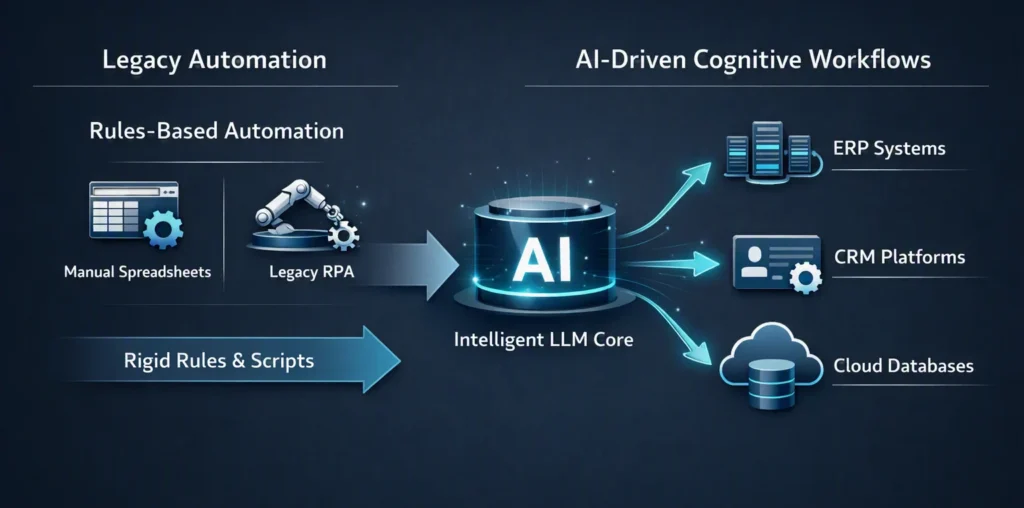
The Evolution from Legacy RPA to Cognitive Automation
Understanding how intelligent automation reshapes back-office operations requires examining how foundational execution layers interact with modern artificial intelligence:
- Deterministic Execution vs. Probabilistic Reasoning: Traditional RPA acts as the reliable digital worker that follows exact scripts. When paired with cognitive AI layers, these systems gain the ability to reason, parse variable text inputs, and handle unexpected edge cases without halting workflows.
- Intelligent Document Processing (IDP): Modern enterprise automation shifts away from manual invoice sorting and PDF data entry. Using advanced parsing models, systems can extract line items from messy, non-standardized vendor documents, validate them against internal databases, and trigger ERP updates instantly.
- Process Mining and Discovery: Rather than guessing which manual tasks cause bottlenecks, organizations use data-driven process mining to map real workflow execution data and prioritize high-impact automation targets.
Driving Strategic Growth Through Digital Transformation
Integrating intelligent tools into legacy enterprise resource planning (ERP) and customer relationship management (CRM) frameworks requires a structured strategy to ensure operational resilience and security compliance.
- Optimizing Customer Operations: Automated lead intake forms now route instantly through sentiment analysis models, scoring potential clients and drafting contextual initial responses before human staff step in.
- Scaling Enterprise Workflows: Executive teams leverage hybrid stacks—combining visual workflow engines, low-code connectors, and secure backend bots—to eliminate operational friction across sales, finance, and human resources departments.
Droven IO Best Tech Tools for Developers & DevOps Optimization
Engineering efficiency relies heavily on high-performance developer stacks, CI/CD pipeline automation, and scalable cloud infrastructure. Tracking insights into Droven IO best tech tools for developers and Droven IO DevOps tutorials helps engineering teams streamline containerization, evaluate cloud costs through a Droven IO AWS vs Azure comparison, and integrate modern machine learning models into production environments.
For modern development teams, managing complex codebases, containerized deployments, and cloud-native infrastructure requires choosing the right balance of automation software and developer utilities. As engineering workflows shift toward cloud-first execution, having a curated stack ensures faster deployment cycles, tighter security, and minimized operational friction.
Curating the Modern Developer Stack
Selecting efficient developer tools is the cornerstone of scaling production applications without sacrificing code quality or speed.
- Streamlining CI/CD Pipelines: Automation tools allow teams to run automated testing, linting, and staging deployments instantly upon every code commit, drastically reducing human error during software releases.
- Leveraging Droven IO Best Tech Tools for Developers: Technical insights focus on identifying high-performance IDE extensions, open-source workflow libraries, and container orchestration frameworks that accelerate feature delivery.
- Mastering Infrastructure Through Droven IO DevOps tutorial: Practical educational resources guide engineers through containerization (Docker and Kubernetes), infrastructure as code (Terraform), and automated rollback strategies for high-availability systems.
Cloud Architecture & Machine Learning Integration
As infrastructure demands scale, choosing the right cloud provider and integrating modern data models dictate long-term system performance and cost efficiency.
- Droven io AWS vs Azure comparison: A structural look at enterprise cloud options, evaluating serverless computing capabilities, global network latency, enterprise security governance, and AI model hosting costs between Amazon Web Services and Microsoft Azure.
- Harnessing droven.io machine learning trends: Moving beyond cloud infrastructure, modern developers focus heavily on local model deployment, edge AI execution, and data grounding through advanced Retrieval-Augmented Generation (RAG) pipelines to keep internal application data secure.
Cybersecurity Updates and Tech Education Trends for 2026
As enterprise automation scales across global networks, threat landscapes are shifting dramatically toward agentic exploits and multi-stage extortion. Simultaneously, modern droven.io tech education trends emphasize bridging the enterprise skills gap through rigorous AI literacy, continuous technical upskilling, and secure data governance frameworks.
The integration of artificial intelligence into corporate workflows has created unprecedented operational speed, but it has also drastically expanded the corporate attack surface. Security leaders and developers can no longer rely solely on legacy perimeter defenses when autonomous software agents, connected APIs, and complex software supply chains form the backbone of modern enterprise architectures.
Mitigating Emerging Threats and AI Vulnerabilities
Recent droven.io cybersecurity updates highlight a critical reality: adversaries are actively leveraging automated, AI-driven workflows to execute sophisticated attacks at scale.
- Defending Against Agentic & Tool-Chain Exploits: As Large Language Models connect directly to corporate databases and internal software via standardized communication protocols, attackers increasingly target these connective layers through prompt-driven data exfiltration and tool poisoning.
- Identity Security as the New Perimeter: With machine-to-machine identities and automated service accounts multiplying across cloud architectures, traditional credential management is being replaced by Zero Trust Network Access (ZTNA) and continuous behavioral monitoring.
- Supply Chain and API Risk Management: Securing public-facing applications requires moving beyond basic Web Application Firewalls (WAFs) to comprehensive Web Application and API Protection (WAAP) platforms that incorporate deep behavioral analytics and strict OAuth token governance.
Upskilling the Workforce: Tech Education Trends
To counter evolving technical threats and maximize the value of automation tools, organizations must prioritize structured education and continuous engineering growth.
- Closing the Enterprise Skills Gap: Technical reference platforms emphasize that the shortage of trained personnel skilled in AI safety and cloud orchestration poses a greater risk than budget limitations.
- Institutional AI Literacy: Modern training programs focus heavily on teaching developers and operational staff how to verify AI-generated outputs, recognize model hallucinations, and enforce strict data privacy standards.
- Competency-Based Microcredentials: As software stacks evolve at breaknote speed, traditional learning models are being supplemented by stackable industry certificates, hands-on cloud simulations, and continuous security awareness frameworks.
Leveraging Intelligence Frameworks for Long-Term Growth
The adoption of droven io ai automation tools marks a permanent evolution in how enterprises build, secure, and scale operations. By synthesizing insights from technical knowledge platforms, modern organizations can transition away from rigid legacy systems and implement secure, future-proof automation frameworks that drive sustainable growth.
Navigating the 2026 enterprise landscape requires a careful balance between rapid technological adoption and rigorous system governance. As organizations transition from isolated software utilities to fully integrated cognitive ecosystems, success depends entirely on how strategically leadership evaluates infrastructure, security, and developer efficiency.
Key Strategic Takeaways for Enterprise Leaders:
- Avoid Vendor Lock-In Through Informed Research: Leveraging independent technology platforms and educational frameworks helps IT decision-makers select open-source and interoperable tool stacks rather than becoming trapped in closed proprietary ecosystems.
- Prioritize Security Alongside Automation: Deploying autonomous workflow agents and generative pipelines must always be paired with Zero Trust architectures, strict PII data masking, and continuous threat monitoring.
- Invest in Continuous Workforce Education: Equipping teams with the technical literacy needed to audit AI outputs, manage cloud architectures, and maintain compliance ensures long-term operational resilience.
- The Bottom Line: True digital transformation is not measured by the number of software applications a company implements, but by how effectively intelligent automation reduces friction, protects sensitive assets, and scales human potential.