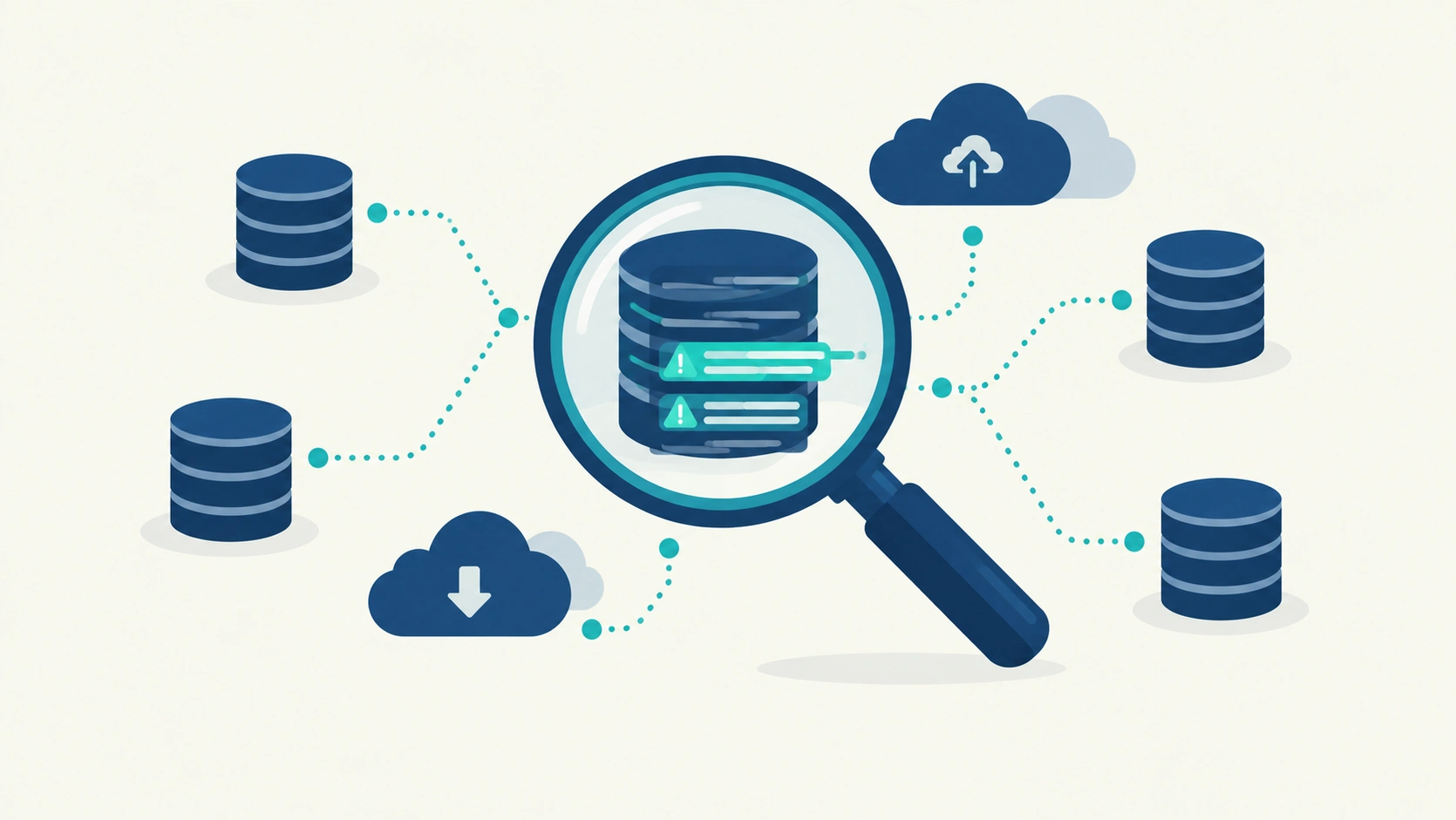
Search for “data discovery tools” and you’ll get results mixing two genuinely different software categories together as if they’re the same purchase decision. One type finds sensitive personal data hiding across your systems so you don’t get fined under GDPR or HIPAA. The other helps an analyst find a trustworthy dataset buried somewhere in your company’s sprawling collection of databases and dashboards. Both get called “data discovery,” and buying the wrong one because a vendor page blurred the line is a genuinely expensive mistake to make.
The Two Real Categories, Explained Separately
Category 1: Sensitive Data Discovery (Security and Compliance)
This category exists to answer one specific question: where does sensitive information actually live across your organization? These tools scan databases, file systems, cloud storage, and applications to locate personally identifiable information, financial records, healthcare data, or intellectual property, using pattern recognition and increasingly AI-driven classification to flag data that’s at risk of exposure or falls under regulatory requirements like GDPR, HIPAA, or CCPA. The output isn’t a dashboard for analysts — it’s a risk map for security and compliance teams, showing exactly where a breach would actually hurt.
Category 2: Data Catalogs (Analytics and Governance)
This category solves a completely different problem: making an organization’s existing data assets findable, understandable, and trusted by the people who need to use them — data engineers troubleshooting a pipeline, analysts hunting for a dataset they can actually rely on, governance teams preparing for an audit. Rather than scanning for sensitive content specifically, these tools index metadata across databases, warehouses, and BI tools, building a searchable map of what data exists, where it lives, and how trustworthy it is.
Sensitive Data Discovery: Who Leads the Category
Vendors here focus heavily on classification accuracy and reducing false positives, since a tool that constantly cries wolf over harmless data trains security teams to ignore its alerts entirely. Platforms in this space typically emphasize real-time monitoring across structured, semi-structured, and unstructured data simultaneously, along with insider-risk detection that goes beyond simple pattern matching to flag genuinely risky user behavior around sensitive files. The practical differentiator between vendors in this category tends to be how well they handle unstructured data specifically — PDFs, scanned documents, free-text fields — since structured database scanning has been a solved problem for years, while unstructured content remains genuinely harder to classify reliably.
Data Catalogs: Who Leads the Category
The data catalog market has grown into a real, sizable industry — reaching an estimated $1.72 billion in 2026, up from $1.38 billion the prior year, a 24.7% compound annual growth rate, according to The Business Research Company’s Data Catalog Global Market Report. Despite that growth, adoption remains surprisingly shallow: fewer than 25% of organizations have fully deployed a data catalog, according to Gartner’s own survey of enterprise data and analytics leaders — meaning most companies are still working with fragmented, undocumented data estates even as the tooling to fix that has matured considerably.
Leading platforms in this category each carve out a genuinely different niche rather than competing head-to-head on identical features: some focus on search-driven discovery with behavioral intelligence that surfaces the datasets analysts actually trust most; others specifically target regulated enterprises needing complex, auditable governance workflows; and open-source options exist for teams wanting the largest possible community and no vendor lock-in, trading some polish for flexibility and cost control. Cloud-native organizations already standardized on a specific platform (Azure, for instance) often find the native-integration options meaningfully faster to deploy than a fully independent third-party catalog, simply because the connective work is already done.
Why Fewer Than 25% of Companies Have Actually Deployed One
This gap is worth understanding rather than glossing over, since it says something real about why these projects stall. A data catalog’s entire value depends on organization-wide adoption — a catalog nobody actually searches before pulling a report is functionally useless, no matter how comprehensive its metadata is. Successful deployments consistently treat this as a change-management project as much as a technical one: the platforms cited as easiest to adopt specifically emphasize how quickly analysts start using the tool voluntarily, not just how much metadata gets indexed on day one. A technically excellent catalog that takes a year to roll out and requires extensive manual tagging tends to lose momentum long before it delivers value — deployment speed and ease of adoption matter as much as raw feature depth.
How to Actually Choose Between the Two Categories
The honest starting question isn’t “which data discovery tool is best” — it’s “which problem am I actually trying to solve”:
| Your actual need | Category |
|---|---|
| Find and protect PII/PHI/financial data for compliance | Sensitive Data Discovery |
| Reduce breach and regulatory fine risk | Sensitive Data Discovery |
| Help analysts find trustworthy datasets faster | Data Catalog |
| Prepare for a data governance audit | Data Catalog |
| Document what data exists across the organization | Data Catalog |
| Monitor insider risk around sensitive files | Sensitive Data Discovery |

Many larger organizations genuinely need both, run by different teams for different purposes — a security team running sensitive data discovery for compliance, and a data/analytics team running a separate catalog for internal data usability. Treating these as one combined purchase decision, or expecting one tool to competently do both jobs, is where a lot of failed data-tooling projects actually start.
What to Actually Evaluate Before Buying Either Type
Unstructured data handling
For sensitive data discovery specifically, ask directly how the tool handles PDFs, scanned images, and free-text fields — this is where classification accuracy varies most between vendors, and it’s the part demo environments tend to gloss over.
Real integration breadth, not just a logo list
For data catalogs, the number of pre-built connectors to your actual existing stack (specific databases, BI tools, cloud warehouses) matters far more than a vendor’s marketing page suggesting broad compatibility in the abstract.
Deployment and adoption timeline
Ask any vendor directly how long a typical customer takes to reach real, organization-wide usage — not just technical go-live. The gap between those two milestones is where most of these projects actually succeed or quietly fail.
Total cost including the human side
Licensing cost is only part of the real investment — factor in the ongoing effort of metadata curation, tagging, and governance workflow management that most of these platforms require to stay useful over time, rather than becoming an expensive, unmaintained index nobody trusts.
Frequently Asked Questions
What’s the difference between data discovery and a data catalog?
Sensitive data discovery specifically hunts for regulated or risky information (PII, financial data, health records) across systems for compliance and security. A data catalog indexes broader metadata about all organizational data assets to make them findable and trustworthy for everyday analytics work — a different goal despite overlapping terminology.
Do I need both types of data discovery tools?
Larger, more regulated organizations often do, typically run by different teams — security/compliance for sensitive data discovery, and data/analytics teams for a catalog. Smaller organizations may only need whichever problem is actually causing pain right now.
Why do so few companies have a fully deployed data catalog?
Adoption, not technology, is usually the bottleneck — a catalog only creates value once people across the organization actually use it to find data, and many deployments underestimate the change-management effort required to get there.
Are open-source data catalog tools a good option?
They can be, particularly for teams wanting to avoid vendor lock-in and comfortable managing more of the implementation themselves — the trade-off is generally less out-of-box polish and support compared to commercial platforms.
How much does enterprise data discovery software typically cost?
Pricing varies significantly by data volume, number of connected systems, and whether you need sensitive-data compliance features, catalog functionality, or both — get a quote based on your actual data environment rather than assuming a fixed industry-standard price point.
The single most useful thing to take from all of this: before evaluating a single vendor, get clear on which of the two real problems you’re actually solving. Everything else — which platform, which price point, which deployment timeline — falls out of that answer far more cleanly than any generic “best tools” ranking ever will.