Navigating the modern digital and financial landscape requires a keen eye for untapped opportunities and structural inefficiencies. Across global financial exchanges and digital service industries alike, technological advancements are constantly reshaping how value is created, priced, and exchanged. Understanding these shifts is essential for entrepreneurs, investors, and professionals looking to stay ahead of the curve.
At the intersection of machine learning and market dynamics lies a powerful strategy known as artificial intelligence arbitrage. By harnessing automated systems to detect and exploit minor discrepancies across different platforms or service models, innovators are unlocking unprecedented margins. The following breakdown explores the core mechanics of this practice and how it redefines efficiency in both digital markets and modern business operations.
What Is AI Arbitrage? (Defining the Core Concept)
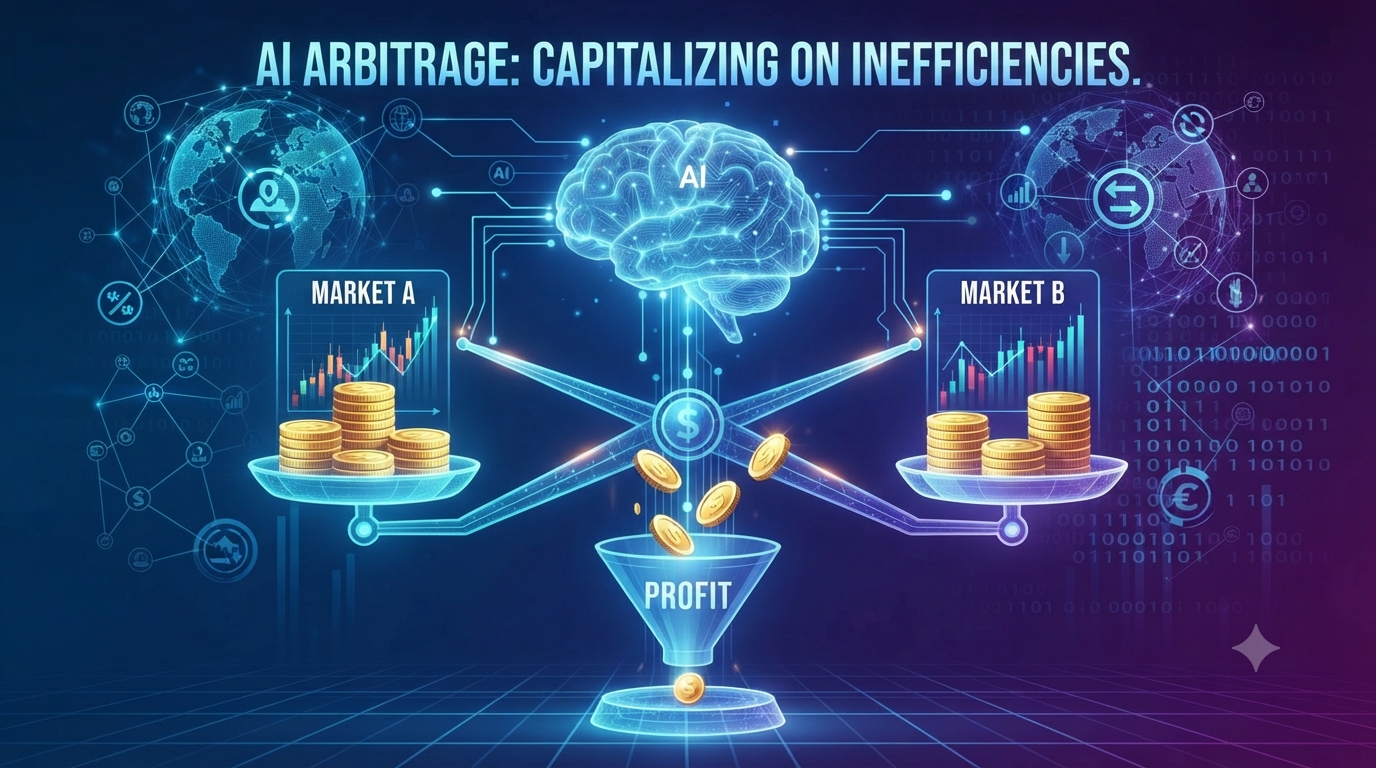
At its fundamental level, arbitrage is the practice of taking advantage of a price difference between two or more markets—buying an asset or service cheaply in one place and simultaneously selling it at a higher price elsewhere. AI arbitrage supercharges this traditional financial and business concept by integrating machine learning models, predictive algorithms, and automated execution engines to identify, analyze, and capitalize on these discrepancies at speeds and scales impossible for humans.
Moving Beyond Human Limitations
Traditional arbitrage relies on human traders monitoring order books, manual data entry, or traditional service staffing. However, human speed is inherently limited by cognitive processing times and physical reaction limits. AI arbitrage introduces autonomous software agents that can scan millions of data points, cross-reference pricing metrics across disparate ecosystems, and execute transactions within fractions of a second. Whether applied to micro-second price gaps in decentralized cryptocurrency exchanges or the rapid production-to-pricing gaps in digital service agencies, artificial intelligence transforms slow, manual observation into lightning-fast, data-driven execution.
The Two Pillars: Financial Markets vs. Agency Models
To fully grasp AI arbitrage, it is essential to recognize that the term spans two very different economic environments:
- Algorithmic/Financial Arbitrage: Utilizing high-frequency trading (HFT) bots and machine learning models to exploit pricing inefficiencies across stock, commodity, or cryptocurrency exchanges.
- Service/Agency Arbitrage: Leveraging advanced artificial intelligence tools, automation frameworks, and language models to produce high-value digital deliverables (such as software, content, or marketing assets) at a fraction of traditional labor costs, while capturing the margin between automated input costs and premium client billing.
The Two Faces of AI Arbitrage: Financial Markets vs. Agency Business Models
While the core principle of arbitrage remains the same—capturing the value created by a pricing inefficiency—the practical application of artificial intelligence splits into two entirely distinct domains. Depending on whether your focus is capital markets or digital service delivery, the mechanics, tools, and risk profiles vary dramatically.
1. Algorithmic and Financial Market Arbitrage
In the realm of finance and cryptocurrency, AI arbitrage is a high-speed, capital-intensive quantitative discipline.
- The Mechanism: High-frequency trading (HFT) bots and machine learning models scan order books across multiple global exchanges simultaneously. When a token or asset is priced slightly lower on a decentralized exchange (DEX) than on a centralized exchange (CEX), the algorithm instantly executes a buy order on one and a sell order on the other.
- The AI Advantage: Traditional quant trading relied on rigid mathematical formulas. Modern AI models incorporate natural language processing (NLP) to read news sentiment, predictive regression to forecast short-term volatility, and pattern recognition to spot non-linear cross-asset discrepancies before human traders even notice the market shift.
- Key Challenges: Razor-thin profit margins, extreme competition from institutional co-located servers, and the risk of slippage or network latency wiping out gains during sudden market crashes.
2. Service and Agency Arbitrage
On the commercial and entrepreneurial side, AI arbitrage (often referred to as AI service arbitrage) operates on a completely different economic model. It focuses on the massive gap between the cost of human labor and the cost of AI-driven production.
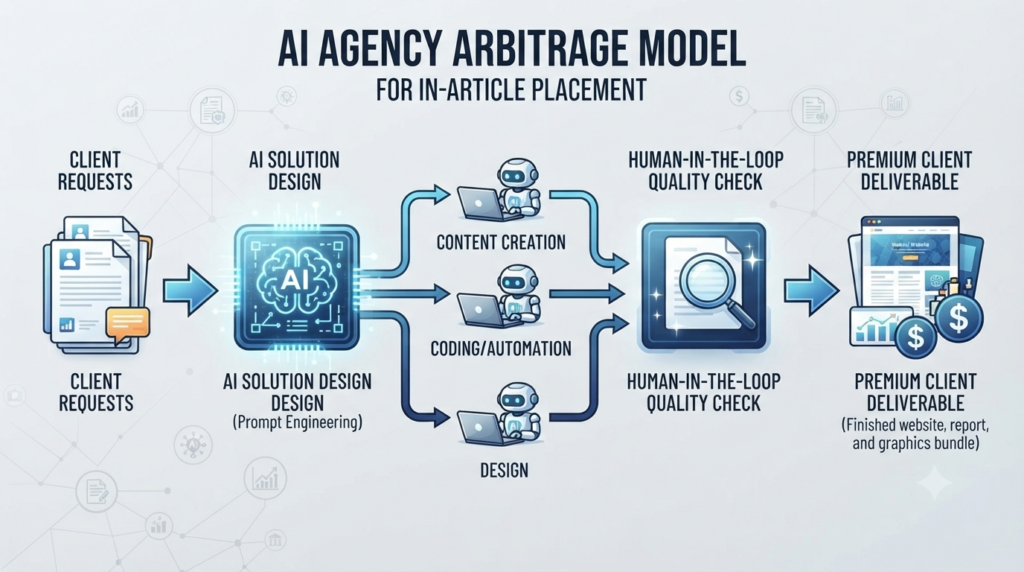
- The Mechanism: An agency or freelancer leverages advanced generative AI models, automation workflows, and specialized tool stacks to deliver high-end digital services—such as custom software code, content marketing, video editing, or data analysis—at a fraction of the time and overhead traditionally required.
- The AI Advantage: Instead of billing a client for 40 hours of manual copywriting or junior developer time, an operator uses AI prompts and fine-tuned frameworks to generate the baseline output in minutes. After applying expert human editing (human-in-the-loop review), the final product is delivered at standard market rates, capturing a massive margin.
- Key Challenges: Maintaining rigorous quality control against AI hallucinations, managing client expectations regarding automated workflows, and avoiding commoditization as basic AI tools become accessible to everyone.
Why Do AI Arbitrage Pricing Gaps Exist and How Long Do They Last?
The existence of any arbitrage opportunity boils down to one fundamental market reality: imperfect information flow and friction. In a completely frictionless, perfectly efficient market, prices would instantly equalize, leaving zero room for profit. However, real-world markets—whether they are digital cryptocurrency exchanges or freelance service economies—are inherently fragmented. Understanding why these gaps occur and how long they persist is vital for anyone looking to build a sustainable AI arbitrage strategy.
The Anatomy of Pricing Gaps in Financial Markets
In financial and crypto markets, price discrepancies do not happen because the asset has different intrinsic values; they happen because information, liquidity, and capital do not move instantaneously. Key drivers include:
- Market Fragmentation: With hundreds of decentralized and centralized crypto exchanges operating globally, liquidity is siloed. A sudden sell-off on a regional exchange can drop an asset’s price locally before global arbitrage bots catch up.
- Network Latency and Gas Fees: Blockchain congestion or varying network confirmation times mean transactions clear at different speeds, creating temporary windows where an asset is mispriced across chains.
- Information Asymmetry: Sudden news events or macroeconomic data releases hit different markets at staggered intervals, causing momentary lag in order book adjustments.
The Anatomy of Pricing Gaps in Agency and Service Models
In the business and service sector, pricing gaps exist for an entirely different reason: the lag in enterprise adoption and the retention of legacy pricing models.
- Value-Based vs. Labor-Based Pricing: Traditional agencies charge based on billable hours ($150/hour for a copywriter or developer). They sell time, not speed. AI allows an operator to produce the exact same (or superior) outcome in minutes instead of days.
- Knowledge and Skill Asymmetry: While AI tools are publicly available, the expertise required to prompt, chain, error-correct, and package them into reliable client deliverables is not universal. Businesses are willing to pay standard market rates for solutions because they lack the internal bandwidth or technical know-how to build automated workflows themselves.
The Half-Life of an Inefficiency: How Long Do Gaps Last?
The defining characteristic of arbitrage is that it is self-correcting.
- In High-Frequency Trading: AI arbitrage windows measure in milliseconds. As more institutional funds deploy smarter algorithms, microscopic price gaps disappear almost as soon as they appear, requiring faster infrastructure (co-location, fiber optics) to stay competitive.
- In Service Markets: Agency arbitrage windows last longer (measured in months or years), but they are steadily compressing. As more freelancers and businesses adopt advanced automation, basic content generation or simple code scripting will commoditize. To maintain profitability, arbitrageurs must constantly move up the value chain—evolving from basic prompt execution to building complex, proprietary autonomous agent workflows that standard competitors cannot easily replicate.
Deep Dive: The AI Agency and Service Arbitrage Model
While financial market arbitrage demands multi-million-dollar server infrastructure and nanosecond execution speeds, service and agency arbitrage offers a highly accessible entry point for entrepreneurs and modern digital businesses. This model leverages advanced generative AI models, custom workflow automation, and structured prompt engineering to capture massive profit margins by transforming how services are produced, scaled, and delivered.
Input vs. Output Economics: Breaking the Time-for-Money Trap
Traditional service agencies operate on a linear economic model: revenue is directly tied to human hours billed. If a copywriter or software developer takes 20 hours to build a landing page or write an e-book, the client pays for those 20 hours.
AI service arbitrage completely shatters this constraint. By deploying specialized AI agents and automated pipelines, the human input time drops from days to minutes. You are no longer selling your hours; you are selling outcomes and speed. Because the client values the end result (e.g., a fully optimized SEO content cluster or functional web code) rather than the sweat equity required to produce it, you capture the vast margin between minimal AI operational costs and standard market pricing.
High-Margin Service Pipelines You Can Build
To successfully execute an agency-level arbitrage model, you must structure your offerings around processes that traditionally required expensive specialized labor:
- Content and SEO Operations: Utilizing AI models to generate high-intent articles, optimize keyword silos, and format schema markup at scale, followed by rigorous human editorial oversight to ensure E-E-A-T compliance.
- Custom Software & Automation Building: Leveraging low-code platforms paired with AI code-generation tools to build Zapier/Make automations, custom chatbots, or internal business dashboards for clients in a fraction of the traditional development cycle.
- Lead Generation & Research: Deploying automated scraping and AI-driven data enrichment pipelines to compile hyper-targeted prospect lists, personalize cold outreach, and draft customized pitch decks.
The Human-in-the-Loop Quality Control Shield
The biggest trap in AI service arbitrage is relying blindly on raw, unedited AI output. Unchecked outputs often contain hallucinations, generic phrasing, or structural errors that destroy client trust.
A sustainable agency model relies on a strict human-in-the-loop (HITL) framework. AI acts as the high-speed multiplier for drafting, coding, and ideation, while human experts act as the final quality assurance filter. This hybrid approach ensures you deliver exceptional, error-free deliverables that command premium agency pricing while maintaining lightning-fast turnaround times.
Step-by-Step Blueprint: How to Get Started With AI Arbitrage
Transitioning the concept of AI arbitrage into a functional, revenue-generating venture requires a structured, tactical approach. Whether you are stepping into automated digital service delivery or building an operational framework to capture market gaps, following a methodical execution roadmap mitigates risk and accelerates your path to profitability.
1. Niche and Problem Identification
The foundation of any successful arbitrage model is finding acute, high-value inefficiencies where clients or markets are losing money or wasting massive amounts of time.
- Audit Operational Bottlenecks: Look for repetitive, multi-step digital workflows in industries like real estate, e-commerce, legal services, or digital publishing.
- Identify High-Value Outcomes: Focus on problems where businesses are currently paying high retainers for manual labor—such as weekly content creation, customer data enrichment, or basic software script maintenance.
2. Toolstack and Technology Selection
You do not need to build artificial intelligence models from scratch; your competitive advantage lies in how effectively you orchestrate existing tools.
- Foundation Models & APIs: Leverage advanced large language models, vision APIs, and specialized code generation tools capable of handling complex multi-modal inputs.
- Automation and Orchestration Frameworks: Connect your AI engines to business apps using workflow automation platforms like Make, Zapier, or custom Python scripts hosted on cloud infrastructure.
- Data and Scraping Infrastructure: For market-based arbitrage, establish reliable proxy networks, low-latency API connections, and real-time database tracking to capture price movements instantly.
3. Implementing Rigorous Quality Control (The HITL Standard)
Never deliver raw, unverified AI outputs directly to an end client or execute unmonitored financial transactions.
- Build Verification Checkpoints: Program automated validation checks into your pipelines (e.g., syntax checkers for code or fact-checking layers for content).
- Human Oversight Integration: Establish a strict review phase where an experienced professional audits the AI’s output, polishes the final deliverable, and ensures it meets rigorous industry standards.
4. Packaging and Pricing Your Offers
Shift your marketing conversation entirely away from how the work gets done and anchor it firmly on what the client receives.
- Value-Based Pricing Models: Instead of charging hourly rates that expose your high efficiency, price your services based on project outcomes, speed to delivery, or retainer packages.
- Scale Through Productization: Turn custom AI service pipelines into repeatable, productized services (e.g., a standardized monthly SEO content system or a fixed-price automation setup) so you can onboard multiple clients without linearly increasing your workload.
Risks, Limitations, and Ethical Considerations in AI Arbitrage
While the profit potential and operational speed of AI arbitrage are compelling, a realistic and sustainable strategy must account for its inherent risks. Whether you are deploying high-frequency trading algorithms or running an AI-powered service agency, ignoring operational pitfalls, technical failures, and ethical boundaries can lead to devastating financial losses or damaged client relationships.
Operational and Execution Risks in Financial Markets
In algorithmic trading, even the most sophisticated machine learning model is vulnerable to market volatility and infrastructure breakdowns:
- Slippage and Latency: When market conditions shift violently between the moment an AI model detects a price discrepancy and the moment the order is actually executed, the profit margin can evaporate or turn into a net loss.
- Cascading System Failures: Unsupervised trading bots can encounter unexpected market anomalies, triggering infinite loops of erroneous trades or flash crashes before human operators can intervene with a kill switch.
- Transaction Fee Erosion: High-frequency arbitrage relies on razor-thin margins. Gas fees on blockchains, exchange trading commissions, and network withdrawal costs can quickly wipe out gross profits if transaction volumes are not carefully optimized.
Quality Drift and Client Risk in Agency Models
In service and agency arbitrage, the risks stem from over-reliance on automation without adequate oversight:
- AI Hallucinations and Errors: Generative models are prone to confabulations—confidently stating incorrect facts, generating broken code, or missing compliance nuances. Delivering unverified work destroys client trust instantly.
- Commoditization and Race to the Bottom: As basic AI tools become universally accessible, clients will increasingly question why they should pay premium retainers for services that take minutes to generate. Long-term viability requires moving past simple prompt execution into building complex, proprietary workflows that competitors cannot easily duplicate.
Legal, Regulatory, and Ethical Boundaries
Operating in the gray areas of automation carries significant compliance risks:
- Market Manipulation Scrutiny: In financial markets, certain aggressive algorithmic strategies—such as spoofing, front-running, or artificial volume generation—are strictly illegal and heavily monitored by regulatory bodies.
- Data Privacy and Intellectual Property: Feeding proprietary client data, confidential financial records, or copyrighted source material into public or third-party AI models can violate data protection laws (like GDPR or CCPA) and breach non-disclosure agreements. Always utilize enterprise-tier APIs with strict zero-data-retention policies.
Frequently Asked Questions (FAQs)
Can individual retail traders use AI arbitrage bots?
While retail traders can access automated trading bots and basic crypto arbitrage tools, successfully competing against institutional high-frequency trading (HFT) firms is extremely difficult. Institutional players invest heavily in co-located servers sitting directly next to exchange matching engines to achieve sub-millisecond execution speeds. Retail traders operating over standard internet connections often face high latency, slippage, and transaction fees that erode narrow profit margins. However, retail operators can still find niche opportunities in less crowded decentralized finance (DeFi) liquidity pools or cross-chain decentralized exchanges (DEXs) with lower institutional saturation.
What is the difference between labor arbitrage and AI arbitrage?
Traditional labor arbitrage involves outsourcing work to geographic regions with lower average wages (e.g., hiring overseas freelancers or building offshore teams) to reduce operational overhead. In contrast, AI arbitrage replaces or massively augments human labor with machine learning systems, generative models, and workflow automation. Instead of arbitrage driven by geographic wage differences, AI arbitrage captures value through extreme speed, efficiency, and scale—allowing a single operator or lean team to produce enterprise-grade outputs in minutes rather than days.
Do I need coding skills to start an AI arbitrage business?
You do not need to be a software engineer or data scientist to build a successful AI service or agency arbitrage business. Modern no-code and low-code orchestration platforms—such as Make, Zapier, and specialized AI wrappers—allow you to connect APIs, build automated content pipelines, and structure client deliverables visually. Success relies much more heavily on your ability to understand client pain points, design effective prompt workflows, and implement rigorous human-in-the-loop quality control than on writing raw code.
Is AI arbitrage legal and legitimate?
The legality of AI arbitrage depends entirely on the domain and execution method:
- In Service and Agency Models: Absolutely legal and legitimate. Businesses routinely pay for outcomes and speed. As long as you deliver accurate, high-quality work, respect intellectual property, and protect client confidentiality, using AI to streamline your agency operations is a standard modern business practice.
- In Financial Markets: Perfectly legal when operating within exchange rules. However, certain aggressive, manipulative algorithmic strategies—such as front-running retail orders, spoofing order books, or exploiting systemic platform bugs—violate financial regulations and can lead to severe legal penalties and account bans.