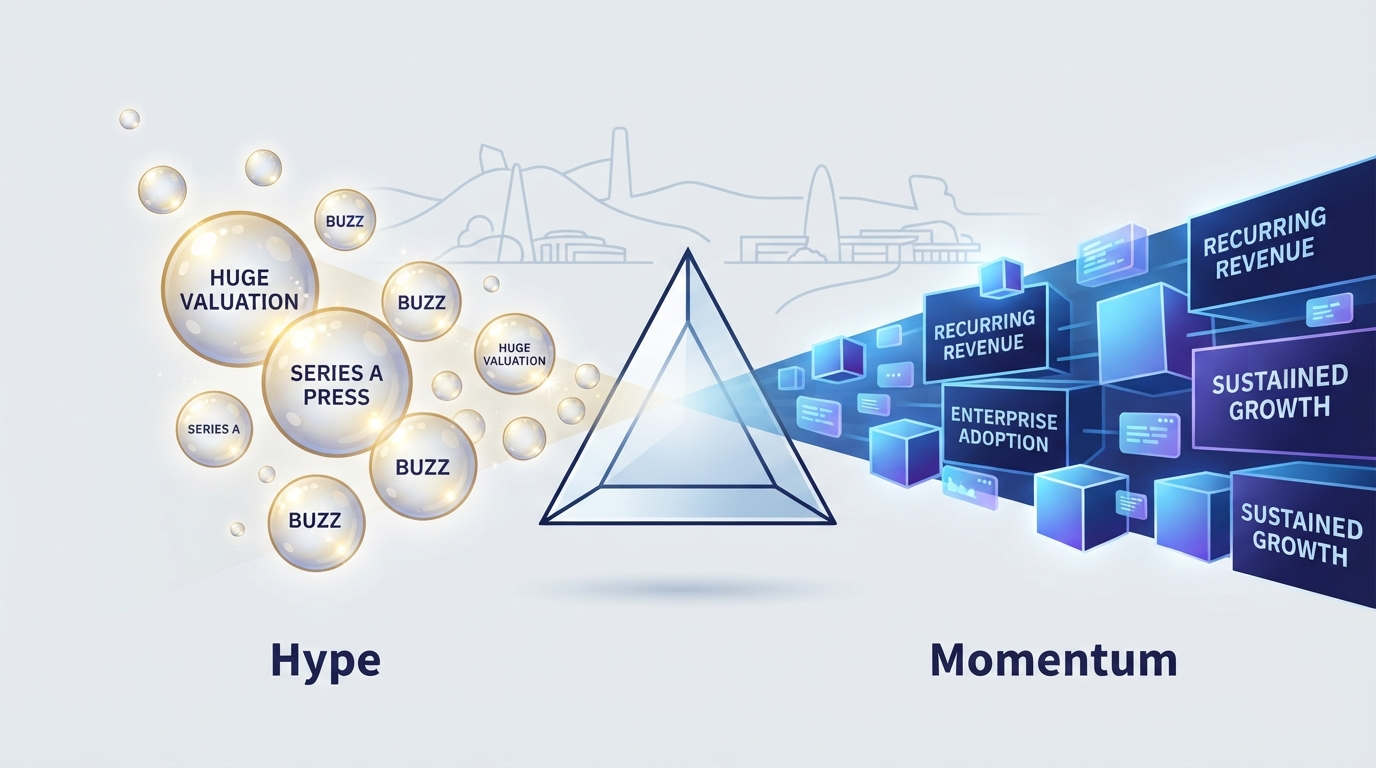
Search this topic and you’ll find a dozen nearly identical lists — the same eight or nine company names, reshuffled, each with a valuation figure attached like a trophy. What almost none of them tell you is why a $30 billion round means something different in 2026 than it did in 2021, or how to tell a company that’s actually embedded in daily workflows from one that’s still living off its Series A press cycle. That distinction is the whole story right now, and it’s worth understanding before the list of names means anything.
The Filter That Actually Matters in 2026
For years, “hot” in Silicon Valley meant one thing: a large round, a headline valuation, a founder with an impressive resume. That filter has quietly broken. According to the Stanford Institute for Human-Centered AI’s 2025 AI Index Report, AI investment and adoption have both accelerated sharply — but the same report is explicit that the frameworks for evaluating what actually works are falling behind the pace of the hype. In practice, that gap is exactly what separates this year’s real category leaders from the companies still coasting on demo momentum.
The more useful filter, and the one this piece uses: does the company have recurring revenue that’s actually growing, not just a valuation that sounds impressive in isolation? A handful of names below report real, disclosed run-rate revenue in the hundreds of millions — that’s a meaningfully different signal than a funding round alone, since it means real organizations are paying, repeatedly, not just piloting.
Frontier Model Labs
The foundation layer hasn’t gotten less crowded, but it has gotten more differentiated by what each lab is actually optimizing for — raw capability, safety and enterprise trust, or speed of iteration. OpenAI remains the largest by valuation and consumer reach. Anthropic has positioned itself specifically around reliability and safety for regulated industries — banks, law firms, and healthcare organizations weighing AI adoption tend to cite predictability as the deciding factor, which is a different competitive lane than raw benchmark performance. xAI rounds out the trio with a more consumer- and platform-integrated approach tied to X.
Enterprise AI Agents — Where the Real Revenue Is Showing Up
This is the category most worth watching closely, because it’s the one where “hot” and “actually generating revenue” have started to mean the same thing. Glean, an enterprise search and knowledge platform, reported roughly $300 million in annual recurring revenue as of mid-2026. Cognition AI, the company behind the Devin AI coding agent, disclosed run-rate revenue north of $490 million. Sierra, building customer-facing conversational AI agents, crossed $100 million ARR within roughly seven quarters of operating — a genuinely fast climb for enterprise software, where sales cycles are typically long and cautious.
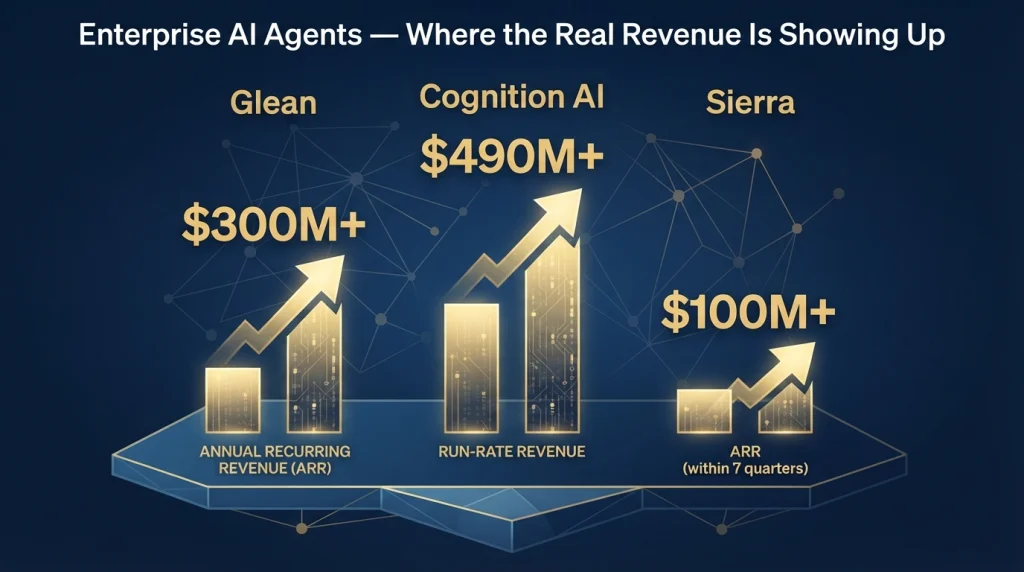
The pattern across all three: none of them are selling a chatbot demo. They’re selling a specific, measurable outcome — fewer support tickets, faster internal search, code shipped — to buyers who can point to a number that changed because of it.
AI Coding and Developer Tools
Cursor (built by Anysphere) has become one of the fastest-adopted developer tools in recent memory, embedding AI directly into the coding workflow rather than bolting it on as a separate chat window. Cognition AI‘s Devin takes a more autonomous approach — an agent that attempts full coding tasks rather than just suggesting completions. The competitive tension between these two approaches (AI-assisted coding vs. AI-autonomous coding) is arguably the most active technical debate in the sector right now, and it’s not remotely settled.
Specialized AI Infrastructure and Chips
Not every company on this list is building a model or an app — some are building the picks and shovels underneath the boom. Groq, based in Mountain View, designs inference-specific processors built to run pre-trained models faster and cheaper than general-purpose GPUs. In September 2025 the company raised $750 million, roughly doubling its valuation to $6.9 billion, in a round backed by BlackRock and Samsung alongside its lead investor. With ongoing GPU supply constraints and rising cloud compute costs, infrastructure plays like this have become as closely watched as the model companies themselves — the industry’s shift from training massive models to deploying them cheaply at scale is exactly the problem Groq is betting on.
Physical AI and Robotics
Humanoid robotics has moved from research-lab curiosity to a genuine funding category, even though consumer-ready products remain years out by most credible estimates. Figure has attracted blue-chip investor backing at valuations that would have seemed implausible for a pre-revenue robotics company a few years ago. Physical Intelligence, backed by Sequoia among others, is working on foundation models for robotic control rather than hardware alone. The willingness of major investors to back humanoid robotics at these prices — years ahead of mass-market readiness — says as much about available capital chasing the next platform shift as it does about any single company’s near-term prospects.
Search, Knowledge, and Creative Generation
Perplexity AI has built a real audience around AI-native search, positioning directly against the traditional search-engine-plus-ads model. Runway ML, Pika Labs, and Character.AI each occupy different corners of AI-generated creative content and interactive entertainment — video generation, short-form generative video, and character-based conversational products, respectively. Writer has carved out an enterprise-focused niche in AI-assisted content generation aimed specifically at large organizations with brand and compliance requirements, a notably different buyer than the consumer-facing tools in this category.
Legal and Vertical-Specific AI
Harvey AI, focused on legal work, has become the clearest example of a vertical AI company reaching genuine enterprise scale rather than staying a horizontal, general-purpose tool. Its traction says something broader about where 2026’s AI investment is actually heading: narrow, deep, and built around a specific professional workflow tends to outcompete a broad tool trying to be useful to everyone.
A Quick Reference
| Company | Category | Notable 2025-2026 signal |
|---|---|---|
| Glean | Enterprise search/knowledge | ~$300M ARR (May 2026) |
| Cognition AI | AI coding agents | ~$492M run-rate revenue |
| Sierra | Conversational AI agents | $100M ARR within ~7 quarters |
| Groq | AI inference chips | $750M raise, $6.9B valuation (Sept 2025) |
| Harvey AI | Legal AI | Enterprise-scale vertical adoption |
| Figure / Physical Intelligence | Robotics/physical AI | Major backing despite pre-mass-market stage |
Why This List Will Look Different in Six Months
Every list like this one, including this one, has a built-in expiration date, and it’s worth saying so plainly rather than pretending otherwise. A company can raise a massive round, pivot its product, lose a key customer, or get acquired inside a single quarter — the pace of change in this sector right now is genuinely faster than the traditional startup news cycle. The more durable skill isn’t memorizing this specific list of names; it’s the filter itself — recurring revenue over hype, workflow adoption over demo polish — since that’s the part that keeps working no matter which company is on top when you actually read this.
If there’s one habit worth carrying into every “hottest startup” list from here forward, including next quarter’s version of this one, it’s the same discipline that applies to evaluating any confident AI-era claim: check what’s actually being measured before deciding it’s real.