
A Pokémon database is the place you go when a question about Pokémon needs a fact, not an opinion. Which Pokémon has the highest base Speed? What moves can Pikachu learn in Scarlet and Violet? How do you pull all of that into your own app? The answers live in different databases, and picking the wrong one wastes your time. This guide sorts them out: the count, the sites players actually use, and the free API developers build on.
What “Pokémon Database” Actually Means
A Pokémon database is three different things wearing one name, and most of the confusion about the term comes from never saying which one you mean. The first is a player Pokédex: a website where you look up a Pokémon’s stats, types, moves, abilities, evolutions, and where to catch it. The second is a developer dataset: a machine-readable source of the same data, usually an API, that an app or a bot can query. The third is a code project literally named “pokemon-database” on GitHub, usually a student demo or a fan-game’s internal data store. Searches for pokémon database, with the accent, mean the same thing as without it.
The search itself is split, too. For the keyword “pokemon database”, only about 17% of searches are informational — people who want an explanation. Around 29% are navigational, meaning the searcher already has a specific site in mind and just wants to get to it, and 44% are commercial, looking for a tool or a product. So a third of the traffic was never looking for an article at all. This article is for the two groups that are: developers who want the data in code, and players who want to know which database to use for which job.
How Many Pokémon Are There?

There are 1,025 Pokémon species, numbered #001 Bulbasaur through #1025 Pecharunt, across nine completed generations. If you searched for pokemon every pokemon ever, this is the list: every species ever introduced, in one numbering. The generations break down as 151, 100, 135, 107, 156, 72, 88, 96, and 120, which adds up to 1,025. A tenth generation has been announced for 2027, but as of late 2026, nine is the completed count.
Three Numbers, Three Definitions
Three different numbers circulate for how many Pokémon there are, and all three are correct — they just count different things. The first is 1,025, the species count, which is the number this article uses. The second is roughly 1,164, which adds regional forms, Mega Evolutions, Gigantamax forms, and other variants on top of the species. Sources disagree slightly on the variant counts — 58 or 59 regional forms, 94 or 96 Megas — which is why the total is approximate. The third is 1,351, which is what PokéAPI returns when you ask it how many records it holds under /pokemon, because that endpoint counts every form as its own record, including totem forms, battle-only forms, and gender differences. Whenever a number appears in this article, it comes with its definition attached, and any guide that quotes one of these three without saying which is counting something else.
The 1,028 Figure, Explained
You may have seen 1,028 quoted as the total. That figure comes from adding the three starters of the tenth generation — Browt, Pombon, and Gecqua, announced on 27 February 2026 for Pokémon Winds & Waves, due in 2027 on Switch 2 — to the 1,025 numbered species. Those three have been revealed but not numbered, so they are not part of the official count yet. The honest way to write it is 1,025 plus 3 revealed-but-unnumbered, and any article that states 1,028 as the official total is jumping ahead of the numbering.
What a Pokédex Number Is
A Pokédex number is a species’ permanent place in the National Pokédex, and once a number is assigned it never changes. Bulbasaur is #0001 and Pecharunt is #1025, and those numbers are the same in every game, every guide, and every database. Regional Pokédex numbers are different: each game numbers only the Pokémon that appear in it, in that game’s own order, so the same species can carry a different regional number in different games. When a database says “National №” it means the permanent one; when it says a local or regional number, it means that game’s list.
PokéAPI: The Database for Developers
PokéAPI is a free, keyless, community-run REST API that serves Pokémon game data as JSON, and it is the database developers actually build on. It covers the video game franchise specifically, it needs no signup and no API key, and it is consumption-only: you send GET requests and it sends data back. There is no official Nintendo or Game Freak API, and that absence is the reason PokéAPI exists — it was built so that a hundred different fan sites and apps would not each have to re-enter the same data by hand.
The project started as a weekend build by Paul Hallett, was rebuilt as version 2 by Zane Adickes as a mirror of the open-source Veekun dataset, and has been community-run since 2018. It is open source, and its current owners are listed on its own about page as Paul Hallett, Tim Malone, and Alessandro Pezzé.
The Endpoints That Matter
The API exposes more than 50 resources, all under the same pattern: GET https://pokeapi.co/api/v2/{resource}/{id or name}/. The ones you will actually use are /pokemon for a Pokémon’s battle record (stats, types, abilities, moves, sprites, height, weight, held items, and forms), /pokemon-species for species data (flavour text, genera, evolution chain link, habitat, capture rate), /ability, /move, /type, /item, /location and /location-area for encounter tables, /evolution-chain (which takes an ID only, never a name), and /generation, /pokedex, /version, and /version-group for the game data itself. Calling an endpoint with no ID returns a paginated list, 20 records per page by default, with ?limit= and ?offset= to page through it. The full list is in the PokéAPI documentation, which is the only source worth trusting for endpoint names, because secondary articles go stale.
The Rate-Limit Confusion, Settled
The rate limit is the single most misreported fact about PokéAPI, so here it is plainly. The REST API has had no enforced rate limit since the move to static hosting in November 2018. What it has instead is a fair-use policy enforced by banning: the docs ask you to cache resources locally whenever you request them, and warn that people who do not comply will have their IP address permanently banned. There is no throttle that slows you down first. The 100-calls-per-hour figure that floats around belongs to something else entirely: the GraphQL beta at graphql.pokeapi.co/v1beta2, which is rate-limited to 100 calls per hour per IP, reboots daily at 1 AM UTC, and had its older v1beta endpoint removed in November 2026. If an article tells you the REST API allows 100 requests an hour, it has confused the two. The GraphQL documentation states its own limits separately, and that is the page to check if you plan to use it.
Wrappers That Save You the Boilerplate
You do not have to call the raw endpoints by hand. The official docs list wrapper libraries for most languages: PokeBase for Python 3, which caches responses automatically; Pokenode-ts for TypeScript, currently at version 5.0.0 as of November 2026, with npm install pokenode-ts as the install; Pokedex Promise v2 for Node; pokeapi-js-wrapper for the browser; and Pokepy, PokeKotlin, PokeApi.NET, and several more for other stacks. A wrapper is worth it the moment you need caching, typed responses, or repeated calls, because the caching rule is the one that keeps your IP unbanned.
When PokéAPI Is Not the Answer
PokéAPI is a data service, not a website, so it is the wrong tool when you want to read rather than build. It has no human-friendly interface, no competitive analysis, and no opinions about which Pokémon are good. If you need bulk or offline data, the Veekun dataset it was built from is available as CSV or SQLite to self-host, and you can self-host PokéAPI itself for heavy use. If you need card prices, the answer is a card database such as TCGApi, which tracks tens of thousands of trading cards — a different database for a different thing, not a substitute for creature data.
How to Use PokéAPI in 10 Minutes

Using PokéAPI takes one GET request, no key, and no signup. You send a request to the endpoint for the thing you want, and you get JSON back. The worked example below fetches Pikachu, and everything after it is just reading the response.
Access It with JavaScript
Searches for how to access pokemon database with javascript all land on the same answer: fetch the REST endpoint from the browser or from Node. In the browser, the plain fetch call is enough:
const res = await fetch("https://pokeapi.co/api/v2/pokemon/pikachu");
const pikachu = await res.json();
console.log(pikachu.name, pikachu.id); // pikachu 25
That is the whole integration for a first version. In Node, the same fetch works, or you can use Pokenode-ts, which adds typed responses and automatic caching. Whichever route you take, cache what you fetch: save responses locally and reuse them instead of requesting the same Pokémon twice, because the fair-use rule is enforced by banning, not by a polite warning.
Read the Response
The response for Pikachu is a good map of the whole API. The id is 25 and the name is “pikachu”. The abilities array lists static, with lightning-rod marked as the hidden ability. Height and weight are in decimetres and hectograms, so a height of 4 means 0.4 metres and a weight of 60 means 6.0 kilograms — a detail that trips up first-time users who expect metres and kilograms. Stats live in a stats array, each entry carrying a base_stat number and a stat.name, and sprites are plain URLs you can drop straight into an <img> tag. Moves come with version_group_details, which tell you how the Pokémon learns each move in each game version. The game_indices list is also worth a look: it includes scarlet, legends-za, and mega-dimension, which proves the live API already carries data from the newest games.
One More Useful Call
The most useful second call is the encounters endpoint: GET https://pokeapi.co/api/v2/pokemon/{name}/encounters returns where a Pokémon can be caught, area by area, with the conditions attached. It is the answer to the most common player question that a database gets asked, and it is one call instead of a page of searching. If you also want the story side — the flavour text, the genus, and the evolution chain — call /pokemon-species/{name} next, which links onward to the full evolution tree.
The Player Databases at a Glance

For looking things up rather than building, the choice is between fan-run websites, and the honest comparison is a short table, not a ranking. Every one of these is free to read, and every one except the official sources is run by fans.
| Database | Run by | Free? | API? | Best for | Weakness |
|---|---|---|---|---|---|
| Pokémon Database (pokemondb.net) | Fan, one person, est. 2008 | Yes (ads) | No — explicitly none | Fast, clean per-Pokémon pages; type chart | No API or download; no anime or TCG depth |
| PokéAPI (pokeapi.co) | Fan community, open source, est. 2014 | Yes, no key | Yes — it is the API | Developers, apps, bots | Raw JSON, no human interface |
| Bulbapedia | Fan wiki, Bulbagarden, est. 2005 | Yes | No | Deepest lore, mechanics, anime, TCG; 65,000+ articles | Dense and cluttered, slow to skim |
| Serebii.net | Fan, Joe Merrick, est. 1999 | Yes (ads) | No | Fastest news and new-game data; Pokéarth locations | Dated, dense design |
| Smogon / Pokémon Showdown | Fan community, est. 2004 / 2011 | Yes | No public data API | Competitive tiers, Strategy Dex, usage stats | Not a general Pokédex |
| pokemon.com / Pokémon HOME | Official — The Pokémon Company / Nintendo | Basic free; HOME Premium paid | No public API | Authoritative announcements; cross-game storage | Thin per-Pokémon data; HOME is storage, not a reference dex |
| DexDB (dexdb.io) | Fan, newer | Yes | No | Clean modern dex with Champions usage data | Newer, less proven than the big three |
| NationalDex (nationaldex.io) | Fan-maintained | Yes | No | Gen I–IX stats, evolutions, moves, locations | Smaller community, less depth |
Only pokemon.com and Pokémon HOME are official. Everything else in the table is fan-run or community-run, and that distinction matters: fan sites are maintained by volunteers, they can lag or change, and they are not Nintendo speaking.
Which Database for Which Job
The right database depends on the job, so here is the decision in one table, with the rows that need more than a line expanded underneath it.
| I want to… | Use this |
|---|---|
| Look up one Pokémon’s stats and moves fast | Pokémon Database |
| Read the deepest mechanics and lore | Bulbapedia |
| Track news, events, and a new game’s data | Serebii |
| Build a competitive team | Smogon / Pokémon Showdown |
| Check a type matchup | The type chart |
| Build an app or a bot | PokéAPI |
| Store my collection across games | Pokémon HOME |
| Check card prices | TCGApi (cards, not creatures) |
Searching for pokemon by stats means you want to sort or filter Pokémon on their numbers, and the fastest route is the Pokémon Database: its per-Pokémon pages list base stats with minimum and maximum values, EV yield, and the full moveset by game, and its type chart is the one other guides most often point to. Bulbapedia is the better choice when the question is why a mechanic works the way it does, and Serebii is the better choice in a new game’s launch week, when it is routinely first with datamined data.
The competitive row deserves a sentence of its own. People searching for how to build a competitive pokemon team pokemon database usually mean one thing: which Pokémon, moves, and items actually win games right now. That is Smogon’s job, through its Strategy Dex and its monthly usage statistics, and through Pokémon Showdown, the battle simulator where those teams get tested. One warning travels with it: Smogon’s tiers are Smogon’s own invention, not Nintendo’s official rules, so a Pokémon’s tier says nothing about its availability in the games.
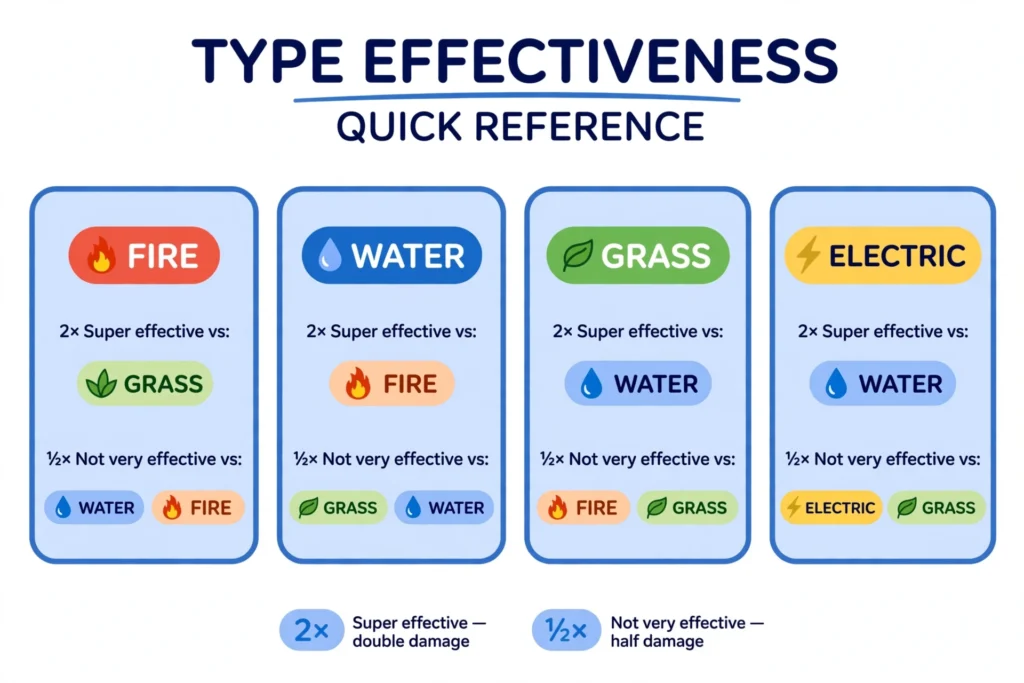
For pokemon types, the chart itself is simple: 18 types, and a move is super effective at 2×, neutral at 1×, not very effective at ½×, or completely ineffective at 0× against a defending type. Dual types multiply, so two weaknesses make 4× and two resistances make ¼×, and any immunity wins outright. A related question — how does the pokemon go database work — has a different answer, because Pokémon GO is a separate game with its own data: its multipliers are 1.6× and 0.625× instead of 2× and ½×, and immunities are not zero. Never use a GO chart for the main-series games.
Pokémon HOME is the official storage answer, not a reference dex: the basic tier is free and holds 30 Pokémon, while Premium costs $15.99 a year and now stores up to 9,000, raised from 6,000 in October 2026. Its predecessor, Pokémon Bank, ends service in February 2027, so anything still sitting in Bank needs moving to HOME before then. The card row is a boundary marker more than a recommendation: pokemon tcg types are card types, not creature types, and a common follow-up — how often does the pokemon tcg pocket database update — has no single official answer, because TCG Pocket is a separate card game and each fan database refreshes on its own schedule when new sets release.
What the Other Guides Get Wrong
The first mistake is counting species and forms as the same thing. Guides that quote 1,351 as the number of Pokémon are reporting PokéAPI’s form records, and guides that quote 1,028 as official are counting three starters that have been revealed but not numbered. The count is 1,025 species, and the other numbers need their definitions attached.
The second mistake is stale counts. Pages still in circulation say 802, 898, 1,008, or 1,010, and even 2025 articles miss what has happened since: Legends: Z-A added no new species at all, only 26 new Mega Evolutions; Pokémon Champions launched in April 2026; Pokémon Bank is ending in February 2027; HOME storage rose to 9,000; and a tenth generation was announced in February 2026.
The third mistake is the PokéAPI rate limit. Secondary articles variously claim 100 requests an hour, no limit at all, or a monthly cap, and most of them have confused the REST API, which has no enforced limit but bans abusers, with the GraphQL beta, which is limited to 100 calls an hour per IP.
The fourth mistake is presenting the Pokémon GO type chart as the main-series chart. GO’s multipliers are 1.6× and 0.625×, and its immunities are not zero, so a GO chart gives wrong answers for the console games.
The fifth mistake is calling fan sites official. Pokemondb.net, Bulbapedia, Serebii, Smogon, and PokéAPI are all fan or community projects, and presenting any of them as Nintendo’s own database is simply wrong. The sixth mistake is the mirror image: citing AI-generated clone dexes that scrape the real fan sites instead of the primary source. Serebii publicly complained about exactly that in March 2026, when a companion app was accused of scraping its data, which is why attribution to the primary site matters.
Frequently Asked Questions
How many Pokémon are there?
There are 1,025 species, numbered #001 Bulbasaur through #1025 Pecharunt. With forms and variants the total is roughly 1,164, and PokéAPI holds 1,351 form records — three different numbers counting three different things.
How many generations of Pokémon are there?
Nine completed generations, from 1996 to 2022. A tenth, Pokémon Winds & Waves, was announced in February 2026 for a 2027 release on Switch 2.
What is the strongest Pokémon?
By base-stat total in base form, Arceus at 720. Mega Rayquaza and Mega Mewtwo reach 780, and Eternamax Eternatus is higher still but uncatchable. “Strongest” depends on the form and the rules you are playing under, so there is no single answer.
What is a Pokédex number?
A species’ permanent number in the National Pokédex. Bulbasaur is #0001 and Pecharunt is #1025, and those numbers never change. Regional Pokédex numbers differ by game.
How many Pokémon types are there?
Eighteen. Fairy is the newest, added in Generation VI, and the chart has been stable since then.
What is PokéAPI?
A free, keyless, community-run REST API for Pokémon game data at pokeapi.co, with a GraphQL beta alongside it. It serves the video game franchise as JSON, and it exists because Nintendo provides no official API.
Is PokéAPI free, and does it need a key?
Yes, it is free, and no, it needs no key, no signup, and no authentication. The REST API has no enforced rate limit, but its fair-use policy is enforced by banning: cache what you fetch, or your IP can be permanently banned.
Is PokéAPI official?
No. It is community-run and open source, and it is not affiliated with, endorsed by, or sponsored by Nintendo, Game Freak, Creatures Inc., or The Pokémon Company.
What is the best Pokémon database?
It depends on the job. For quick lookups, Pokémon Database. For news and new games, Serebii. For depth, Bulbapedia. For competitive play, Smogon. For code, PokéAPI. For storage, Pokémon HOME.
Where can I find where a Pokémon is caught, or its moves?
On a per-Pokémon page at Pokémon Database or in Serebii’s Pokéarth, or through PokéAPI’s /pokemon/{name}/encounters endpoint, which returns encounter areas and conditions.
What are EVs, IVs, and base stats?
Base stats are the six species-fixed numbers — HP, Attack, Defense, Special Attack, Special Defense, Speed — that set a Pokémon’s potential. IVs are hidden values from 0 to 31 per stat, set when the Pokémon is obtained, like genes. EVs are points earned through battling and training, capped at 252 per stat and 510 in total, with every 4 EVs adding one stat point at level 100.
Is Pokémon HOME free?
The basic tier is free and holds 30 Pokémon. Premium costs $15.99 a year and stores up to 9,000 Pokémon, raised from 6,000 in October 2026.
Is Pokémon Bank still working?
Only if you already downloaded it — new downloads ended when the 3DS eShop closed in March 2023. The service ends in February 2027, so anything still in Bank should be moved to Pokémon HOME before then, which needs HOME Premium.
What is Pokémon Champions?
An official battle-focused game, released on Switch on 8 April 2026 and on mobile on 17 June 2026. It links with Pokémon HOME, is free to start, and serves as the platform for official competitive play.
Are there new Pokémon in Legends: Z-A?
No new species. Legends: Z-A, released 16 October 2025, added 26 new Mega Evolutions at launch, and its Lumiose Pokédex holds around 232 Pokémon.
What are the Gen 10 starters?
Browt (Grass), Pombon (Fire), and Gecqua (Water), revealed on 27 February 2026 for Pokémon Winds & Waves, due in 2027. They have been revealed but not numbered, so they are not part of the 1,025 count.
How do I link a Pokémon database to PKHeX?
You do not link one. PKHeX is a free, open-source save file editor: it opens a save file you have exported from your game, lets you edit the Pokémon inside it, and writes the file back. It never talks to a live database or to a console directly, and getting a save file off a Switch needs a save manager and modified console software. PKHeX does keep its own local folder of stored Pokémon files, which works a little like a personal bank, but that is storage on your computer, not a connection to a database.
How do type matchups work?
A move deals double damage (2×), normal damage (1×), half damage (½×), or no damage (0×) against a defending type, and dual types multiply the two results. Pokémon GO uses different multipliers — 1.6× instead of 2× — so use a main-series chart for the console games.
Bottom Line
The whole question comes down to which job you are doing. If you are building something, start at PokéAPI, because it is free, it needs no key, and it is the only database in this guide that hands you the data in a form your code can use — just cache what you fetch, because the one rule that matters is the one enforced by banning. If you are looking something up, start at Pokémon Database, because it is the fastest clean answer to a single question, and reach for Bulbapedia when the question is why something works, Serebii when the news is fresh, and Smogon when the question is what wins. The number to remember is 1,025 species across nine generations, and the distinction to keep is that only Pokémon HOME and pokemon.com are official — everything else that is worth using is a fan project, built and maintained by people who love the games enough to keep the data straight.