
The pursuit of visual fluidity has been a defining goal of display engineering and digital media for decades. At its core, intelligent frame creation refers to any algorithmic or AI-driven process that calculates and injects intermediate images between existing frames to make motion appear smoother and clearer.
While the term traditionally points to home theater configurations, the underlying concept has expanded dramatically. Today, intelligent frame creation acts as a foundational pillar across three distinct technological worlds: television display settings, generative artificial intelligence video tools, and high-performance gaming hardware.
Key Takeaway: The Evolution of Motion Physics What started as a simple pixel-interpolation trick on flat-screen TVs to eliminate judder has evolved into predictive neural networks capable of imagining and rendering entirely new frames of video in real time. Understanding how frame creation works across devices helps creators and consumers optimize their visual setups.
The Origin: Panasonic’s Intelligent Frame Creation (IFC) & TV Motion Smoothing
Long before generative AI became a household term, Intelligent Frame Creation (IFC) was popularized primarily as a proprietary picture setting by Panasonic for its televisions (similar to Samsung’s Auto Motion Plus or Sony’s Motionflow).
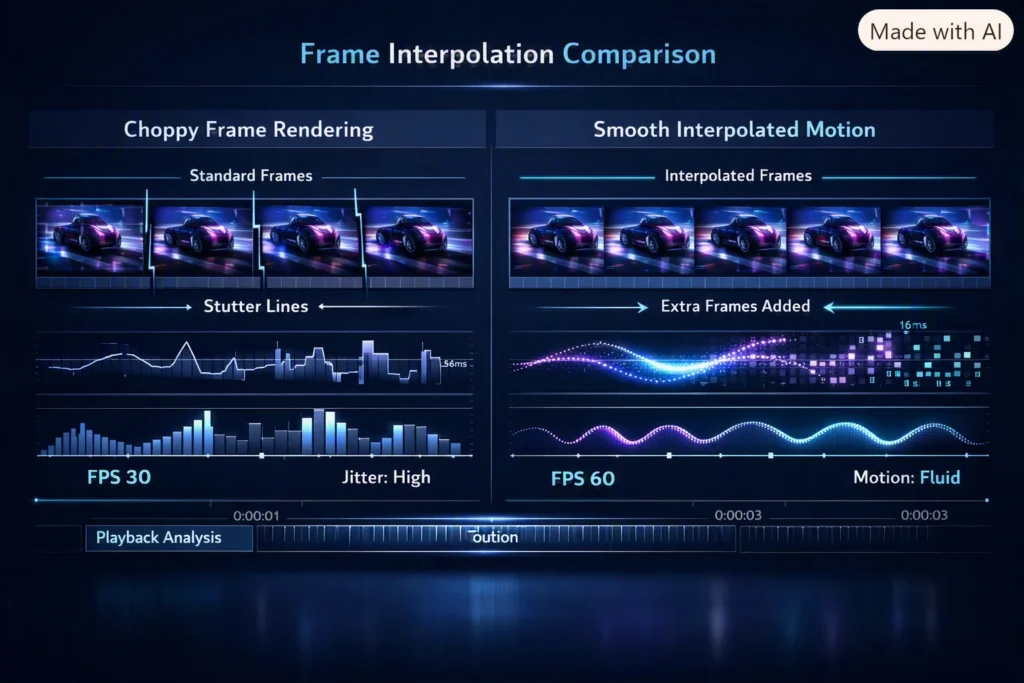
- The Mechanics of Interpolation: Traditional video content often runs at 24 frames per second (fps) for movies or 30 fps for standard broadcasts. When cameras pan quickly across a scene, this low frame rate can cause stutter or motion blur. IFC works by analyzing two consecutive image frames, computing the trajectory of moving objects, and generating a synthetic intermediate frame to bridge the gap.
- The “Soap Opera Effect” Dilemma: While IFC dramatically improves motion clarity for fast-moving sports events or documentaries, applying it to cinematic films often strips away natural motion blur, making high-end movies look like everyday soap operas. This sparked a long-standing debate among home theater enthusiasts regarding accuracy versus smoothness.
The Creative Shift: AI Frame Interpolation & Video Generation
As generative video models and neural networks have matured, the concept of intelligent frame creation has shifted from physical display hardware into digital post-production and AI video generation tools.
- The Mechanics of Optical Flow & Neural Networks: Modern AI interpolation tools rely on advanced optical flow analysis and deep learning models (such as RIFE or specialized video diffusion architectures) to examine two source frames. Instead of simply cross-fading or blending pixels, the algorithm tracks the motion vector of individual objects, predicting how pixels should shift across time to synthesize entirely new, plausible intermediate frames.
- Solving AI Video Jitters: Early text-to-video and image-to-video generators frequently output clips at lower frame rates (such as 12 fps or 24 fps) that can look jerky or inconsistent. Content creators apply AI video frame interpolation as a crucial post-processing step to upscale these clips to fluid 60 fps or higher, drastically improving visual quality without sacrificing temporal consistency.
The Gaming Revolution: Real-Time Frame Synthesis
Beyond home theater displays and creative suites, intelligent frame creation has found its most computationally demanding home in modern PC and console gaming through real-time frame synthesis.
- AI-Driven Hardware Acceleration: Technologies like NVIDIA’s DLSS Frame Generation and AMD’s Fluid Motion Frames use dedicated tensor cores and AI accelerators built directly into modern graphics cards. These systems analyze game engine data—including motion vectors, geometry, and optical flow—to invent brand-new, intermediate frames right between natively rendered ones.
- Balancing Fluidity and Latency: While real-time frame generation can double or triple apparent frame rates (FPS) for smoother gameplay, it introduces unique engineering challenges. Because generating synthetic frames takes a fraction of a millisecond, developers pair these systems with latency-reduction technologies (like NVIDIA Reflex) to ensure that controller inputs remain snappy and responsive.
Summary Table: Intelligent Frame Creation Across Industries
| Industry / Niche | Core Technology & Mechanisms | Primary Benefit | Key Trade-Off |
| Home Theater Displays | Panasonic IFC, MEMC, and TV motion smoothing algorithms | Reduces judder and sharpens fast-moving sports or action sequences | Can trigger the “soap opera effect” on cinematic 24fps movies |
| AI Video Production | Neural frame interpolation and optical flow estimation | Smooths low-framerate AI clips and upscales temporal consistency | Requires heavier render times and processing power |
| PC & Console Gaming | DLSS, AFMF, and real-time hardware frame synthesis | Boosts apparent frame rates (FPS) for high-speed gameplay | Introduces potential input latency if unmanaged |
Final Verdict: Why Intelligent Frame Creation Shapes the Future of All Screens
What began as a localized feature inside high-end home theater displays has transformed into a universal pillar of digital visual engineering. Whether you are adjusting television motion settings, rendering frame-by-frame animations using artificial intelligence, or boosting your gaming framerate through hardware acceleration, intelligent frame creation bridges the gap between static content and human visual perception.
As processors become faster and neural networks more predictive, the boundaries between native capture and intelligent synthesis will continue to blur. Mastering how these tools work across displays, creative suites, and gaming rigs ensures you can extract maximum performance, clarity, and immersion from every screen you use.