

Traditional search engine optimization relied on straightforward mechanics. A user typed a discrete keyword into a search engine, and the platform returned an indexed list of ten organic links. Measuring organic visibility was purely a function of tracking rank position for a specific URL against a fixed query.
Generative Answer Engines—such as OpenAI’s ChatGPT, Google Gemini, Anthropic Claude, and Perplexity—have completely upended that measurement framework. These systems do not retrieve pre-indexed webpage lists; they dynamically generate natural language synthesized answers in real time.
This fundamental shift makes traditional rank tracking obsolete. Because generative models output unstructured paragraphs rather than clean, tabular database rows, brands struggle to extract meaningful analytics without a robust data cleaning layer.
The New Search Landscape: Probabilistic Brand Mentions
In traditional search engines, a website either ranked on page one or it did not. In generative search, brand presence is inherently probabilistic. An Answer Engine might recommend your brand first for a specific prompt, omit it entirely when the prompt is rephrased slightly, or merge your product features with a key competitor’s offerings.
Furthermore, AI models evaluate brand entities based on contextual associations rather than simple keyword matches. When a user asks an Answer Engine for recommendations, the model weighs complex relational signals across its training corpus and real-time search retrievals.
This creates several distinct observation challenges for enterprise marketers:
- Inconsistent Entity Naming: An AI output might refer to a company by its full corporate name, an abbreviated ticker, a common domain name, or a legacy product brand.
- Implicit vs. Explicit Mentions: A model may discuss your flagship product without explicitly naming the parent company, obscuring parent-level brand equity.
- Position Fluidity: Instead of an explicit rank number (e.g., Position #2), a brand might appear as the second bullet point in a bulleted list, a passing suggestion in the third paragraph, or a cited link in the footnotes.
Without a structured method to evaluate these probabilistic mentions, executive reporting becomes guesswork. Marketing teams end up tracking surface-level impressions rather than verifiable market share across generative engines.
The Data Variance Problem in Generative Outputs
The primary technical obstacle when auditing Generative Engine Optimization (GEO) is model variance. Because large language models rely on temperature settings and probabilistic sampling, running the exact same prompt five times can yield five subtly different textual outputs.
If an analytics pipeline ingests raw text directly into a database without standardization, the resulting metrics will be fundamentally distorted:
| Raw Output Variant | Analytical Error Without Normalization | Corrected Data State |
| “Acme Corp”, “Acme, Inc.”, “Acme.com” | Counted as three separate, competing entities. | Consolidated under one canonical brand record. |
| “Acme Cloud Suite” vs. “Acme CRM” | Mixed product-level features with parent company brand equity. | Attribute product performance to parent entity parentage. |
| Uncleaned citation URLs containing tracking parameters | Creates duplicate source records for the same reference site. | Stripped tracking codes to isolate true root domain authority. |
This variance creates severe reporting noise. A brand might assume its AI visibility dropped by 20% week-over-week, when in reality the Answer Engine simply shifted from using the company’s full legal name to its shorter brand alias. Isolating real competitive shifts requires removing synthetic variance at the ingestion level.
Defining Normalization Transformation Rules
This is where BrandRank.ai normalization transformation rules come into play.
At its core, normalization is the process of taking messy, inconsistent, and unstructured text from AI-generated answers and converting it into clean, standardized, and structured database fields. Transformation is the subsequent layer that applies algorithmic logic to convert those cleaned text snippets into quantifiable metrics—such as sentiment scores, recommendation strength rankings, and intent categories.
Key Takeaway: Normalization resolves identity and structure (making sure ‘Acme’ equals ‘Acme Corp’), while Transformation resolves meaning and value (converting a multi-sentence review into a numerical recommendation index).
By enforcing strict transformation rules prior to running executive analytics, organizations can:
- Eliminate Double-Counting: Prevent the system from counting a brand and its sub-products as two competing marketplace options.
- Standardize Citations: Map footnoted web URLs back to primary domain sources to identify which publisher relationships actually move the needle in AI search.
- Quantify Qualitative Text: Convert complex natural language paragraphs into reliable, time-series numerical data that can be tracked alongside traditional KPIs.
Establishing these rules serves as the prerequisite foundation for any enterprise serious about measuring, protecting, and optimizing its presence across modern AI Answer Engines.
Decoding BrandRank.ai Normalization Transformation Rules
To build an enterprise-grade AI analytics pipeline, organizations must move beyond treating Generative Answer Engines like black boxes. Raw text responses from large language models are messy, highly variable, and inherently unstructured.
Decoding how BrandRank.ai normalization transformation rules function reveals how raw, non-deterministic AI text gets systematically converted into clean, actionable, and repeatable enterprise metrics.
Data Ingestion & Extraction Across Answer Engines
The transformation process begins at the ingestion layer. Every day, millions of user prompts are processed across competing models like ChatGPT, Google Gemini, Anthropic Claude, and Perplexity. Because each platform returns text structured in its own unique formatting style, the ingestion pipeline must parse varied outputs through a standardized extraction process.
This ingestion engine extracts four critical primary data elements from every raw response:
- The Primary Response Body: The main conversational text output generated by the AI.
- Citations & Footnotes: Hyperlinks, domain references, and web sources cited as supporting evidence.
- Positional Hierarchy: The physical order in which brands or products are listed (e.g., bulleted lists vs. prose summaries).
- Metadata: Model identifier, temperature settings, prompt intent category, and timestamp.
Without this initial extraction, downstream analytics would attempt to evaluate unstructured paragraphs using broad, imprecise regular expressions. Isolating these components allows the engine to evaluate what was said independently from where the model retrieved the supporting data.
The Core Transformation Logic: Converting Unstructured Text to Metrics
Once raw components are isolated, the system applies transformation rules. Transformation is the specific programmatic logic that converts qualitative natural language into quantitative values.
For example, when an AI model states: “While Acme Corp offers strong enterprise security features, their platform suffers from steep pricing and a clunky interface,” a basic keyword tool might simply register a brand match. The transformation pipeline goes further by converting this string into specific categorical attributes:
- Sentiment Score: Transformed into a normalized scale (e.g., -0.30 Net Sentiment) by evaluating positive security claims against negative cost and usability complaints.
- Recommendation Strength: Rated as Conditional / Low Preference because the model included explicit purchasing caveats alongside its feature summary.
- Claim Extraction: Categorized into discrete strategic topics (Security = Positive; Pricing = Negative; UX = Negative).
By applying this transformation logic consistently across thousands of daily prompt runs, enterprise teams can track subtle shifts in AI perception over time rather than relying on one-off manual audits.
Entity Resolution: Mapping Brand Aliases & Variant Names
The final critical component of decoding these rules is Entity Resolution. Large language models frequently refer to organizations using colloquial nicknames, product names, or shorthand aliases.
For example, an Answer Engine might refer to the same organization as:
- Acme Corporation
- Acme Systems, Inc.
- Acme Cloud
- @AcmeCorp
If an analytics database treats these variations as four separate companies, brand visibility scores become severely diluted
Through normalization, all variant terms, subsidiary brands, and domain variations are mapped back to a single Canonical Entity Record. This ensures that when executives review their AI share of voice against key industry competitors, every mention across every sub-product is accurately attributed to the parent brand.

Key Components of the Normalization Pipeline
A complete normalization pipeline relies on distinct rule sets, each designed to process a specific layer of an AI-generated answer. Together, these rules ensure that messy text is reliably transformed into structured metrics.
Brand Mention & Citation Detection Rules
Before evaluating what an AI model says about your company, the pipeline must verify that your brand was actually mentioned and identify where the model pulled its information.
- Direct vs. Indirect Mention Rules: Differentiates between explicit name drops (e.g., “Company X”) and indirect product references (e.g., “their cloud platform”).
- Citation Domain Extraction: Strips tracking parameters, affiliate tags, and sub-paths from footnoted links to track the root domains AI models trust most.
Contextual Sentiment & Claim Extraction Rules
Standard sentiment analysis tools often fail when evaluating complex business topics because they treat words like “aggressive” or “disruptive” as purely negative.
- Industry-Aware Sentiment: Evaluates tone based on business intent (e.g., “aggressive pricing” might be a positive feature for buyers).
- Feature-Level Claim Tagging: Automatically categorizes text into specific themes like Pricing, Security, Customer Support, and Integration Ease.
Position Weighting & Recommendation Strength Scoring
Where a brand appears in an AI response heavily influences user behavior. Appearing first in a list carries far more weight than being mentioned as a footnote.
- List Position Indexing: Assigns higher visibility values to top-ranked bullet points in generated lists.
- Recommendation Intent Classification: Distinguishes between strong endorsements (“We highly recommend…”), neutral mentions (“Other options include…”), and warnings (“Users should be cautious of…”).
Model Bias & Source Classification Adjustments
Different AI Answer Engines rely on different underlying training sets and real-time search providers.
- Source Authority Weighting: Adjusts scores based on whether an Answer Engine retrieved data from official documentation, authoritative news outlets, or unverified community forums.
- Cross-Model Balancing: Normalizes raw output scores across ChatGPT, Gemini, Perplexity, and Claude so performance can be compared fairly on a single dashboard.
Why Enterprise Brands Need Normalized AI Data
As Generative Answer Engines rapidly replace traditional search engines for product research and vendor discovery, enterprise organizations face a critical blind spot. Relying on uncleaned AI mentions leads to skewed executive reports, misplaced marketing budgets, and misinformed strategic decisions.
Implementing normalized AI data provides the structural clarity required to measure, manage, and scale brand presence across generative platforms.
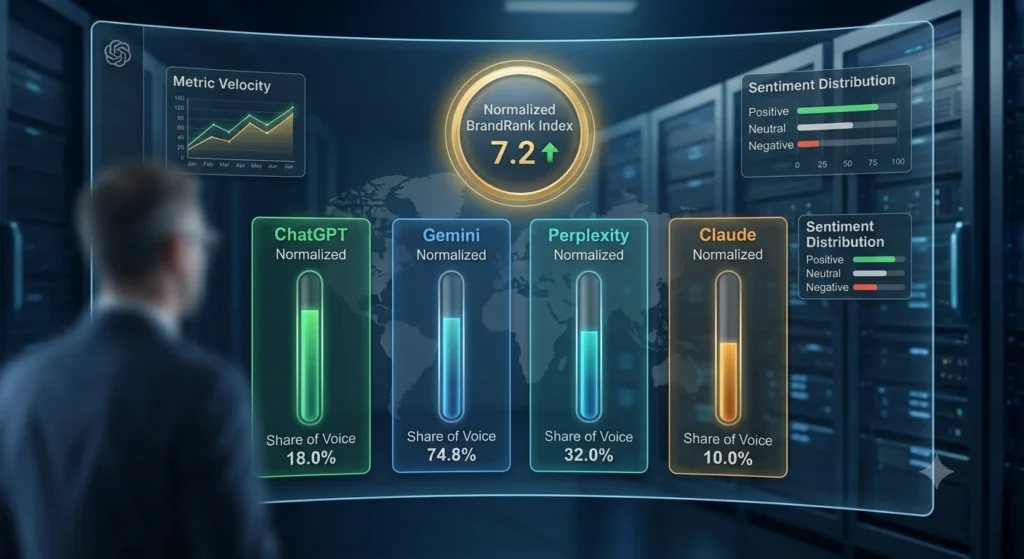
Cross-Model Benchmarks (ChatGPT, Gemini, Claude, Perplexity)
Each major Answer Engine operates on distinct architectural foundations, training data, and real-time retrieval mechanisms. OpenAI’s ChatGPT may prioritize different web sources compared to Google Gemini or Perplexity, leading to contrasting representations of the exact same brand.
Comparing raw outputs across these diverse platforms is like comparing apples to oranges. Normalized transformation rules resolve this by mapping distinct output formats into unified visibility indices.
This enables marketing leaders to:
- Evaluate cross-platform share of voice using a single standardized metric.
- Identify specific platforms where brand representation is lagging behind competitors.
- Allocate optimization resources efficiently based on platform-specific performance gaps.
Isolating Genuine Brand Shifts from LLM Model Drift
Large language models undergo frequent updates, fine-tuning passes, and system prompt adjustments. These backend changes often cause “model drift”—sudden shifts in response formatting, tone, or depth that have nothing to do with real-world changes in consumer sentiment or brand authority.
Without a normalization layer, an executive might mistake a routine model update for a sudden decline in market reputation. Normalized data pipelines filter out technical noise and response formatting shifts.
By stripping away synthetic variance, analytics teams can distinguish between artificial model drift and genuine shifts in brand perception, ensuring strategy shifts respond to real market dynamics rather than algorithm updates.
Powering Actionable Generative Engine Optimization (GEO)
Traditional SEO strategies revolve around keyword density, backlink counts, and technical site performance. Generative Engine Optimization (GEO), by contrast, relies on managing entity associations, topical coverage, and citation authority across the broader web.
Raw AI answers tell you what a model outputted, but normalized metrics reveal why it did so. By breaking down AI outputs into structured categories—such as sentiment triggers, citation sources, and product feature coverage—normalized data highlights precise optimization targets.
For instance, if normalized data reveals that your brand consistently scores low on “pricing transparency” across three major models, your marketing team gains a clear, actionable directive: update canonical documentation, publish targeted FAQ schema, and improve third-party review coverage around enterprise pricing models.
Step-by-Step Guide to Applying Transformation Rules
Implementing normalization transformation rules inside your organization requires a structured approach. Rather than attempting to process all brand data at once, build your pipeline systematically to ensure high data fidelity and actionable reporting.
Step 1: Create a Canonical Brand Record & Alias List
Begin by defining your master brand record. List every official company name, subsidiary, product line, trademark, and known abbreviation.
Include common misspellings, legacy brand names, and executive handles. Mapping these variants to a single primary identifier prevents data fragmentation and ensures full credit for all brand mentions across every Answer Engine.
Step 2: Establish Intent-Based Prompt Clusters
AI visibility varies dramatically depending on user intent. Group your evaluation prompts into clear, distinct functional categories:
- Informational Queries: Broad industry research and educational topics (e.g., “How does enterprise AI governance work?”).
- Commercial Investigation: Comparative product evaluations (e.g., “Top AI brand monitoring tools for enterprise”).
- Transactional / Navigational: Direct brand inquiries and specific product feature checks.
Categorizing prompts allows your transformation pipeline to apply appropriate sentiment and recommendation weights based on buyer intent.
Step 3: Audit Official & Third-Party Citation Sources
Generative Answer Engines rely heavily on third-party web sources to ground their responses. Use citation normalization rules to strip tracking parameters, clean URLs, and group reference links by root domain authority.
Identify which review platforms, industry blogs, and news outlets are cited most frequently when models discuss your brand and your key competitors.
Step 4: Monitor Normalized Metric Velocity Over Time
Avoid overreacting to individual prompt runs. Instead, focus on metric velocity—the direction and speed of change in your normalized visibility, sentiment, and recommendation scores over weeks and months.
Tracking normalized velocity reveals real trends, helping you measure the true ROI of your Generative Engine Optimization (GEO) campaigns.

Final Verdict: Moving from Reactive Tracking to Proactive GEO Strategy
Generative search has fundamentally altered how customers discover, evaluate, and choose enterprise products. Relying on raw, uncleaned AI outputs leaves your organization vulnerable to misreading market signals and fragmented reporting.
BrandRank.ai normalization transformation rules bridge the gap between probabilistic AI responses and structured executive intelligence. By standardizing entities, stripping synthetic model variance, and quantifying qualitative text, enterprise leaders gain the clarity needed to protect brand equity and command market share across modern AI Answer Engines.