“Self-charging” is one of the most quietly misleading phrases in the entire automotive industry — not because it’s a lie, exactly, but because it lets people fill in the blank with something closer to a perpetual motion machine than what’s actually happening under the hood. The honest answer requires separating three different things that get conflated constantly: what “self-charging” actually means in current marketing, what regenerative braking can and can’t do, and what genuinely experimental technology might change down the road.
The Short Answer
No fully electric car can charge itself from nothing — this would violate basic conservation of energy, since a car’s electric motor can’t generate more energy than it consumes moving the vehicle forward. What gets marketed as “self-charging” almost always refers to a standard hybrid (HEV), which never needs plugging in because it recovers energy through regenerative braking and tops up the rest from its gasoline engine — not because it’s generating free electricity. Regenerative braking alone, even on a pure EV, typically recovers somewhere between 16% and 70% of braking energy depending on conditions, extending range meaningfully in stop-and-go city driving but nowhere near enough to replace plugging in.
What “Self-Charging” Actually Means in Marketing
This term, widely used in UK car marketing especially, refers specifically to standard hybrid electric vehicles (HEVs) — not fully electric cars, and not a magical charging technology. The name exists because these vehicles combine a gas engine and electric motor in a way that eliminates the need for an external plug: the smaller hybrid battery recharges itself through regenerative braking and the engine’s own operation while you drive. It’s an accurate description of “you’ll never plug this in,” but it’s a genuinely different claim from “this car generates unlimited free energy” — and the ambiguity between those two ideas is exactly where most of the public confusion on this topic comes from. This overlaps directly with the broader question of whether hybrids need charging at all — the “self-charging” label is really just marketing shorthand for the standard hybrid category covered there.
Why a Pure Electric Car Genuinely Can’t Self-Charge
The electric motor that moves an EV forward consumes energy — it doesn’t produce a surplus that could loop back and recharge the battery it’s drawing from. This isn’t a current technological limitation waiting on a better battery or a smarter engineer; it’s a basic law of physics; a system can’t generate more usable energy than it takes in without an external source, and a car’s own motor moving its own wheels has no external source to draw from. Any EV claiming genuine self-sufficient charging with no external energy input at all is describing something that doesn’t currently exist and can’t exist under conventional physics as we understand it today.
Regenerative Braking: Real, But Limited
This is the genuine technology behind most legitimate “self-charging” claims, and it’s worth understanding precisely rather than dismissing or oversimplifying.
How It Actually Works
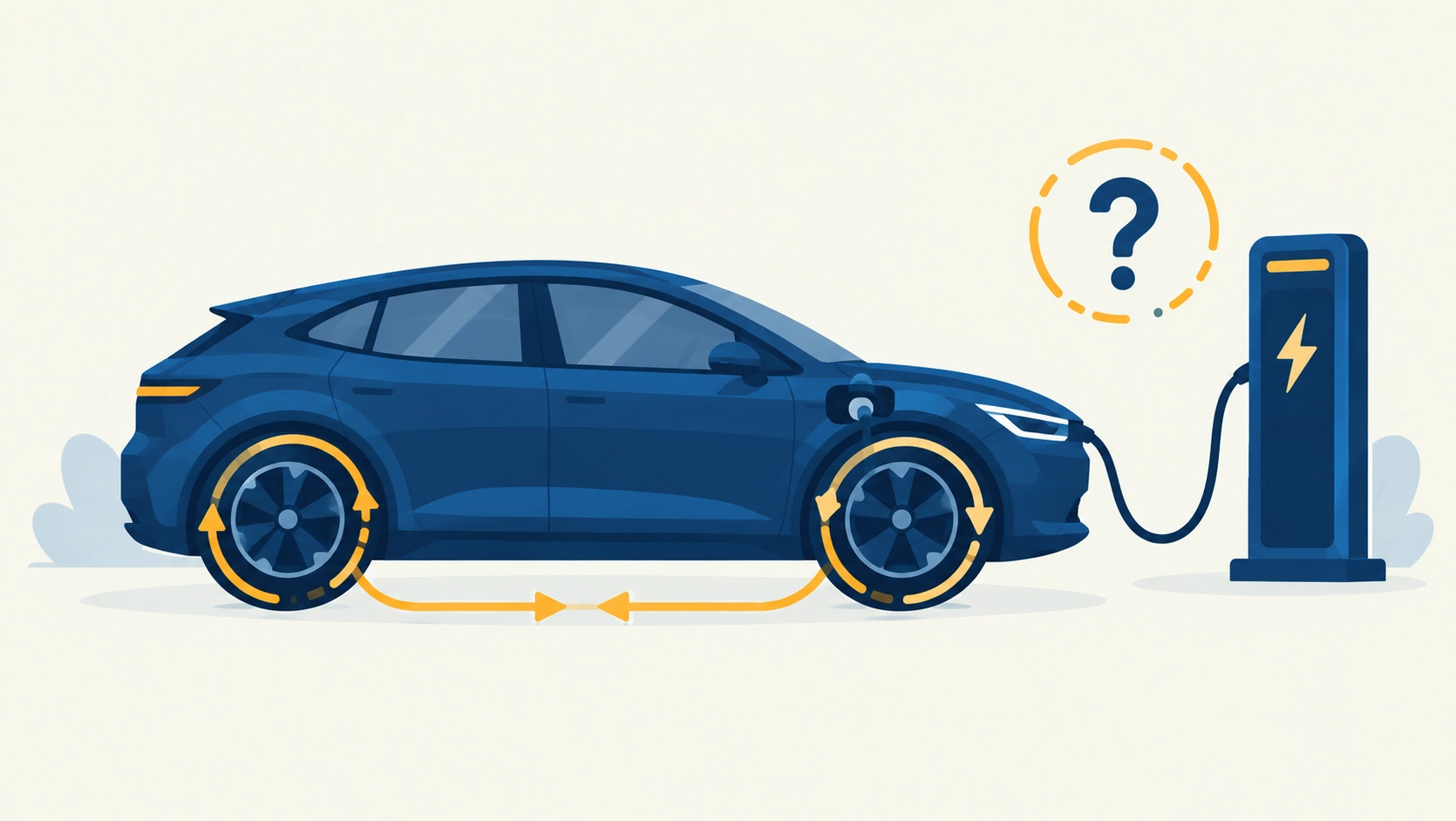
When you lift off the accelerator or press the brake, the electric motor flips roles — instead of consuming energy to spin the wheels, it becomes a generator, using the car’s own momentum to spin itself and produce electricity, which flows back into the battery. Energy that would otherwise be lost entirely as heat through conventional friction brakes gets partially recaptured instead.
The Real Numbers
Independent estimates place regenerative braking’s energy recovery efficiency in a fairly wide range — commonly cited between 16% and 70% of braking energy, depending heavily on speed, deceleration force, temperature, and the specific vehicle’s system. In stop-and-go city driving with frequent braking, this can meaningfully extend range — some estimates suggest up to 20-30% in heavy urban conditions. On a highway, where braking is infrequent and speeds are consistent, the benefit shrinks considerably, since there’s simply less deceleration happening to capture energy from in the first place.
Why It Will Never Replace Plugging In
Even at its most efficient, regenerative braking only recaptures a portion of energy the car itself already spent moving forward — it cannot create new energy, only reduce waste from energy already consumed. This is precisely why every source treating this topic honestly agrees on the same conclusion: regenerative braking is a genuine efficiency gain, not a charging solution, for a fully electric vehicle.
What Actually Might Change This in the Future
A handful of genuinely experimental technologies are worth knowing about, even though none are mainstream today.
Wireless and Inductive Charging
Rather than a physical plug, this approach transfers energy through electromagnetic fields between a ground-mounted pad and a receiver built into the vehicle. Pilot programs in cities including Oslo and Singapore have tested this for both stationary and, more ambitiously, in-motion charging on compatible road surfaces — early results suggest a vehicle could gain roughly 10-20 miles of range per hour of wireless charging, promising for short daily commutes and fleet vehicles, though the infrastructure required to scale this remains a genuinely open problem.
Solar-Integrated Vehicles
Companies including Germany’s Sono Motors have explored solar panels integrated directly into a vehicle’s body panels, harvesting ambient sunlight to supplement charging. This remains a supplementary technology at best — a car’s surface area simply isn’t large enough to capture meaningful charging power from sunlight alone under most real-world conditions.
Autonomous Charging Robots
Volkswagen proposed mobile charging robots for parking structures, summonable via app to autonomously locate and charge a parked vehicle without the driver needing to physically plug anything in. This remains at the prototype and pilot stage rather than deployed technology, and it doesn’t eliminate the need for external charging — it just automates the physical act of connecting to it.
What This Means If You’re Actually Car Shopping
If a vehicle is marketed as “self-charging,” verify immediately whether it’s a standard hybrid or a fully electric car — these are the same three words describing genuinely different vehicles with different real-world implications for your driving habits. If it’s a hybrid, the term is accurate: you’ll never plug it in. If a fully electric vehicle is marketed with self-charging language implying it doesn’t need external power at all, that claim deserves real scrutiny, since it isn’t physically accurate for any production EV currently on the market.
Frequently Asked Questions
Can a Tesla or other EV charge itself while driving?
No — regenerative braking recaptures a portion of energy the car already used moving forward, extending range modestly, but it cannot fully recharge or sustain a pure EV’s battery without external charging.
What does “self-charging hybrid” actually mean if it’s not a real EV?
It refers to a standard hybrid (HEV) that never needs an external plug because it recharges its own battery through regenerative braking and its gasoline engine — a real, accurate description for that vehicle type, distinct from a plug-in hybrid or fully electric car.
How much range can regenerative braking actually add?
Estimates vary by driving conditions, but frequent city braking can extend range by roughly 20-30% in some cases, while highway driving sees a much smaller benefit due to less frequent braking.
Is wireless EV charging available to the public yet?
Only in limited pilot programs in select cities as of this writing — it isn’t widely available consumer technology yet, though it’s an active area of development for both stationary and in-motion charging.
Will self-charging pure EVs ever actually exist?
Not under current physics as understood today — a car’s own motor can’t generate more energy than it consumes to move the vehicle. Future improvements are more likely to come from better regenerative efficiency, wireless charging infrastructure, or solar assistance, not a genuine break from conservation of energy.
The phrase “self-charging” isn’t wrong so much as it’s doing double duty for two very different claims — and knowing which one applies to the car actually in front of you is the difference between a reasonable expectation and one physics was never going to let you keep.