

The internet is overflowing with trillions of digital images.
A single graphic or photo can be shared, edited, and reposted across thousands of websites within hours.
For creators, marketers, and researchers, figuring out where an image originally came from can feel like hunting for a needle in a digital haystack.
When traditional text queries fail, knowing how to find an image source becomes an essential skill.
People frequently wonder what is a reverse image search and how do i search pictures when standard keyword searches come up empty.
Instead of typing descriptions, users execute a reverse image search to upload a file, paste a link, or run a pic to pic search.
Among visual discovery tools, tineye reverse image search stands out as an industry staple for precise digital tracking and historical verification.
What Is TinEye and How Does It Work?

Launched back in 2008, tineye image reverse technology fundamentally changed how internet users search a photograph.
Unlike multi-purpose visual discovery engines that guess what an object is, TinEye acts as a dedicated image finder and image identifier engineered explicitly to track exact-match files.
When you run a tineye reverse image search, the platform relies on complex image recognition technology rather than simple surrounding text keywords.
It indexes billions of individual web pages to serve as a reliable photo identifier, allowing you to execute a backwards image search to trace an asset’s digital footprint.
Core Tracking Advantages
- Chronological Provenance: TinEye highlights the earliest known appearance of a file online, making it uniquely powerful for copyright tracking.
- Modification Detection: The algorithm recognizes cropped, resized, recolored, or flipped copies.
- Side-by-Side Comparison: Users can toggle directly between their query file and indexed matches to spot subtle digital edits.
Why Finding the Origin of a Picture Matters
In the modern digital ecosystem, visual content moves at lightning speed. A single graphic or photo can be shared, edited, and reposted across thousands of websites within hours.
For creators, marketers, and researchers, figuring out where an image originally came from can feel like hunting for a needle in a digital haystack.
When traditional text queries fail, knowing how to find an image source becomes an essential skill.
People frequently wonder what is a reverse image search and how do i search pictures when standard keyword searches come up empty.
Instead of typing descriptions, users execute a reverse image search to upload a file, paste a link, or run a pic to pic search.
Among visual discovery tools, tineye reverse image search stands out as an industry staple for precise digital tracking and historical verification.
Step-by-Step: How to Reverse Image Search Using TinEye
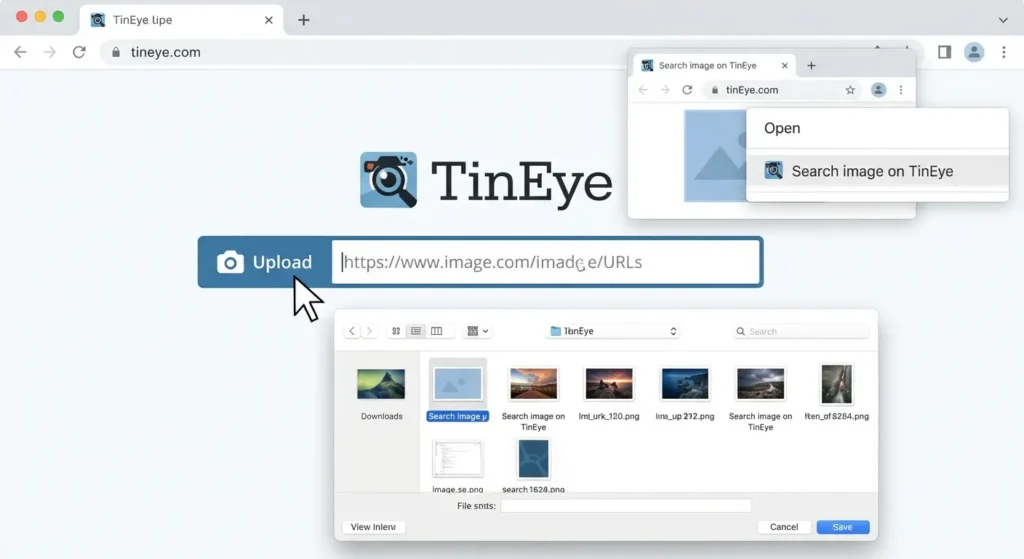
Learning how to reverse image search on this platform is fast, straightforward, and requires no paid account for standard web lookups.
If you are wondering how do you do a reverse photo search, the interface offers several simple pathways depending on how your file is saved.
You can execute a lookup using any of these methods:
- Direct File Upload: Upload a saved photo or graphic straight from your desktop or mobile storage device.
- Search by Image URL: Copy an image address from any webpage and paste the link directly into the TinEye search bar.
- Drag-and-Drop: Grab any graphic from your computer folder and drag it right onto the browser window.
- Browser Extensions: Install the official tineye browser extension for Chrome, Firefox, Edge, or Opera to look up with a picture instantly via a quick right-click menu command.
Once submitted, the engine processes the asset to help you search by the image or figure out how to search an image across billions of indexed web pages.
Utilizing the TinEye Browser Extension for Instant Lookups
If you frequently find yourself needing to backwards image search while browsing, visiting the homepage every time slows you down.
Installing the official TinEye browser extension solves this friction.
By simply right-clicking any image on any webpage, you can trigger a lookup instantly from your context menu, letting you run a rapid reverse photo lookup on the fly without breaking your browsing rhythm.
Head-to-Head: TinEye vs. Google Image Search & Yandex
While TinEye is a powerhouse for tracking exact duplicates and historical file lineage, understanding how it stacks up against alternative tools helps you choose the right engine when you want to search by the image.
Different platforms serve distinct visual discovery workflows.
| Feature / Objective | TinEye Reverse Image Search | Google Reverse Image Search (Google Lens) | Yandex Image Search |
| Primary Strength | Exact match tracking, edited copies, and earliest upload dates. | Broad visual discovery, products, landmarks, and general web context. | High accuracy for facial recognition and matching people. |
| Index Focus | Billions of exact web-indexed images. | Mass scale web crawling and visual similarity matching. | Strong coverage across Eastern European and alternative forums. |
| Best Used For | Copyright verification, finding high-res files, and tracing origin. | Identifying everyday objects, shopping items, and similar concepts. | Locating alternative photos of specific individuals. |
Using a combination of google image search, google reverse image search, and yandex image search alongside your TinEye workflow ensures complete coverage when you need to find image results across diverse web ecosystems.
While platform-specific tools are powerful, mastering this workflow is just one component of a broader strategy. To explore more methodologies, check out our comprehensive guide on Top Image Search Techniques in 2026 to expand your digital asset discovery toolkit.
Best Alternatives for Free Reverse Image Search
Finding a single visual search engine is rarely enough when you are tracking down elusive files.
Different platforms index entirely different corners of the web.
If TinEye comes up empty or you need a reliable photo identifier to double-check your findings, building out a diverse toolkit is essential.
Expanding Your Search with Alternative Visual Identifiers
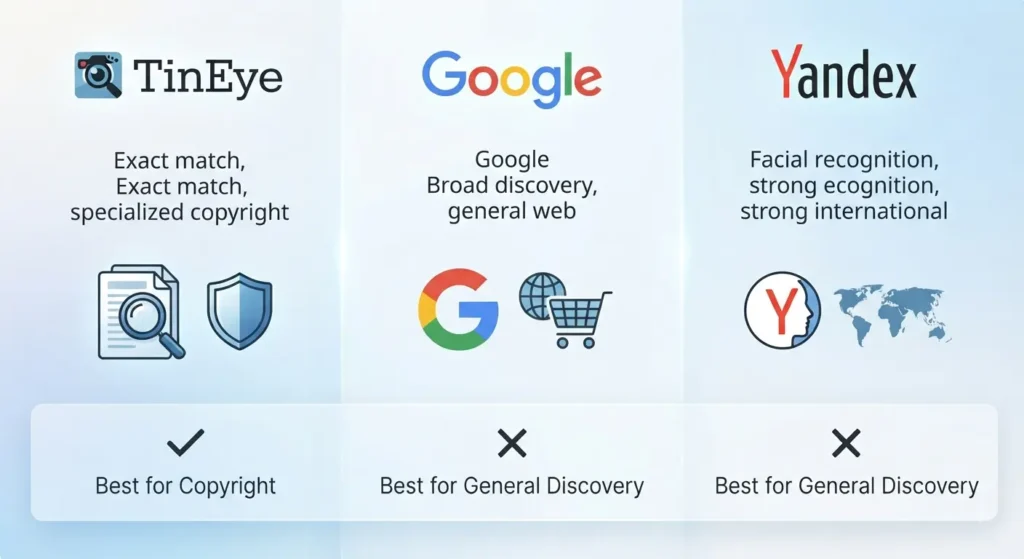
When you need a backup option for a thorough backwards image search, several platforms offer robust scanning capabilities without expensive software subscriptions:
- Google Lens: The powerhouse for broad web discovery, perfect for everyday objects, products, and general context.
- Yandex Images: The go-in-to choice for international web domains, forum boards, and deep visual matching.
- Lenso.ai: A modern AI-driven platform that automatically categorizes results into distinct buckets like people, places, and duplicates.
Choosing the Right Tool for the Job
| Search Engine | Primary Strength | Best Use Case |
| TinEye | Exact pixel tracking & chronological history | Copyright checks & finding original upload dates |
| Google Lens | Massive web scale & object recognition | Identifying consumer products, landmarks, and general web photos |
| Yandex | Deep facial & regional indexing | Finding heavily edited crops or Eastern European media sources |
Combining these platforms ensures that whether you are using an automated image identifier for creative assets or running quick ad-hoc queries, your digital research workflow remains airtight.
Pro Image Search Techniques for Maximum Match Accuracy
Getting the most out of your free reverse image search sessions requires more than just dropping a file into the search bar.
Applying smart image search techniques can drastically improve your match rate when an initial lookup yields fewer results than expected.
Here are the most effective ways to optimize your search:
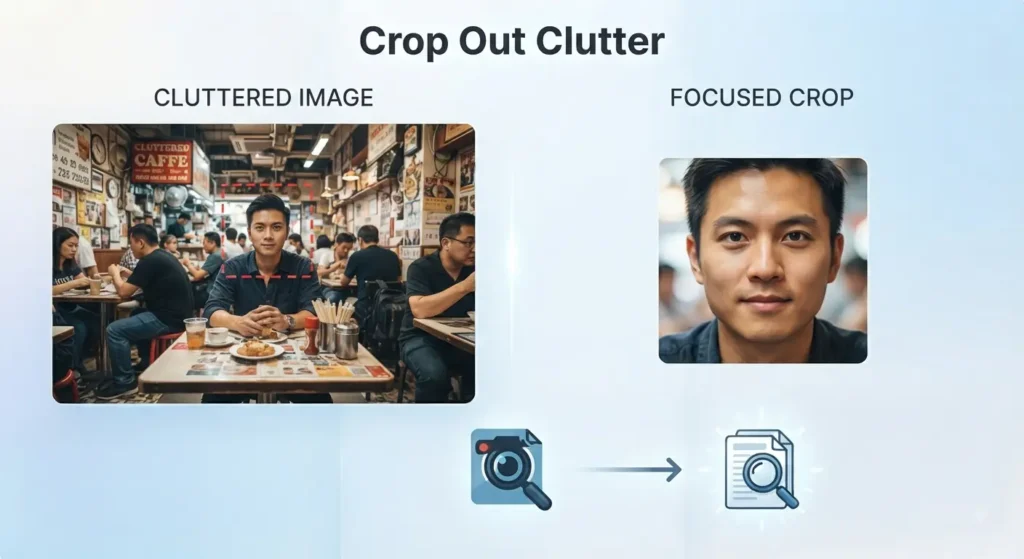
- Crop Out Clutter: If a graphic contains heavy text overlays, distracting borders, or busy background elements, crop them out before running your picture search so the algorithm can focus on the core subject.
- Prioritize High-Resolution Files: Always feed the clearest, sharpest version of a graphic into the engine to secure the most accurate reverse photo lookup results.
- Utilize Sorting Filters: Once your results load, sort them by “Oldest” to trace the root source and original publisher, or by “Biggest Image” to locate clean, high-resolution copies for your own content projects.
Frequently Asked Questions (FAQ)
Every researcher or creator evaluating visual discovery tools eventually runs into practical questions about how these systems function behind the scenes.
Getting straight answers helps prevent wasted time during deep digital investigations.
What is a reverse image search and how does TinEye work?
A reverse image search is a query method where you input a picture instead of text to find where it appears online.
TinEye works by creating a unique digital signature—or hash—of your uploaded visual and comparing it against its massive database of indexed web files.
How do I search pictures using the TinEye browser extension?
Once you install the official extension for your preferred browser, you can right-click any graphic while browsing the web.
This lets you select the option to search it instantly without having to save or download the file first.
Is TinEye a free reverse image search tool?
Yes, standard web-based searches on TinEye are completely free and require no account registration.
This makes it easily accessible for casual users, journalists, and digital researchers alike.
Can TinEye find visually similar images like Google Lens?
No. TinEye is specifically optimized for finding exact matches, edited copies, and modified variations of the same image rather than generating broad, visually similar suggestions.
For general object or landmark discovery, pairing it with a google reverse image search is recommended.