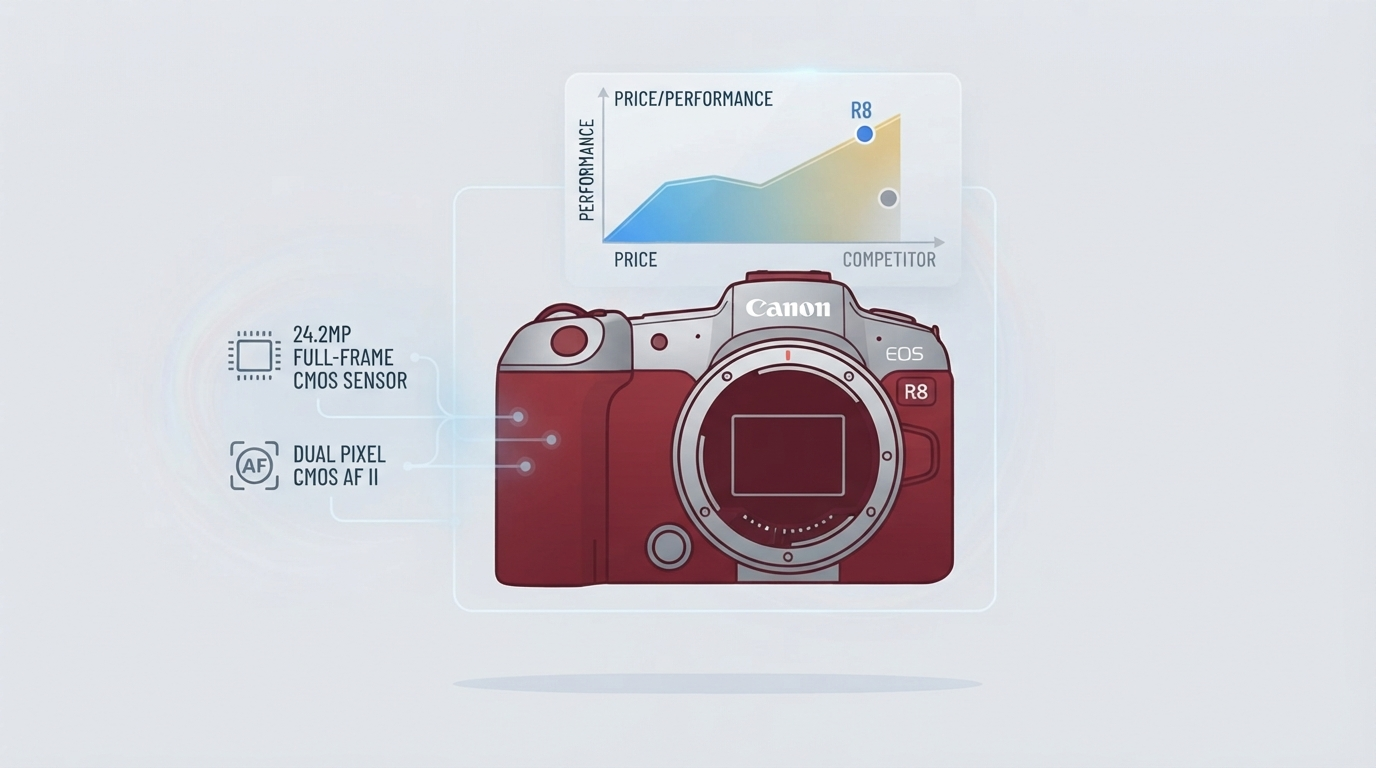
The Canon EOS R8 sits in a genuinely unusual spot in Canon’s lineup: it borrows the sensor and autofocus system from a camera costing $800 more, then strips out enough elsewhere to hit a price that undercuts almost everything else in full-frame mirrorless. That’s not a subtle marketing trick — it’s a real, deliberate set of trade-offs, and whether they matter to you depends entirely on what you actually shoot.
Here’s what Canon kept, what it cut, and — the part most reviews of this camera skip — how it actually compares once you look outside Canon’s own lineup.
Quick Summary
The Canon EOS R8 is a full-frame mirrorless camera built for travel photographers, hybrid content creators, and DSLR upgraders who want flagship-level image quality and autofocus without flagship pricing. It shares its 24.2MP full-frame sensor and Dual Pixel CMOS AF II autofocus system with the considerably more expensive EOS R6 Mark II, and adds uncropped 4K 60p video, 40fps burst shooting, and a lightweight 461g body. What it lacks: in-body image stabilization, a second memory card slot, an AF joystick, and meaningful weather sealing — all genuine cuts made specifically to hit its price point, not oversights.
What Canon Kept From a Much Pricier Camera
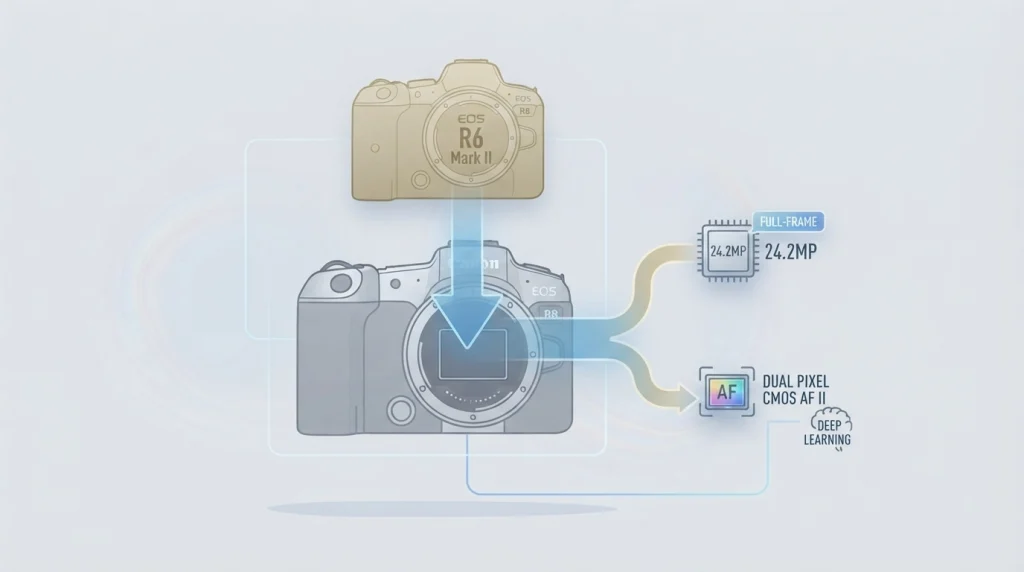
The headline reason the R8 gets attention is straightforward: its sensor and autofocus system are shared with the EOS R6 Mark II, a camera that costs roughly $800 more. That’s the same 24.2MP full-frame CMOS sensor with a native ISO range of 100-102,400, and the same Dual Pixel CMOS AF II system using deep-learning subject detection for people, animals, and vehicles. In practical terms, that means the R8’s actual image quality and autofocus reliability aren’t “good for the price” — they’re genuinely comparable to a camera in a meaningfully higher tier.
Video capability follows the same pattern: uncropped 4K at up to 60fps with 6K oversampling, internal 10-bit Canon Log 3 for color grading flexibility, and native vertical 9:16 recording built specifically for social content. Burst shooting hits 40fps with the electronic shutter (6fps with the mechanical first-curtain shutter, useful when rolling shutter distortion on fast motion is a concern).
What Canon Cut to Hit This Price
This is the half of the story that determines whether the R8 fits your actual shooting style, and it’s worth being direct about each cut rather than glossing over it.
No in-body image stabilization
The R8 relies entirely on stabilized lenses (or none at all) rather than sensor-shift IBIS. This shows up most in handheld video and low-light handheld stills — a genuine limitation for anyone shooting without a gimbal or tripod in dim conditions.
A single UHS-II SD card slot
For casual and travel shooting, one card is a non-issue. For paid event or wedding work, where losing a single card means losing irreplaceable files with no backup, this is a real deal-breaker, not a minor inconvenience.
No AF joystick
Canon removed the dedicated joystick found on higher-tier bodies, relying instead on the touchscreen and Q-menu for focus point selection. Photographers used to a joystick on a DSLR or higher-end mirrorless body will need a short adjustment period.
Modest battery life
The smaller LP-E17 battery delivers roughly 220 shots per charge (CIPA rating, EVF use) — noticeably below competitors in this price range, and independent reviews consistently flag battery life as the R8’s single weakest point.
Minimal weather sealing
Not built for reliable use in sustained rain or dusty conditions — worth knowing before booking an outdoor shoot with uncertain weather.
How It Stacks Up Against Sony and Nikon
This is the comparison most Canon-focused reviews skip entirely, and it’s arguably more useful than comparing the R8 only against other Canon bodies — most buyers in this price range are genuinely cross-shopping brands, not just Canon’s own lineup.
| Canon EOS R8 | Sony a7C II | Nikon Z6 III | |
|---|---|---|---|
| Approx. price (body) | ~$1,299-$1,499 | ~$2,199 | ~$2,499 |
| In-body stabilization | No | Yes | Yes |
| Autofocus | Excellent (arguably the category’s best per independent reviews) | Excellent, slightly behind Canon’s latest tracking | Very good, geared more toward stills |
| Card slots | 1 (UHS-II) | 1 (UHS-II) | 2 (CFexpress + SD) |
| Battery life (CIPA) | ~220 shots | Notably better than R8 | Solid, higher-capacity body |
| Best for | Value-focused hybrid shooters, travel | Compact full-frame with IBIS | Higher-tier video/stills hybrid work |
The honest read on this table: the R8 wins decisively on autofocus-per-dollar and price — nothing at the Sony a7C II or Nikon Z6 III price point beats its subject tracking. Where it loses is stabilization and battery life, both of which the pricier Sony specifically addresses. If handheld low-light video or IBIS is a non-negotiable requirement, the extra $700-900 for the a7C II is a defensible spend. If it isn’t, the R8’s autofocus system at this price is difficult to beat regardless of brand.
Who Should Actually Buy This
- Travel and street photographers wanting the lightest full-frame kit available, especially paired with Canon’s compact RF 24-50mm kit lens
- Hybrid content creators and vloggers who need uncropped 4K, vertical video, and reliable webcam functionality (the R8 works as a plug-and-play UVC/UAC webcam over USB-C, no capture card required) in one body
- Canon DSLR owners upgrading to mirrorless who already own EF lenses — the EF-EOS R adapter preserves near-native autofocus performance
- Budget-conscious full-frame buyers who prioritize image quality and autofocus over pro-body durability features
Who Shouldn’t
- Wedding and event photographers who need dual-card backup for paid, irreplaceable shoots
- Sports and wildlife shooters doing long high-speed burst sequences, where the single card slot and buffer become real limits
- Anyone shooting handheld in low light regularly without a stabilized lens, given the lack of IBIS
- All-day shooters without easy charger access, given the modest battery life
- Anyone needing real weather sealing for consistent outdoor use in rough conditions
Frequently Asked Questions
Can the Canon EOS R8 be used as a webcam without extra hardware?
Yes — it supports UVC/UAC plug-and-play webcam functionality over USB-C, working directly with Zoom, Teams, OBS, and similar apps on both Windows and macOS, without a capture card.
Does the Canon EOS R8 have in-body image stabilization?
No. It relies entirely on stabilized RF lenses (or electronic stabilization in video) rather than sensor-shift IBIS — a deliberate cut Canon made to reach this price point.
Is the Canon EOS R8 better than the Sony a7C II?
It depends on priorities. The R8 has a genuine edge in autofocus-per-dollar and costs significantly less; the a7C II adds in-body stabilization and notably better battery life for roughly $700-900 more.
What memory card does the Canon EOS R8 use?
A single UHS-II SD card slot — Canon recommends a UHS-II-rated card specifically for smooth 4K video recording.
Is the Canon EOS R8 weather-sealed?
Only minimally — it isn’t built for reliable use in sustained rain or dusty environments, unlike higher-tier bodies with more robust sealing.
Choosing between the R8 and its pricier cross-brand rivals really comes down to one honest question: does your shooting style ever depend on IBIS or all-day battery life without a charger nearby? If not, the R8’s autofocus-per-dollar is genuinely hard to beat anywhere in this price bracket, Canon or otherwise. If it does, that’s exactly the roughly $800 Sony and Nikon are asking you to pay for.