
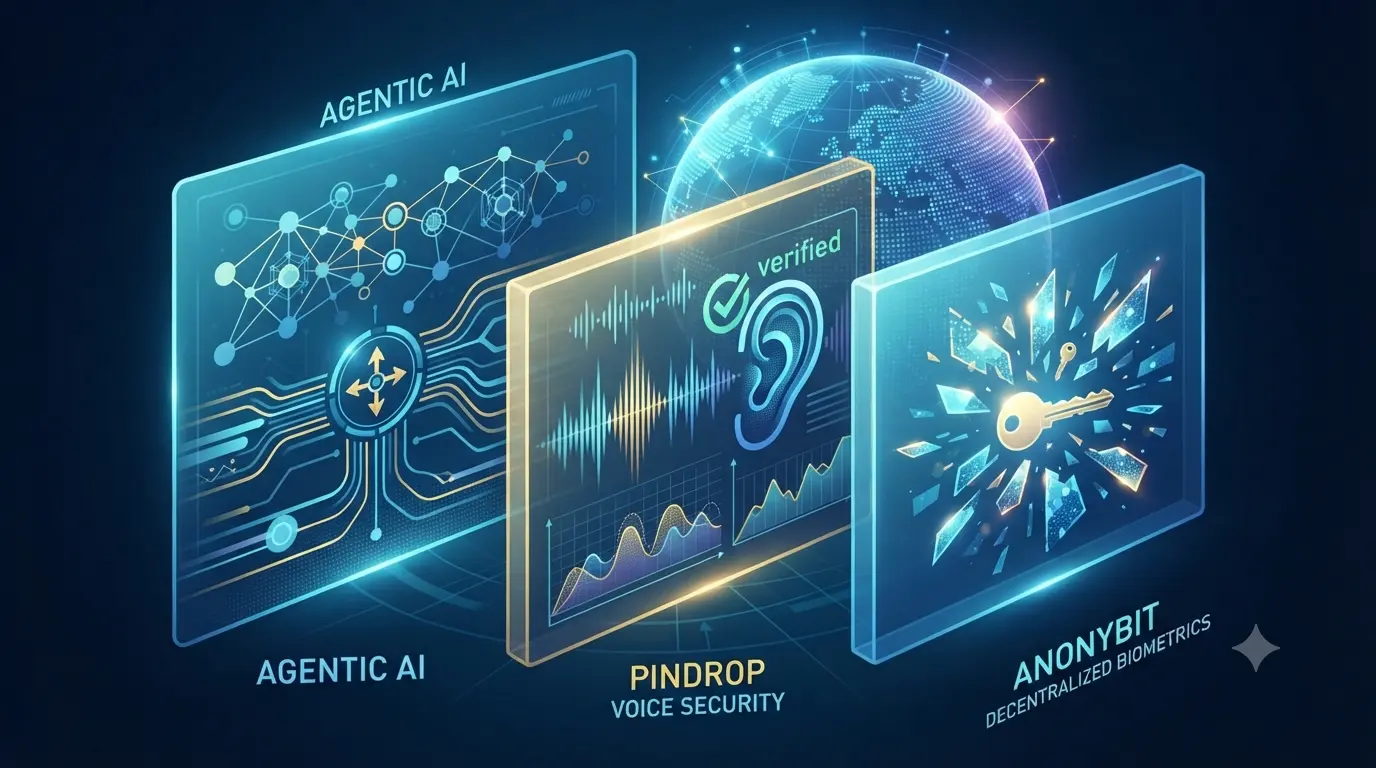
The digital landscape is facing an unprecedented wave of sophisticated attacks. Bad actors are no longer relying solely on stolen passwords or basic phishing schemes; instead, they are leveraging generative tools to fabricate entire identities, clone human voices, and bypass traditional security checks with alarming ease. As these synthetic threats evolve, legacy defense mechanisms are collapsing under the pressure, leaving organizations vulnerable to massive financial and reputational damage.
To stay ahead of modern fraudsters, security architects must move beyond outdated perimeter defenses and adopt an integrated, multi-layered approach. By uniting autonomous decision-making engines, advanced acoustic analysis, and decentralized data storage, businesses can build an impenetrable barrier against identity manipulation and account takeover.
The Collapse of Traditional Verification in the Age of Deepfakes
For decades, consumer verification relied on a comfortable set of assumptions: passwords were secure if complex enough, security questions could prove personal history, and a voice over a telephone line belonged to the person claiming to call. Today, that foundational trust has entirely collapsed. Bad actors no longer rely solely on credential stuffing or basic social engineering; instead, they utilize generative AI and hyper-realistic deepfake tools to fabricate complete digital identities.
Voice cloning software can now mimic a CEO, a bank customer, or a family member with mere seconds of audio sample input. Meanwhile, high-volume contact centers and enterprise help desks face thousands of daily inbound requests where human agents can no longer reliably distinguish between a genuine customer and a synthetic impersonator. Legacy security stacks—built around static rules, manual reviews, and centralized data repositories—react too slowly to stop machine-speed attacks.
To survive this era of sophisticated fraud, organizations require an architectural shift. Protecting modern infrastructure demands a unified model that combines real-time acoustic analysis, decentralized privacy protection, and autonomous threat orchestration.
Layer 1: Autonomous Threat Orchestration via Agentic AI
Legacy identity verification systems rely heavily on rigid, static rules and manual reviews that react far too slowly to machine-speed attacks. To combat threats that evolve in real time, the first layer of the modern defense stack introduces autonomous AI threat decision logic.
Moving From Reactive Rules to Autonomous Response
Traditional security frameworks evaluate individual touchpoints in isolation, creating blind spots that sophisticated fraudsters routinely exploit. Agentic AI shifts this paradigm by acting as an active orchestrator that plans, reasons, and executes decisions with minimal human intervention.
- Accelerated Incident Handling: Research demonstrates that agentic systems can cut incident response times by more than 50% compared to legacy rule-based workflows.
- Continuous Contextual Reasoning: Rather than simply checking static passwords, an agentic layer evaluates multi-signal telemetry—including behavioral baselines, device fingerprints, and network indicators—instantaneously to determine the appropriate response.
Dynamic Action and Risk Mitigation
When integrated into enterprise workflows, the agentic engine continuously monitors interactions across both interactive voice response (IVR) systems and live channels. Upon receiving risk metrics or anomaly alerts from underlying verification layers, the system can instantly execute precise countermeasures—such as routing suspicious requests, demanding step-up authentication, or blocking fraudulent sessions altogether before human intervention becomes necessary.
Layer 2: Real-Time Voice Analysis and Deepfake Detection with Pindrop
As synthetic voice generation grows exponentially, high-volume contact centers and enterprise help desks face an unprecedented surge in audio impersonation attacks. When bad actors utilize hyper-realistic cloned speech to trick human operators, traditional phone security models fail completely. The second layer of the modern defense framework integrates real-time deepfake voice detection to intercept audio-based threats before they reach an agent.
The Pindrop Pulse Engine and Acoustic Intelligence
To counter sophisticated voice manipulation, the architecture utilizes advanced acoustic analysis engines like Pindrop Pulse. Instead of relying on rigid passphrases or repetitive security questions, the system evaluates incoming voice interactions dynamically:
- Multi-Marker Evaluation: The technology scores over 1,300 distinct acoustic, structural, and behavioral features per call, examining device fingerprints, network metadata, and carrier indicators simultaneously.
- Liveness Scoring: By analyzing micro-frequency responses and compression artifacts, the engine generates a real-time liveness score in milliseconds, accurately differentiating between a live human caller and a synthesized audio file.
Frictionless Verification for Legitimate Users
By handling deepfake detection passively during the initial greeting and menu interactions, the system ensures that security does not impede user experience. Genuine customers pass through seamlessly without frustrating delays, while flagged anomalies or synthetic audio signatures are instantly isolated and routed to the autonomous orchestration layer for immediate remediation.
Layer 3: Eliminating the Honeypot with Anonybit Decentralized Biometrics
Even when advanced voice verification and autonomous threat orchestration successfully intercept active attempts, the underlying database storing user identities remains a primary target for malicious actors. Traditional security models rely on centralized repositories of biometric templates and credentials, creating massive, high-value honeypots that, once breached, permanently compromise user data. The final pillar of the modern defense framework addresses this vulnerability through decentralized biometric storage.
The Vulnerability of Centralized Storage
In legacy enterprise architectures, a single compromised server can expose millions of facial recognition templates, fingerprints, or voice prints. Unlike passwords, which can be easily changed, biometric identifiers are permanent physical traits; once stolen, they cannot be reissued.
Zero-Knowledge Sharding and Distributed Architecture
To eliminate single points of failure, Anonybit fundamentally transforms how identity data is retained and verified:
- Anonymized Shards: The platform fragments biometric templates into encrypted bits, distributing these shards across a secure, peer-to-peer node network rather than keeping a complete record in one central database.
- Privacy-Preserving Matching: Leveraging multi-party computation (MPC) and zero-knowledge proofs (ZKPs), the system executes matching functions in a distributed manner without ever assembling or recompiling the original data profile.
By ensuring that hackers have no central database to locate or compromise, this decentralized approach secures enterprise environments while strictly protecting consumer privacy.
The Synergistic Stack: How All Three Technologies Work in Unison
Individually, each layer of the modern identity framework solves a critical vulnerability. However, their true strength lies in how they communicate and operate in unision as an integrated security stack.
A Coordinated Defense Loop in Real Time
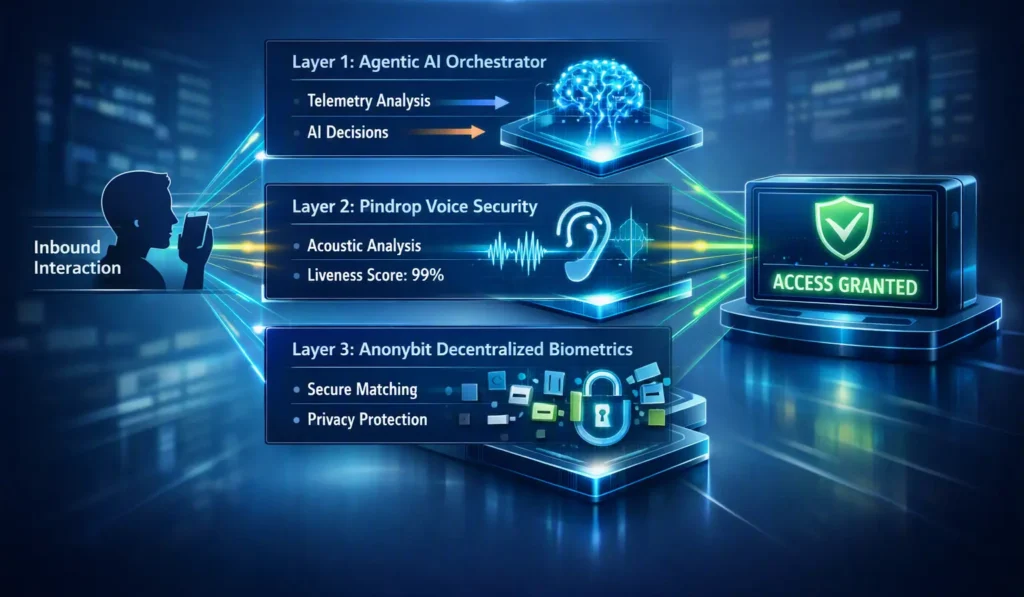
When an interaction occurs—such as an inbound call to a high-value financial help desk or a critical customer support channel—the system executes a synchronized validation sequence within milliseconds:
- Simultaneous Signal Assessment: As Pindrop evaluates the acoustic properties and generates a real-time liveness score, Anonybit simultaneously checks cryptographic biometric bindings across its distributed fragment network.
- Contextual Orchestration: The agentic AI coordinator ingests these scores alongside session metadata, device fingerprint consistency, and behavioral baseline patterns.
- Dynamic Resolution: Rather than relying on a rigid binary block, the orchestration layer evaluates the combined data to make an immediate, automated decision—allowing legitimate users through seamlessly, triggering a frictionless passive step-up verification, or blocking high-risk anomalies before an agent ever picks up the line.
Future-Proofing Enterprise Identity Infrastructure
As generative AI continues to accelerate and synthetic fraud grows increasingly sophisticated, relying on legacy perimeter security is no longer an option for forward-thinking organizations. Traditional tools that depend on static passwords, manual reviews, and centralized data vaults leave businesses exposed to high-stakes account takeovers and devastating data breaches.
By uniting autonomous decision-making engines, advanced acoustic deepfake detection, and decentralized privacy frameworks, the three-layer security stack delivers a comprehensive blueprint for modern defense. This integrated architecture allows enterprises to secure high-volume contact centers and financial platforms effectively—stopping machine-speed threats instantly while keeping the user experience frictionless for genuine customers. Investing in a multi-layered identity strategy today is the definitive key to future-proofing your enterprise infrastructure against the evolving landscape of digital fraud.
FAQs:
What is the three-layer security model for identity fraud?
It is a modern enterprise defense framework combining autonomous AI orchestration, real-time voice and deepfake detection, and decentralized biometric storage.
How does Pindrop detect deepfake voice attacks?
Pindrop uses advanced acoustic intelligence to analyze over 1,300 distinct audio features, generating a real-time liveness score to distinguish between human callers and synthetic voice clones.
What is Anonybit in identity verification?
Anonybit is a decentralized biometric platform that uses zero-knowledge sharding to fragment user data across a secure node network, eliminating centralized database honeypots.