

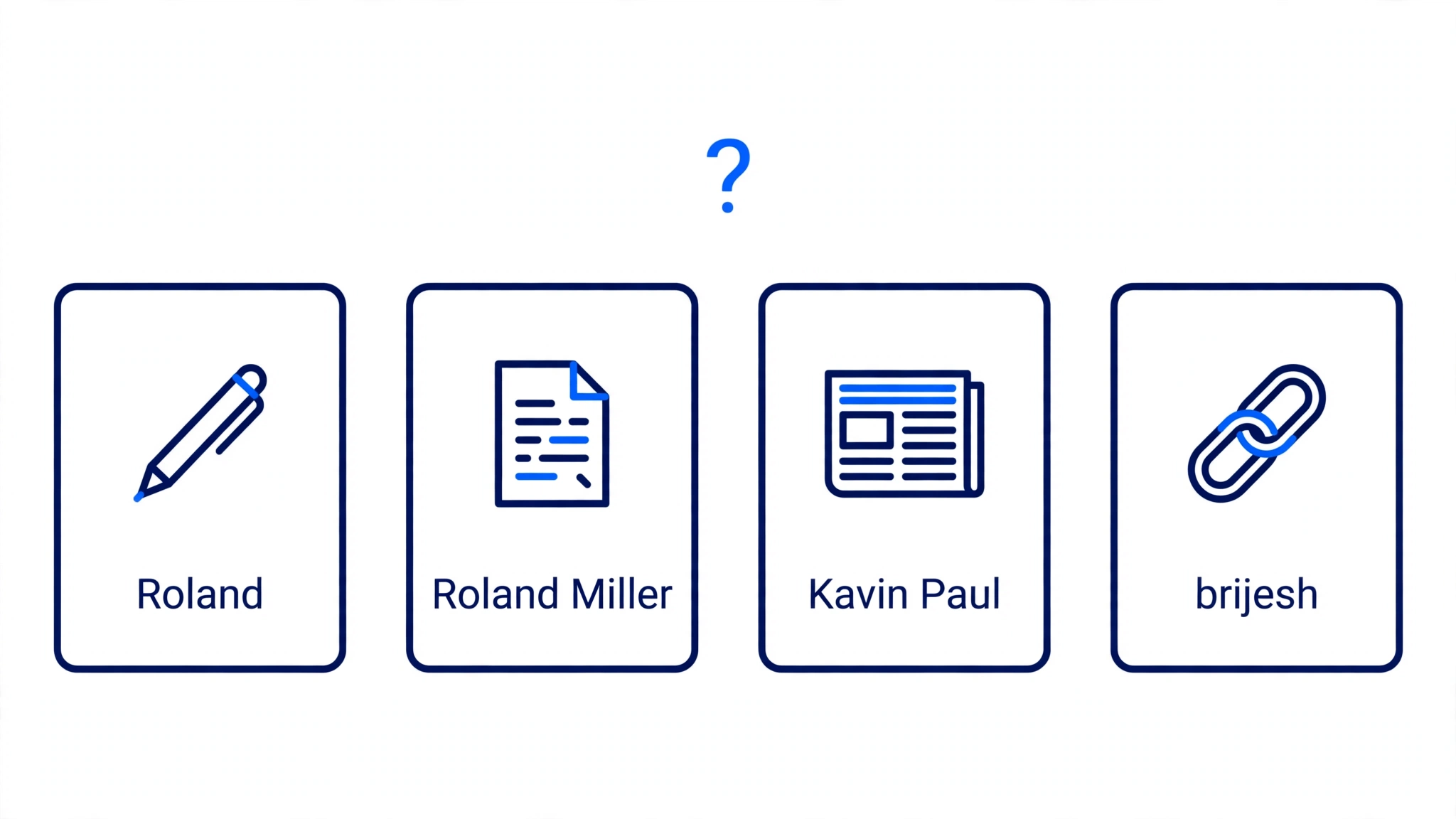
Thesindi.com is a free explainer site that about 221,000 searches a month carry by name — and it cannot keep its own name straight. On its own pages, four different names take turns being the person behind it: Roland signs every article, Roland Miller runs the site according to the About page, Kavin Paul is the Chief Author and Editor according to the site’s own overview article, and the author archive lives at a URL carrying a fourth name, brijesh. None of that makes the site fake. It makes it a puzzle — and it is a puzzle no other review leads with, because until this month, nobody had checked all four places at once.
A note on how this article is built, because it decides what you can trust here. The site itself was checked first-hand on November 20, 2026 — homepage, About page, author archive, identity page, and the overview article, all read directly. That matters because a month ago the site blocked automated fetching, so the previous round of coverage had to rely on reviewers; this one does not. Where a fact comes from someone else’s check, it says so. Throughout, every fact carries a label: confirmed means seen first-hand on November 20, reported means a reviewer claims it and it has not been re-verified here, and unverified means it could not be confirmed at all.
The Short Answer
Thesindi.com is a real, working, still-publishing publication that explains things in plain language and charges nothing to read it. It is also a thin-sourced generalist whose own pages disagree about who runs it, whose Sports section carries casino content, and whose name is shared by lookalike domains registered in mid-2026. Read it freely, rely on it article by article, and never act on it alone for money, health, legal, or gambling decisions. The rest of this article shows the working behind each of those sentences — starting with the four names, because that is the part every other review gets wrong or leaves out.
Four Names, One Site
Four different names appear in public places attached to one site, and that is the sharpest thing about Thesindi.com. Each name was verified first-hand on November 20, 2026, in the place
listed. None of them is presented here as the “real” one, because the site itself never says which one is.
| Name | Where it appears | Status |
|---|---|---|
| Roland | Byline on every article, homepage and all posts | Confirmed first-hand, Nov 20 |
| Roland Miller | About page, “Author and Admin” section | Confirmed first-hand, Nov 20 |
| Kavin Paul | Site’s own overview article (Aug 24, 2026) and its press release (Aug 10, 2026) | Confirmed first-hand (overview article), Nov 20; press release reported |
| brijesh | Author archive URL: thesindi.com/author/brijesh/ | Confirmed first-hand, Nov 20 |
Roland: The Byline on Every Post
Every article on the site carries the same byline: Roland. Open the homepage, open any post, and the name at the top is Roland — no surname, no second author anywhere in the archive. That is confirmed first-hand, and it is also the thinnest fact of the four: a first name on a byline tells you nothing about who wrote the piece, and the site’s own pages offer no author biography under that name. A single byline across roughly five hundred articles is a pattern in itself, and it is the first thing every review notices. It is also the only name that appears on the articles themselves.
Roland Miller: The About Page’s Author and Admin
The About page goes further than the byline. Its “Author and Admin” section names Roland Miller and describes him as an SEO specialist, copywriter, content strategist, author, and admin of thesindi.com, with over five years of experience helping businesses grow their online presence. That is confirmed first-hand, and it is new: a month ago, reviewers who read the live pages found no named person on the site at all. The About page also says the site was founded in 2023, and its monthly archive runs back to May 2023, which lines up with the domain’s registration in March 2023. Roland Miller appears nowhere else on the site — not on any article, not in any other section. He exists on exactly one page.
Kavin Paul: The Overview Article’s Chief Author and Editor
A third name appears in the site’s own overview article, “What Is TheSindi.com? A Deeper Look Inside the Digital Publication,” dated August 24, 2026: “With its editorial direction led by Kavin Paul, Chief Author and Editor.” Its FAQ asks who the editor is and answers: “Kavin Paul serves as the Chief Author and Editor.” That is confirmed first-hand from the article itself. The same title appears in the site’s press release of August 10, 2026, in an IssueWire release, and in a SlideShare deck — all reported, not re-verified here. The press release is the one external source this article links to, because it is the only place the Kavin Paul claim appears outside the site’s own pages: the site’s own press release on its editorial expansion. Note what this means in plain terms. The About page says Roland Miller runs the site. The overview article says Kavin Paul edits it. Neither page mentions the other name.
brijesh: The Author URL
The fourth name is in the address bar. The author archive lives at thesindi.com/author/brijesh/ — but the page itself is titled “Roland” and headed “Author: Roland.” So the URL says brijesh, the page says Roland, and the About page says Roland Miller. That is confirmed first-hand, and it is the hardest of the four to explain away as a pen name or a rebrand, because a URL slug is a technical fact, not a piece of writing. Somebody set that archive up under the name brijesh, and somebody else — or the same somebody, later — titled it Roland.
The honest reading is that the site contradicts itself on its own pages, and the contradiction should be left standing rather than resolved into a tidy identity claim. Two further details are suggestive and nothing more, both reported rather than verified here: the LinkedIn link under the Roland Miller bio carries a profile address containing “kavin-paul,” and the same bio wording appears under the name Kavin Paul on another site’s author page. Those coincidences point in a direction; they do not prove a destination. The same caution applies to the older Kavin Paul note: bumpdots.com publicly lists a founder called Kavin Paul in Noida, and the Thesindi press release gives a Noida address — the same name and the same city on two publications. That is worth one line, not a conspiracy, and it carries no internal link here because there is no Bumpdots article on aibropro to link to.
What the Site Actually Publishes
Thesindi.com is a free, multi-niche WordPress publication with no paywall, no signup, and no account. Its navigation lists nine categories — Technology, Gaming, Finance, Business, Education, Health, Lifestyle, Law, and Travel — and the About page adds AI, digital marketing, SEO, home improvement, real estate, and product guides to the list. The articles are short, plain-language explainers, mostly around a thousand words or fewer, and the archive runs to roughly five hundred to five hundred and eighty pieces (reported). It is still publishing: the homepage listed posts dated as recently as November 17, 2026, three days before this article’s checks, with visible posts running from July through November. The site’s own description of itself, on the homepage, promises “accurate reporting, expert perspectives, and thoughtfully researched content” — a pitch the rest of this section tests against what the pages actually show. Its technical footprint is confirmed first-hand: the site runs on WordPress with the AIOSEO plugin at version 5.0.5.1, its canonical address is https://www.thesindi.com/, and its images are served from a third-party CDN subdomain.
How It Makes Money
The money is ordinary for a site of this type, and it is worth stating plainly rather than hinting at. The site runs display ads — one reviewer found a banner ad that caused a layout shift and made him tap the ad by accident — and its sidebar carries a banner for a “Guest Post Marketplace 2026” linked to adoovy.com, which is a paid guest-post marketplace (both reported). A guest-post listing for the site also appears on an outside marketplace, so some articles may be third-party placements rather than editorial work (reported). One health article, on plant-based omega-3, is factually accurate about ALA-to-EPA/DHA conversion but links to a Flora Health product page with no affiliate disclosure (reported). None of this makes the site fake; paid-adjacent posts do not carry the same editorial standard as the rest, and a reader should know which kind they are looking at. The site’s own Editorial Policy, checked against its pages in October, says writers draw on official organisations, government resources, academic publications, and industry experts, with editorial review before publication; that AI tools may be used for research, organisation, and grammar but no unreviewed automated content is published; and that sponsored content and affiliate links “may be clearly identified where applicable” (reported). That last phrase is conditional wording, not a guarantee — “may be” is doing a lot of work there.
The Gambling Drift, Kept Tight
A real slice of the Sports and Finance content is crypto-casino comparisons and casino income reporting, filed under Sports and surfacing in trending and recent listings alongside everything else. The newest deep-dive on the site goes further, reporting that recent content “leans noticeably toward gambling-adjacent topics” and calling the category routing a known SEO tactic — gambling content filed where it faces less scrutiny (reported). The miscategorisation is systemic rather than isolated: casino income under Sports, travel insurance under Fashion, UX design under Education (reported). One placement makes the point concretely: a promotional explainer for an external platform called CracksTube carries no critical framing and no verification, reads as unlabeled sponsored content, and links out to bumpdots.com and cnlawblog.com — named here in plain text, not linked (reported). That is enough on this thread. The deep version of the gambling story already exists elsewhere, and repeating it at length would only duplicate it.
The Review Swarm
Thesindi.com has something no obscure blog should have: more than fifteen near-identical reviews of it, published between August and November 2026, most of them repeating the same consensus in the same order. The reason is a number. About 221,000 searches a month carry the name worldwide, 79 percent of them from the United States, according to Ahrefs data from September 2026 (reported via softwarecurio). A name that searched-for, attached to a site that almost nobody has heard of, is a standing invitation to write a review of it — and fifteen sites accepted. One reviewer counted at least eight near-identical review articles appearing within a few weeks of each other, all built on the same skeleton: legit-or-scam framing, a pros-and-cons list, a trust table, a checklist, and the same concluding sentence, that the site is a starting point rather than a final source (reported). Another, the freshest review in the current top results, published November 17, 2026, adds a section called “What the Reviews Agree On” — and then cross-links to same-template guides on other sites, making it part of the very pattern it describes (reported). The October set has already thinned out: the same-template guides that filled the US top ten in October — mixraa among them — no longer show in the visible top, replaced by the November set above. Mixraa’s review still exists on its own site, in its trending archive; it simply no longer ranks for the name. The strongest review on method, published in July, promised a follow-up in October and never delivered one; it is now four months stale, and still the most careful of the lot. That is the swarm: a pile of content manufactured by search demand, all concluding the same thing, none of it adding a fact the others lack.
What the Reviews Agree On
Three independent reviews, published in different months, agree on the same four points: the site is free, the writing is plain, the categories are broad, and the sourcing is thin. That agreement is stable, which is itself a finding — the site has not changed its stripes in 2026, only its nameplate. The consensus is also the ceiling: a review that only repeats those four points tells a searcher nothing the search results did not already say. The only reviews worth reading are the ones that add a fact — a domain record, a live read, a registration date, a name nobody else noticed.
How to Spot a Copycat Review
A copycat review is easy to recognise once you know the template: it opens by asking whether the site is legit or a scam, runs a pros-and-cons list, shows a trust table, offers a checklist, and closes by calling the site a starting point rather than a final source. If the review you are reading has all five, it was written from the template, not from the site. The check that actually works is simpler: does it cite a page it read, a date it verified, or a record it looked up? If it only repeats the four consensus points, close it and read the site’s own pages instead — they are free, and they are the one source the swarm cannot copy without noticing the four names.
The Lookalike Map

The name Thesindi is shared by lookalike domains, and the registration dates are the story: the copies were registered in June and August 2026, right as searches for the name spiked. The table below is built from domain-record checks and reviewer reports; the real site is the first row, and everything after it is not the site, whatever its homepage claims.
| Domain | Registered | What is on it | Same site? |
|---|---|---|---|
| www.thesindi.com | 18 Mar 2023 | The original publication | Yes — the real one |
| the-sindi.com | 29 Jun 2026 | “TheSindi Com | Technology, Business & Digital Knowledge”; bed-bug treatment and football live-betting posts | No |
| the-sindi.org | 30 Aug 2026 | “TheSindi com: Trusted Hub for Tech, Business & Digital Knowledge”; homepage led with online poker and casino posts | No |
| thesindicom.us | Not shown in domain records | “TheSindi Com | Trusted Information & Expert Resources”; invites submissions to a Gmail address | No |
| thesindi.net | Not re-checked this round | A separate multi-niche publication whose mission language is nearly identical to the real site’s | No — separate site |
| thethesindi.com | Not re-checked this round | Copies the real site’s mission statement almost word for word | No |
Two more domains from the earlier round, thesindi.com.co and thesindicom.com, were not re-confirmed this time and are listed here only so they are not mistaken for new findings. The most-visited result for the name was a lookalike as recently as September: domain-record data from September 25, 2026, showed the-sindi.org at number one and a page on the-sindi.com at number three, with thesindi.com itself nowhere in the top ten (reported). That has since shifted — the real site’s own About page now ranks fourth for “what is thesindi.com” (confirmed first-hand) — but the point stands: for months, the first thing a searcher met was a copy.
The site itself is fighting back, and no competitor has quoted the evidence. It published an “Official Identity” page in late July 2026 — an “Official Brand Verification Statement” naming the-sindi.com and thethesindi.com as unofficial and stating that the only official address is https://www.thesindi.com (confirmed first-hand, cited here in plain text, not linked). That is the copycat problem told from the victim’s side, and it is the one page on the site that takes a position rather than explaining something. One more risk, reported rather than verified here: a third-party page ranking for the name talks about installing or downloading Thesindi, a format one reviewer flags as high-risk. The real site has no app, no installer, and no download button — if a page tells you to install something in Thesindi’s name, close it. And one line to clear up a confusion that has nothing to do with any of this: Sindi is not Sindh, the province. The names sound alike; the subjects do not overlap.
Read, Rely, Act
Three separate verdicts, never one blanket label — because a site can be safe to read, weak to rely on, and dangerous to act on, all at once.
| Verdict | |
|---|---|
| Read | Low risk. Free, no account, no aggressive popups, fast to load. A working publication, and no scam or fraud evidence anywhere. |
| Rely | Article by article. Thin sourcing, a uniform generalist voice, and a single byline across the whole archive. Check the date, the author, and the sources before you cite anything from it. |
| Act | Never on this site alone — not for money, health, legal, or gambling decisions. Those need specialists, and this site’s own pages cannot even agree on who runs it. |
The deciding factor is the four names. A publication that cannot keep its own name straight across its About page, its overview article, and its author archive has an identity problem that no amount of plain writing fixes — and that is the reason to verify before relying, not a reason to call it fake. It is real, it is free, it is still publishing, and it should be read the way it deserves to be read: as a starting point, checked against a better source before anything depends on it.
FAQ
Is thesindi.com legit?
Yes, as a working publication. It is free to read, asks for no account, shows no aggressive popups, and there is no scam or fraud evidence anywhere in the coverage. Legit does not mean authoritative — its sourcing is thin, so treat it as orientation, not evidence.
Who runs thesindi.com?
Four names appear on its own pages: Roland signs every article, Roland Miller is named author and admin on the About page, Kavin Paul is named Chief Author and Editor in the site’s overview article and press release, and the author archive lives at a URL carrying the name brijesh. The site never says which one is in charge, and this article does not guess.
Is thesindi.com safe to read?
Reading it is low risk. The one thing to avoid is installing anything in its name: the real site has no app, installer, or download button, and a third-party page ranking for the name talks about downloading Thesindi. If a page tells you to install something, close it.
Which thesindi.com is the real one?
Only https://www.thesindi.com. The lookalikes — the-sindi.com, the-sindi.org, thesindi.net, thethesindi.com, and thesindicom.us — are separate sites or copycats, and the real site’s own identity page names two of them unofficial.
Bottom Line
Thesindi.com is a real, free, still-publishing explainer site that does orientation well and consequence poorly — and the most useful thing a reader can know about it is not in any of its articles but on its own pages, where four names take turns running a site that cannot agree with itself. Around it sits a swarm of a dozen reviews that all say the same four things, and a set of lookalike domains registered in the summer of 2026 to catch the 221,000 monthly searches the name draws. Read it when you need a quick explanation, check anything that matters against a source with a name you can verify, and never install anything in its name. It belongs on the same shelf as Seekde and Adstotally — sites that are real, readable, and worth exactly one careful look before you trust them with anything that matters.