
Finding specialized software has become an absolute nightmare. Search engine results are completely cluttered with low-effort ChatGPT wrappers, making genuine discovery nearly impossible. If you are exhausted from filtering through the noise, the goseboze ai list offers a flat, straightforward alternative. It functions as an unbloated directory indexing hundreds of utilities. The main draw? It bypasses complex ranking algorithms to deliver a simple, visible roster of software choices. You do not need to create an account or navigate aggressive ad pop-ups just to see what tools are available to the public. It is a raw look at the current software market.
What Goseboze AI Tools Actually Are?
Many web managers ask a fundamental question: Is Goseboze an AI tool that generates text, code, or artwork on its own? It is not. It is strictly a crowdsourced index. The platform serves as an open library hosting hundreds of third-party goseboze ai tools.
Instead of building proprietary machine learning models, the platform aggregates external applications under a single domain. This saves users from jumping between Reddit threads, Twitter launches, and obscure GitHub repositories just to find a niche utility. Some web curators have even compiled these listings into an external Goseboze AI Tools Directory PDF to track the rapid expansion of these platforms offline. Think of it as a digital phonebook specifically built for independent developers and early adopters looking for the latest software releases.
How Goseboze AI Tools Work?
The operational framework behind the site is entirely developer-driven, relying on a flat, crowdsourced pipeline rather than restrictive corporate partnerships. The platform runs on an open submission model where software creators can submit tools for free.
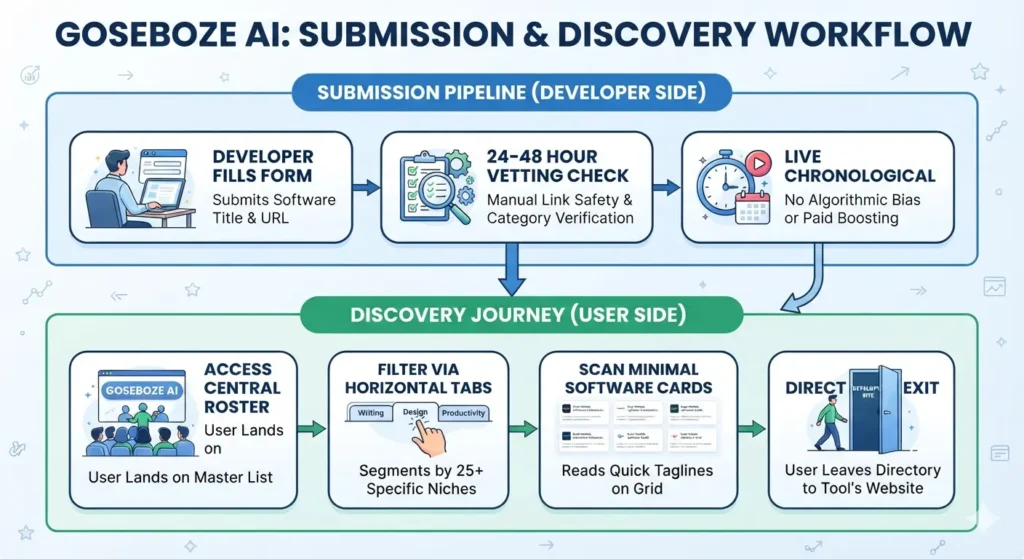
Once a developer fills out the basic submission metadata, the platform runs a 24-to-48-hour vetting check. This initial screening acts as a baseline safety layer to confirm that the destination URL is active, secure, and clear of immediate malware. Once the listing clears this checkpoint, it bypasses complex algorithms and goes live directly into one of the 25+ specific category tabs. The feed operates on standard chronological order, meaning visibility is determined entirely by the time of approval rather than paid promotion or artificial site authority.
How Users Actually Use Goseboze (Step-By-Step Flow)?
Navigating the interface requires zero account configuration, sign-up fees, or persistent tracking cookies. The standard step-by-step user journey is explicitly flat to maximize browsing speed:
- Access the Central Roster: Navigators land directly on the master goseboze ai list homepage, which acts as a centralized dashboard.
- Execute a Segmented Filter: Users skip messy search sub-menus by selecting specific, horizontal category tags (e.g., SEO, writing, or coding assistants).
- Scan the Software Cards: The page instantly populates a grid layout displaying clean cards that feature the software name, a 1-sentence functionality summary, and a distinct outbound link.
- Exit to the Target Platform: Clicking the card routes traffic away from the directory entirely, landing the user straight onto the creator’s official domain.
Why Platforms Like Goseboze Exist?
The explosive growth of indie software creation has generated a massive discoverability gap across the digital tech market. Modern search engine algorithms heavily favor legacy corporations with massive backlink profiles and enterprise-level marketing budgets. Because of this structural bias, highly efficient software utilities built by solo developers frequently end up buried deep within search engine results pages where regular consumers will never see them.
Directories emerge as decentralized discovery layers to solve this specific visibility crisis by completely lowering the barrier to entry for early-stage software companies. They provide immediate web exposure to bootstrapped projects that possess zero advertising capital. For consumers, these platforms serve as a centralized hub for rapid software testing. Instead of wasting hours tracking down individual product launches across fractured social media networks like X, Product Hunt, or Reddit, users can access a single dashboard to evaluate emerging web applications before they go viral.
Types of Tools You Typically Find on Goseboze
Sifting through the index reveals a heavy emphasis on practical utilities built for digital creators, content managers, and web developers who need to streamline their workflows without purchasing expensive enterprise software suites. The master index organizes its growing collection of software applications into several distinct operational pillars:
- SEO and Marketing Automation: Includes platforms engineered to track algorithmic search visibility, scrape keyword intent data, or automate routine technical website audits.
- Content and Copywriting Assistants: Focuses on lightweight drafting interfaces, structured outline generators, and formatting frameworks designed to streamline high-volume editorial production.
- Image Generation and Video Editing: Highlights accessible design modules, asset rendering tools, and background removal software that function as accessible entry-level options for creative beginners.
- Coding Utilities and Custom Chatbots: Lists technical development APIs, automated script helpers, and customer support chat modules built for rapid web deployment and integration.
Key Features that Shape the User Experience
The platform strips away the heavy visual clutter common in modern software review sites to maintain incredibly fast page-loading speeds. By focusing purely on a functional interface, the platform relies on three defining usability elements:
- Chronological Feed System: Software utilities appear on the site based entirely on their time of approval rather than through hidden algorithmic biases or paid sponsorship boosts. This gives every newly approved developer an equal window of visibility at the top of the main feed.
- Minimalist Software Cards: The directory bypasses intrusive video advertisements, autoplay modules, and aggressive pop-up banners. Users are presented with a clean grid layout containing only the tool’s name, a 1-sentence functionality tagline, and a direct outbound link.
- Pure Outbound Flow: Unlike traditional directories that force visitors to register an email address or navigate internal gateway pages, this platform acts as a transparent traffic router. One click takes the browser completely off-site directly to the vendor’s landing page.
The Core Limitation of Goseboze (Where it Falls Short)
To maintain editorial integrity, any comprehensive review must address where a platform fails to deliver. The primary weakness stems directly from its open submission policy: because the directory allows anyone to list a product for free, the baseline quality control remains incredibly low.
The internal vetting process ensures that a submission link is live and free of immediate malware, but it does not evaluate whether the software actually functions well. Consequently, the master index contains a high volume of repetitive wrapper applications, unpolished software scripts, and abandoned projects. Furthermore, the platform completely lacks an internal peer-review ecosystem. Users cannot read community feedback, view star ratings, or check verified user complaints, meaning you must act as your own quality filter and manually test every application yourself.
When Goseboze is Useful vs. When it is Not?
Understanding exactly when to utilize this index will save you hours of wasted browsing time. The platform is not a universal solution for software research, but it serves a highly specific purpose depending on your current project goals.
- When It Is Highly Useful: The directory excels when you are looking for early-stage, budget-friendly software alternatives. It is an excellent playground for indie developers, tech hobbyists, and digital creators looking for the best AI software for beginners without committing to expensive enterprise subscriptions. If you want to broadly brainstorm what kinds of automated workflows are currently entering the tech market, this chronological list gives you an unfiltered look at the latest software releases.
- When You Should Avoid It: You should completely skip this index if you are sourcing enterprise-grade tools that require strict data compliance, SOC-2 security audits, or verified corporate track records. It is also entirely useless if you need detailed, peer-reviewed software case studies or transparent pricing comparisons. For those scenarios, you require heavily moderated platforms with built-in user testimonial ecosystems.
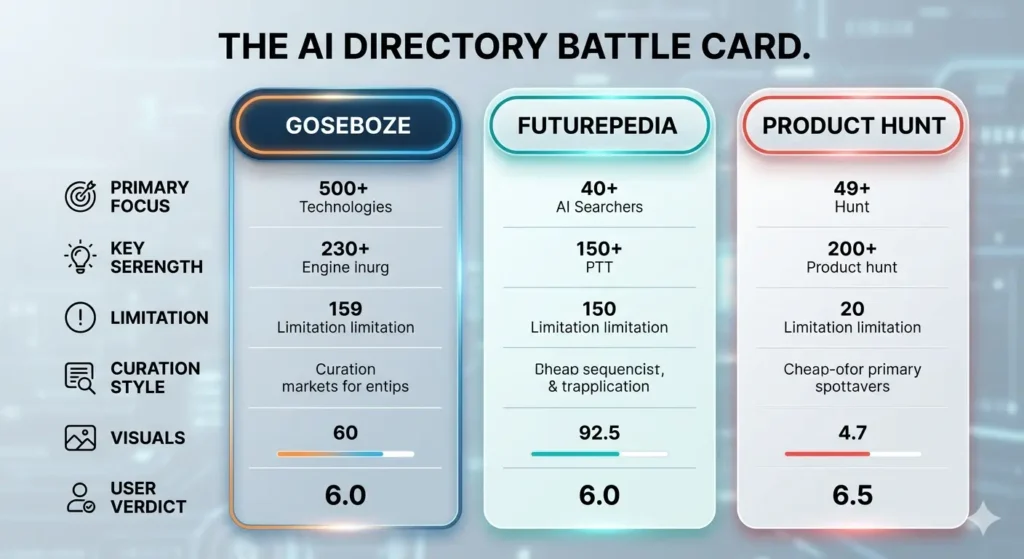
Directory Showdown: Goseboze vs. Futurepedia vs. Product Hunt
To understand the true value of the market, you must look at how this platform stacks up against the heavyweights of digital product discovery. While they all index software, their internal philosophies and sorting metrics are completely different.
- Goseboze: This platform acts as a flat, decentralized traffic router. It relies entirely on a chronological submission feed. There are no social upvote buttons, no complex internal recommendation engines, and no premium editorial walls. You see tools purely based on the exact day and time the developers submitted them.
- Futurepedia: Unlike the flat approach, Futurepedia is heavily editor-curated. The team actively filters submissions, writes detailed in-house reviews, and heavily features premium sponsorships. It offers a much higher baseline of tool quality, but it is deeply influenced by corporate advertising budgets.
- Product Hunt: This ecosystem is completely driven by real-time community engagement and social upvotes. Products launch daily, and their visibility is determined entirely by how many users vote, comment, and share the listing. It is fantastic for tracking major viral tech launches, but brilliant tools built by small creators often get completely crushed by established brands with massive launch teams.
The Real Role of Goseboze in the AI Tool Selection Process
Treat this platform strictly as a preliminary discovery sandbox rather than a final stamp of software validation. It should serve as the absolute starting point of your research framework, not the closing argument. When you uncover an appealing software card on the main index feed, your immediate next step must involve aggressive external verification to protect your digital asset workflow.
Copy the exact name of the tool and run a cross-reference search across unfiltered public tech hubs like Reddit, specialized subreddits, or dedicated tech forums. Check to see if real professionals are testing the software in live, operational environments. Use the directory to bypass search engine bias and find hidden names, but rely entirely on independent manual testing to verify that the tool delivers on its marketing promises before you input any proprietary company data.
The Developer’s Perspective: Is Listing Worth It?
If you are an indie developer or a bootstrapped software founder, understanding the true return on investment for directory placement is critical for your growth roadmap. Sifting through free software indexes offers distinct advantages that directly impact your startup’s foundational AI search visibility:
- Referral Traffic Velocity: Because the site operates on a flat, chronological layout, your newly approved tool will land at the very top of its designated category feed for a brief window. This provides an immediate, unmanipulated spike of highly targeted traffic from early adopters actively looking for new solutions.
- Foundational Clean Backlinks: Submitting your platform secures a clean, direct outbound link from a domain that search engine crawlers routinely index. For a brand-new website with zero authority, these directory backlinks signal foundational entity legitimacy to search bots, helping kickstart your organic indexing speeds without requiring thousands of dollars in outreach capital.
Wrapping Up
The platform serves a distinct, functional purpose in a deeply oversaturated tech market. It intentionally strips away heavy, biased search algorithms to give web browsers a transparent, chronological view of new software releases. While it will never replace the necessity for rigorous, independent software testing, it remains a highly efficient tool for rapid market scouting and discovery. Use it wisely as an ideation engine, verify everything externally, and you can easily uncover powerful niche utilities before they hit mainstream adoption.
Frequently Asked Questions
Is the Goseboze AI tools directory free to use?
Yes. The platform is entirely free for regular web browsers looking for software, and it costs nothing for creators who want to list their new products on the master feed.
Can anyone submit a software utility to the list?
Any developer can submit a tool, but it must pass a manual 24-to-48-hour internal vetting check to ensure the link is active, safe, and categorized correctly.
How often is the master directory list updated?
The index updates continuously throughout the week as new submissions clear the moderation pipeline and roll live onto the chronological category tabs.
Is Goseboze an AI tool that generates content?
No. The site is strictly a crowdsourced software directory indexing external, third-party software applications rather than generating its own proprietary models.
Where can I find an offline copy of the directory listings?
Some web curators compile the active database into a downloadable Goseboze AI Tools Directory PDF to track new software launches and categorize tools for offline reference.